
Introduction to IELTS Speaking Part 1 Sample Answers
The IELTS Speaking test evaluates your ability to communicate clearly, fluently, and naturally in English. In Speaking Part 1, the examiner asks short questions about familiar topics such as your hometown, hobbies, work, studies, and daily life.
This guide includes 50 IELTS Speaking Part 1 questions with Band 7–8 sample answers, vocabulary explanations, and audio recordings to help you understand how strong responses are structured.
In this guide you will find:
• real IELTS Speaking Part 1 questions
• Band 7–8 sample answers
• useful vocabulary and phrases
• explanations of why the answers score well
If you want to improve your overall IELTS performance, you may also find our complete IELTS Speaking guide useful.
Practise answering these questions aloud and compare your responses with the sample answers to improve fluency, vocabulary, and confidence.
Practise English every weekday with me
Get short Mon–Fri English practice in LINE with LEW Daily, plus regular feedback to help you improve.
Explore LEW DailyNT$399/month • Cancel anytime

What Happens in IELTS Speaking Part 1
Speaking Part 1 usually lasts four to five minutes.
The examiner asks around 4 to 8 questions about everyday topics.
Typical topics include:
• hometown
• work or study
• hobbies
• travel
• food
• music
• technology
The questions are designed to help you relax and begin speaking naturally. However, examiners still evaluate your fluency, vocabulary, grammar, and pronunciation.
You can learn more about how the test is scored on How IELTS Speaking Is Marked.
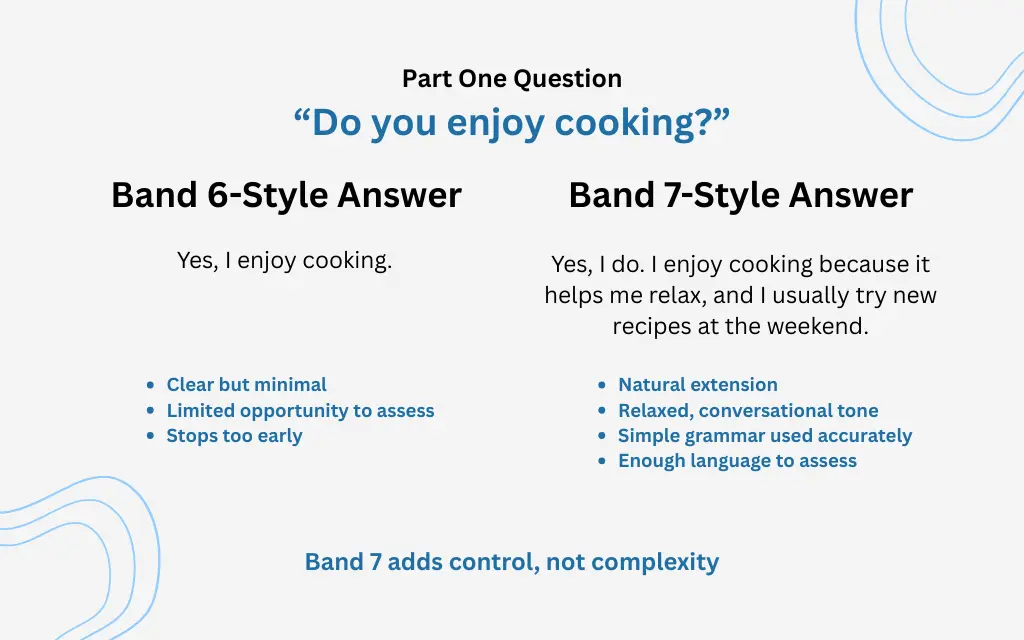
IELTS Speaking Part 1 Sample Questions and Answers
Below are some common Part 1 topics with Band 7–8 style answers.
When practising, focus on:
• speaking naturally
• expanding your answers
• using varied vocabulary
IELTS Speaking Part 1 Topics
Jump to a topic:
Topic: Personal Life
These IELTS Speaking Part 1 questions focus on everyday personal topics such as your hometown, work or studies, friendships, family life, and free time. Examiners use these questions to assess how naturally you can talk about familiar aspects of your life.
Where is your hometown?
🔊 Listen to the Band 7–8 sample answer:
Sample Answer (Band 7–8)
I am originally from a small town in the north of England. It is quite well known for its historic buildings and surrounding countryside. Although it is not a very large place, it has a friendly atmosphere and a strong sense of community.
Vocabulary
historic buildings — noun phrase referring to old buildings that have historical importance
surrounding countryside — noun phrase describing the rural land and nature around a town or city
sense of community — noun phrase meaning a feeling that people in a place support and care about each other
Why This Is a Good Answer
This answer expands beyond a short reply and includes descriptive vocabulary. The speaker also uses complex sentence structures and natural phrasing.
Do you work or are you a student?
🔊 Listen to the Band 7–8 sample answer:
Sample Answer (Band 7–8)
At the moment I am working as an English teacher. I mainly teach students who are preparing for international exams such as IELTS. What I enjoy most about the job is helping learners gain confidence when they communicate in English.
Vocabulary
prepare for exams — verb phrase meaning to study and practise in order to succeed in a test
gain confidence — verb phrase meaning to become more self assured or comfortable doing something
communicate in English — verb phrase meaning to express ideas and interact with others using English
Why This Is a Good Answer
The speaker gives additional information and explains their opinion. This demonstrates stronger fluency and vocabulary range.
Sample Answer (Band 7–8)
At the moment I am working as an English teacher. I mainly teach students who are preparing for international exams such as IELTS. What I enjoy most about the job is helping learners gain confidence when they communicate in English.
Vocabulary
prepare for exams — verb phrase meaning to study and practise in order to succeed in a test
gain confidence — verb phrase meaning to become more self assured or comfortable doing something
communicate in English — verb phrase meaning to express ideas and interact with others using English
Why This Is a Good Answer
The speaker gives additional information and explains their opinion. This demonstrates stronger fluency and vocabulary range.
Do you spend a lot of time with your friends?
🔊 Listen to the Band 7–8 sample answer:
Sample Answer (Band 7–8)
Yes, I try to spend time with my friends whenever I can, although everyone is quite busy these days. We usually meet for meals or coffee and catch up on what has been happening in our lives. I think maintaining friendships is very important.
Vocabulary
spend time with — common verb phrase about social relationships
catch up — phrasal verb meaning to talk about recent events
maintaining friendships — noun phrase meaning keeping relationships strong
Why This Is a Good Answer
This answer describes typical social activities and includes natural conversational language.
Do you spend a lot of time with your family?
🔊 Listen to the Band 7–8 sample answer:
Sample Answer (Band 7–8)
Yes, I try to spend time with my family whenever possible, although everyone tends to be quite busy. We usually meet for meals or talk about what has been happening in our lives. I think maintaining strong family relationships is very important.
Vocabulary
spend time with — common verb phrase referring to social interaction
quite busy — adjective phrase meaning having many responsibilities
maintaining relationships — phrase meaning keeping connections strong
Why This Is a Good Answer
The speaker gives a clear answer and expands with examples of family activities. The response sounds natural and conversational.
Do you have enough free time during the week?
🔊 Listen to the Band 7–8 sample answer:
Sample Answer (Band 7–8)
Not always, because my schedule can be quite busy during the week. However, I usually try to make time for relaxation in the evenings or on weekends.
Vocabulary
quite busy schedule — noun phrase meaning a full timetable
make time for — phrase meaning to intentionally find time
relaxation — noun meaning rest or leisure
Why This Is a Good Answer
The speaker gives a realistic answer and explains their routine clearly, which demonstrates natural speaking ability.
Topic: Daily Life
Daily life questions in IELTS Speaking Part 1 often ask about routines, habits, and everyday activities. You may be asked to describe your typical day, weekend activities, sleep habits, cooking, or how often you use technology such as your phone or the internet.
What do you usually do on weekends?
🔊 Listen to the Band 7–8 sample answer:
Sample Answer (Band 7–8)
On weekends I usually try to relax and spend time with family or friends. Sometimes I go out for a meal, while other times I stay at home and read or watch films. It depends on how busy my week has been.
Vocabulary
spend time with family — common phrase about relationships
go out for a meal — collocation meaning to eat at a restaurant
depends on — phrase meaning something changes according to the situation
Why This Is a Good Answer
The speaker gives multiple examples of weekend activities and uses linking language to organise ideas.
What is your typical daily routine?
🔊 Listen to the Band 7–8 sample answer:
Sample Answer (Band 7–8)
My daily routine usually starts quite early because I prefer to begin work in the morning. During the day I spend most of my time teaching or preparing lessons. In the evening I normally relax by reading or watching something online.
Vocabulary
daily routine — noun phrase referring to everyday activities
prepare lessons — verb phrase commonly used by teachers
relax in the evening — phrase describing free time after work
Why This Is a Good Answer
The answer describes activities clearly and logically. It also uses time expressions that make the response easy to follow.
What do you usually do in the morning?
🔊 Listen to the Band 7–8 sample answer:
Sample Answer (Band 7–8)
My mornings are usually quite structured. I normally wake up early, have breakfast, and check my schedule for the day. After that I start working or studying depending on my plans.
Vocabulary
quite structured — adjective phrase meaning organised and planned
check my schedule — verb phrase meaning to review daily plans
depending on — phrase used to show conditions or situations
Why This Is a Good Answer
The speaker describes a clear routine and uses time expressions to organise the answer logically.
Do you usually get enough sleep?
🔊 Listen to the Band 7–8 sample answer:
Sample Answer (Band 7–8)
I usually try to get enough sleep because it helps me stay focused and productive during the day. If I do not sleep well, I often feel tired and find it harder to concentrate.
Vocabulary
get enough sleep — phrase meaning to rest sufficiently
stay focused — verb phrase meaning to maintain concentration
find it harder to concentrate — phrase meaning to struggle to focus
Why This Is a Good Answer
The speaker explains both the importance of sleep and the consequences of not getting enough rest.
Do you like cooking?
🔊 Listen to the Band 7–8 sample answer:
Sample Answer (Band 7–8)
Yes, I enjoy cooking, especially when I have enough time to prepare a proper meal. I find it quite satisfying to experiment with different ingredients and try new recipes.
Vocabulary
prepare a meal — verb phrase meaning to cook food
experiment with ingredients — phrase meaning to try different foods when cooking
try new recipes — phrase referring to cooking unfamiliar dishes
Why This Is a Good Answer
The answer includes a reason and a personal example, which makes the response more developed.
How often do you use your mobile phone?
🔊 Listen to the Band 7–8 sample answer:
Sample Answer (Band 7–8)
I use my mobile phone many times throughout the day, mainly for communication and checking information. It has become an essential tool for both work and daily life.
Vocabulary
throughout the day — phrase meaning during the whole day
communication — noun meaning exchanging information
essential tool — noun phrase meaning something very important or useful
Why This Is a Good Answer
The speaker gives a realistic answer and explains how the phone is used.
How often do you use the internet?
🔊 Listen to the Band 7–8 sample answer:
Sample Answer (Band 7–8)
I use the internet every day for both work and personal purposes. It helps me find information quickly and stay connected with people around the world.
Vocabulary
personal purposes — noun phrase meaning private or individual use
find information quickly — phrase meaning to search efficiently
stay connected — phrase meaning to maintain communication
Why This Is a Good Answer
The speaker clearly explains how the internet is used in daily life and gives practical examples.
Topic: Interests & Activities
Many IELTS Speaking Part 1 questions focus on hobbies and personal interests. Common topics include reading, music, sports, films, photography, walking, and outdoor activities. These questions allow you to describe what you enjoy doing in your free time and explain why you like these activities.
What do you usually do in your free time?
🔊 Listen to the Band 7–8 sample answer:
Sample Answer (Band 7–8)
In my free time I usually enjoy reading and going for long walks. Reading helps me relax after a busy day, while walking allows me to clear my mind and stay active. I find that these activities help me maintain a good balance between work and personal life.
Vocabulary
clear my mind — phrase meaning to relax and stop worrying
stay active — verb phrase meaning to remain physically healthy
maintain a balance — collocation meaning to keep different parts of life stable
Why This Is a Good Answer
This answer explains two hobbies and gives reasons for each activity. The speaker uses natural expressions and linking language, which improves fluency.
Do you enjoy watching or playing sports?
🔊 Listen to the Band 7–8 sample answer:
Sample Answer (Band 7–8)
I enjoy both watching and playing sports, although I probably watch them more often. I particularly enjoy football because it is exciting and very popular in my country. Watching sports is also a great way to relax and spend time with friends.
Vocabulary
particularly enjoy — phrase used to emphasise preference
very popular — common descriptive collocation
spend time with friends — phrase describing social activity
Why This Is a Good Answer
The speaker clearly explains their interest in sports and gives a reason for their preference.
Do you enjoy reading books?
🔊 Listen to the Band 7–8 sample answer:
Sample Answer (Band 7–8)
Yes, I enjoy reading quite a lot, especially books related to education and personal development. I think reading regularly helps improve vocabulary and knowledge. It is also a great way to relax and learn new ideas at the same time.
Vocabulary
personal development — noun phrase referring to improving skills and knowledge
improve vocabulary — verb phrase commonly used in language learning
learn new ideas — phrase describing gaining knowledge
Why This Is a Good Answer
The speaker explains why they enjoy reading and provides additional information. This makes the answer sound more natural and complete.
Do you often listen to music?
🔊 Listen to the Band 7–8 sample answer:
Sample Answer (Band 7–8)
Yes, I listen to music quite frequently, especially when I am working or travelling. I find that music helps me concentrate and improves my mood. Different types of music can also create a relaxing atmosphere.
Vocabulary
listen quite frequently — adverb phrase meaning often
improve my mood — verb phrase meaning to feel happier
create a relaxing atmosphere — collocation meaning to make a calm environment
Why This Is a Good Answer
The answer uses clear explanations and natural vocabulary. It also demonstrates good fluency and sentence variety.
Do you enjoy watching films?
🔊 Listen to the Band 7–8 sample answer:
Sample Answer (Band 7–8)
Yes, I enjoy watching films, especially in the evening when I want to relax after a long day. I usually prefer films that have an interesting storyline or strong characters. Watching films can also be a good way to learn about different cultures.
Vocabulary
interesting storyline — noun phrase referring to the plot of a film
strong characters — phrase describing well developed characters
learn about different cultures — phrase meaning to understand cultural differences
Why This Is a Good Answer
The speaker explains their preference and includes additional ideas that make the answer more detailed.
Do you enjoy writing?
🔊 Listen to the Band 7–8 sample answer:
Sample Answer (Band 7–8)
Yes, I quite enjoy writing, especially when I want to organise my thoughts or explain ideas clearly. Writing also helps me improve my English because it encourages me to think carefully about vocabulary and grammar.
Vocabulary
organise my thoughts — phrase meaning to arrange ideas clearly
explain ideas clearly — verb phrase meaning to communicate effectively
think carefully about — phrase meaning to consider something deeply
Why This Is a Good Answer
The speaker gives reasons for enjoying writing and explains its benefits, which makes the answer more detailed.
Do you enjoy taking photos?
🔊 Listen to the Band 7–8 sample answer:
Sample Answer (Band 7–8)
Yes, I enjoy taking photos whenever I travel or visit interesting places. Photography allows me to capture memorable moments and keep them for the future. It is also a great way to share experiences with friends and family.
Vocabulary
capture memorable moments — collocation meaning to record important experiences
keep them for the future — phrase meaning to preserve memories
share experiences — verb phrase referring to telling others about events
Why This Is a Good Answer
The answer explains why the speaker enjoys photography and includes natural descriptive language.
Do you often take photos with your phone?
🔊 Listen to the Band 7–8 sample answer:
Sample Answer (Band 7–8)
Yes, I take photos with my phone quite frequently, especially when I travel or visit interesting places. It is convenient because I always have my phone with me, so I can quickly capture moments that I want to remember.
Vocabulary
take photos — common verb phrase meaning to capture pictures
quite frequently — adverb phrase meaning quite often
capture moments — collocation meaning to record memories
Why This Is a Good Answer
The speaker provides a clear explanation and includes a practical reason for the behaviour.
Do you enjoy walking?
🔊 Listen to the Band 7–8 sample answer:
Sample Answer (Band 7–8)
Yes, I enjoy walking quite a lot, especially in quiet areas such as parks or near nature. Walking helps me relax and clear my mind after a busy day. It is also a simple way to stay physically active.
Vocabulary
clear my mind — phrase meaning to relax mentally
physically active — phrase meaning involved in physical movement
quiet areas — noun phrase referring to calm locations
Why This Is a Good Answer
The speaker explains both the emotional and physical benefits of walking, which adds depth to the response.
Do you enjoy spending time outdoors?
🔊 Listen to the Band 7–8 sample answer:
Sample Answer (Band 7–8)
Yes, I enjoy spending time outdoors whenever the weather is nice. Activities such as walking in parks or visiting natural places help me relax and take a break from daily routines.
Vocabulary
spending time outdoors — phrase meaning doing activities outside
take a break — phrasal verb meaning to rest or pause work
daily routines — noun phrase referring to everyday habits
Why This Is a Good Answer
The speaker describes activities and explains why they are enjoyable, which helps develop the response naturally.
Practise English every weekday with me
Get short Mon–Fri English practice in LINE with LEW Daily, plus regular feedback to help you improve.
Explore LEW DailyNT$399/month • Cancel anytime
Topic: Learning & Education
Education and learning are common IELTS Speaking topics. In this section, questions explore areas such as learning English, studying habits, learning new skills, reading books, online learning, and improving vocabulary. These questions allow you to discuss personal development and learning experiences.
Why are you learning English?
🔊 Listen to the Band 7–8 sample answer:
Sample Answer (Band 7–8)
I am learning English because it is an important international language. It allows people from different countries to communicate with each other and access global opportunities. In my case, it is also useful for education and career development.
Vocabulary
international language — noun phrase referring to a language used globally
communicate with each other — verb phrase meaning to exchange information
career development — noun phrase meaning professional growth
Why This Is a Good Answer
The speaker explains multiple reasons for learning English and uses academic vocabulary.
Do you think learning languages is important?
🔊 Listen to the Band 7–8 sample answer:
Sample Answer (Band 7–8)
Yes, I believe learning languages is very important in today's globalised world. It allows people to communicate with others from different cultures and creates more opportunities for education and work.
Vocabulary
globalised world — noun phrase referring to an interconnected world
communicate with others — verb phrase meaning to exchange information
create opportunities — phrase meaning to open new possibilities
Why This Is a Good Answer
The speaker explains the importance of language learning and uses academic style vocabulary.
Do you like learning new skills?
🔊 Listen to the Band 7–8 sample answer:
Sample Answer (Band 7–8)
Yes, I enjoy learning new skills because it keeps life interesting and challenging. For example, recently I started learning basic photography, which has helped me become more creative.
Vocabulary
learning new skills — phrase referring to developing abilities
keeps life interesting — expression meaning to prevent boredom
become more creative — phrase meaning to develop creative ability
Why This Is a Good Answer
The speaker provides a clear example and explains the personal benefits of learning new skills.
Do you like learning new English words?
🔊 Listen to the Band 7–8 sample answer:
Sample Answer (Band 7–8)
Yes, I enjoy learning new vocabulary because it helps me express my ideas more clearly. Every time I learn a new word, I try to practise using it in sentences so that I remember it better.
Vocabulary
new vocabulary — noun phrase referring to newly learned words
express my ideas — phrase meaning to communicate thoughts
practise using — verb phrase meaning to actively apply knowledge
Why This Is a Good Answer
The speaker explains both the motivation and the strategy for learning vocabulary, which develops the answer naturally.
Do you enjoy learning things online?
🔊 Listen to the Band 7–8 sample answer:
Sample Answer (Band 7–8)
Yes, I enjoy learning online because it gives me access to a huge amount of information and educational resources. It is also very flexible, which means I can study whenever it is convenient for me.
Vocabulary
educational resources — noun phrase referring to learning materials
access information — verb phrase meaning to obtain knowledge
very flexible — phrase meaning easy to adapt to different situations
Why This Is a Good Answer
The speaker explains advantages of online learning and uses vocabulary related to education.
Do you learn things from videos online?
🔊 Listen to the Band 7–8 sample answer:
Sample Answer (Band 7–8)
Yes, I often learn from videos online because they are easy to understand and usually more engaging than reading long articles. Educational videos can explain complex ideas in a very clear and visual way.
Vocabulary
educational videos — noun phrase referring to learning content in video form
easy to understand — phrase meaning simple to follow
complex ideas — noun phrase referring to difficult concepts
Why This Is a Good Answer
The speaker explains why video learning is effective and uses descriptive language.
Do you prefer studying alone or with others?
🔊 Listen to the Band 7–8 sample answer:
Sample Answer (Band 7–8)
I generally prefer studying alone because it helps me concentrate more effectively. When I study by myself, I can work at my own pace and focus on the areas that need the most improvement. However, studying with others can sometimes be useful for sharing ideas.
Vocabulary
study alone — phrase meaning to study individually
work at my own pace — expression meaning to progress at a personal speed
sharing ideas — phrase meaning exchanging thoughts or opinions
Why This Is a Good Answer
The speaker explains a clear preference and compares two options. This demonstrates the ability to expand an answer naturally.
What kind of books do you like to read?
🔊 Listen to the Band 7–8 sample answer:
Sample Answer (Band 7–8)
I usually prefer non fiction books because they help me learn something new. In particular, I enjoy books related to education, psychology, and personal development.
Vocabulary
non fiction books — noun phrase referring to factual books
learn something new — phrase meaning to gain knowledge
personal development — noun phrase referring to self improvement
Why This Is a Good Answer
The speaker clearly describes their reading preference and gives specific examples.
Do you enjoy learning about history?
🔊 Listen to the Band 7–8 sample answer:
Sample Answer (Band 7–8)
Yes, I find history quite interesting because it helps us understand how societies have developed over time. Learning about historical events can also help people understand the world we live in today.
Vocabulary
historical events — noun phrase referring to important past events
developed over time — phrase meaning gradually changed through history
understand society — phrase meaning to learn about how people live together
Why This Is a Good Answer
The speaker explains the value of history and includes an abstract idea, which helps demonstrate stronger language ability.
Topic: Technology & Modern Life
Technology plays an important role in modern life, so IELTS Speaking questions often include topics such as technology use, social media, and artificial intelligence. These questions test your ability to describe how technology affects communication, work, and daily activities.
Do you use technology every day?
🔊 Listen to the Band 7–8 sample answer:
Sample Answer (Band 7–8)
Yes, I use technology on a daily basis, especially for work and communication. For example, I often use my laptop for teaching and my phone to stay in contact with friends and colleagues. Technology has become an essential part of modern life.
Vocabulary
on a daily basis — phrase meaning every day
stay in contact — verb phrase meaning to communicate regularly
essential part — collocation meaning something very important
Why This Is a Good Answer
The speaker gives examples of how technology is used in daily life. Providing examples helps develop the answer naturally.
Do you think artificial intelligence is important today?
🔊 Listen to the Band 7–8 sample answer:
Sample Answer (Band 7–8)
Yes, artificial intelligence has become increasingly important in modern society. It helps improve efficiency in many fields such as business, healthcare, and education.
Vocabulary
artificial intelligence — noun phrase referring to advanced computer technology
increasingly important — phrase meaning becoming more significant
improve efficiency — verb phrase meaning to make processes faster or more effective
Why This Is a Good Answer
The speaker explains the importance of the topic and gives examples of real world applications.
Topic: Places & Environment
This group of IELTS Speaking questions focuses on places, cities, travel, and the environment. You may be asked about travelling, public transport, parks, weather, quiet places, or the differences between living in a city and a small town.
Do you enjoy travelling?
🔊 Listen to the Band 7–8 sample answer:
Sample Answer (Band 7–8)
Yes, I enjoy travelling quite a lot because it allows me to experience different cultures and see new places. Whenever I visit a new country, I try to explore local food and historical landmarks. I think travelling is one of the best ways to broaden your perspective.
Vocabulary
experience different cultures — collocation commonly used in travel contexts
historical landmarks — noun phrase referring to important historical places
broaden your perspective — idiom meaning to gain a wider understanding of the world
Why This Is a Good Answer
The answer contains descriptive language and explains the reasons for enjoying travel. It also includes natural expressions often used in everyday English.
What kind of weather do you like most?
🔊 Listen to the Band 7–8 sample answer:
Sample Answer (Band 7–8)
I generally prefer warm and sunny weather because it makes outdoor activities much more enjoyable. When the weather is pleasant, I usually go for walks or spend time outside with friends. I find that sunny weather also improves my mood and gives me more energy.
Vocabulary
pleasant weather — adjective phrase meaning comfortable and enjoyable weather
outdoor activities — noun phrase referring to activities done outside
improves my mood — verb phrase meaning to make someone feel happier
Why This Is a Good Answer
The speaker clearly explains their preference and provides examples of activities. The answer includes natural vocabulary and connected ideas.
Do you like spending time in parks?
🔊 Listen to the Band 7–8 sample answer:
Sample Answer (Band 7–8)
Yes, I enjoy visiting parks because they provide a peaceful environment away from busy city life. Parks are also great places for walking, exercising, or simply relaxing.
Vocabulary
peaceful environment — noun phrase meaning a calm place
busy city life — phrase describing a fast paced urban lifestyle
simply relaxing — phrase meaning resting without doing much
Why This Is a Good Answer
The answer explains both the environment and the activities people do in parks.
Do you like spending time in quiet places?
🔊 Listen to the Band 7–8 sample answer:
Sample Answer (Band 7–8)
Yes, I really enjoy spending time in quiet places because they allow me to relax and think more clearly. After a busy day, a peaceful environment helps me recover my energy and feel more calm.
Vocabulary
quiet places — noun phrase referring to calm locations
peaceful environment — phrase meaning a relaxing atmosphere
recover energy — phrase meaning to regain strength
Why This Is a Good Answer
The speaker clearly explains the emotional benefits of quiet environments and uses natural descriptive language.
Do you prefer living in a city or a small town?
🔊 Listen to the Band 7–8 sample answer:
Sample Answer (Band 7–8)
Personally, I prefer living in a city because there are usually more opportunities for work, education, and entertainment. Cities also tend to have better public transport and more cultural activities.
Vocabulary
more opportunities — phrase meaning more chances for success
public transport — noun phrase referring to buses, trains, and similar services
cultural activities — phrase meaning events related to arts or culture
Why This Is a Good Answer
The speaker expresses a preference and explains several advantages of city life.
Do you usually use public transport?
🔊 Listen to the Band 7–8 sample answer:
Sample Answer (Band 7–8)
Yes, I often use public transport because it is convenient and usually faster than driving in busy cities. Buses and trains allow people to travel efficiently without worrying about traffic or parking.
Vocabulary
public transport — noun phrase referring to buses, trains, and similar services
convenient — adjective meaning easy and practical to use
travel efficiently — verb phrase meaning to travel quickly and effectively
Why This Is a Good Answer
The answer clearly explains the reason for using public transport and includes practical examples.
Topic: Health & Lifestyle
Health and lifestyle questions are common in IELTS Speaking Part 1. These topics often include food preferences, exercise habits, staying healthy, and daily lifestyle choices such as drinking coffee or tea. These questions allow you to explain personal habits and healthy routines.
What kind of food do you like?
🔊 Listen to the Band 7–8 sample answer:
Sample Answer (Band 7–8)
I enjoy a wide range of food, but I particularly like Asian cuisine. I find the flavours quite rich and balanced, especially dishes that include fresh ingredients and spices. Whenever I have the opportunity, I like to try new dishes from different cultures.
Vocabulary
a wide range of — phrase meaning many different types
Asian cuisine — noun phrase referring to food from Asian countries
fresh ingredients — collocation commonly used when describing food
Why This Is a Good Answer
The answer expands beyond a simple preference and includes description and explanation. This demonstrates stronger vocabulary and fluency.
Do you prefer coffee or tea?
🔊 Listen to the Band 7–8 sample answer:
Sample Answer (Band 7–8)
I would say I slightly prefer coffee, especially in the morning because it helps me feel more awake and focused. However, I also enjoy drinking tea in the evening since it is more relaxing and helps me unwind after a long day.
Vocabulary
slightly prefer — verb phrase used to express a small preference
feel more awake — phrase meaning to feel more alert or energetic
unwind after a long day — idiom meaning to relax after work or stress
Why This Is a Good Answer
The speaker compares two options and explains the reasons clearly. This demonstrates natural fluency and the ability to expand an answer.
Do you exercise regularly?
🔊 Listen to the Band 7–8 sample answer:
Sample Answer (Band 7–8)
I try to exercise several times a week because it helps me stay healthy and improves my overall wellbeing. Even simple activities like walking or cycling can make a big difference.
Vocabulary
exercise regularly — phrase meaning to exercise often
overall wellbeing — noun phrase referring to general health
make a big difference — idiom meaning to create noticeable improvement
Why This Is a Good Answer
The speaker gives a clear habit and explains the benefits of exercise.
What do you do to stay healthy?
🔊 Listen to the Band 7–8 sample answer:
Sample Answer (Band 7–8)
I try to stay healthy by maintaining a balanced lifestyle. For example, I exercise regularly, eat reasonably healthy food, and make sure I get enough sleep.
Vocabulary
stay healthy — phrase meaning to maintain good health
balanced lifestyle — noun phrase meaning a healthy combination of habits
exercise regularly — verb phrase meaning to exercise often
Why This Is a Good Answer
The speaker provides clear examples and uses natural expressions related to health.
Topic: Entertainment & Leisure
Entertainment and leisure questions explore how people spend their free time. IELTS examiners may ask about activities such as watching television, shopping, reading news, travelling during holidays, visiting restaurants, or going to museums and art galleries.
Do you enjoy shopping?
🔊 Listen to the Band 7–8 sample answer:
Sample Answer (Band 7–8)
To be honest, I do not particularly enjoy shopping, especially in crowded places. I usually prefer shopping online because it is more convenient and saves time. However, I still enjoy visiting local markets occasionally.
Vocabulary
to be honest — phrase used to introduce a personal opinion
crowded places — noun phrase meaning locations with many people
saves time — verb phrase meaning to reduce time spent
Why This Is a Good Answer
The speaker gives a clear opinion and explains their reasoning with natural conversational phrases.
Do you read the news regularly?
🔊 Listen to the Band 7–8 sample answer:
Sample Answer (Band 7–8)
Yes, I try to read the news every day in order to stay informed about what is happening in the world. I usually check news websites or mobile apps because they are quick and convenient.
Vocabulary
stay informed — phrase meaning to remain aware of information
news websites — noun phrase referring to online news sources
quick and convenient — adjective phrase describing efficiency
Why This Is a Good Answer
The speaker explains their habit clearly and uses common vocabulary related to news and information.
What do you usually do during holidays?
🔊 Listen to the Band 7–8 sample answer:
Sample Answer (Band 7–8)
During holidays I usually try to travel or visit new places if I have the opportunity. If I stay at home, I often use the time to relax and catch up on hobbies.
Vocabulary
visit new places — phrase referring to travelling
use the time to relax — phrase describing rest during free time
catch up on hobbies — phrasal verb meaning to spend time doing activities you enjoy
Why This Is a Good Answer
The speaker provides two possible activities and explains their preferences.
Do you like eating at restaurants?
🔊 Listen to the Band 7–8 sample answer:
Sample Answer (Band 7–8)
Yes, I enjoy eating at restaurants because it gives me the opportunity to try different types of cuisine. It is also a nice way to spend time with friends or family.
Vocabulary
different types of cuisine — phrase meaning food from different cultures
spend time with — verb phrase referring to social interaction
opportunity to try — phrase meaning a chance to experience something
Why This Is a Good Answer
The speaker explains both the experience and the social benefit of eating out.
Do you watch television often?
🔊 Listen to the Band 7–8 sample answer:
Sample Answer (Band 7–8)
I watch television occasionally, usually in the evening when I want to relax. I particularly enjoy documentaries because they are both interesting and educational.
Vocabulary
watch occasionally — phrase meaning to watch sometimes
documentaries — noun referring to factual television programmes
educational — adjective meaning related to learning
Why This Is a Good Answer
The speaker describes when they watch TV and explains the type of programmes they prefer.
Do you enjoy visiting art galleries or museums?
🔊 Listen to the Band 7–8 sample answer:
Sample Answer (Band 7–8)
Yes, I do enjoy visiting museums from time to time. They provide an opportunity to learn about history and culture, and they often display fascinating artwork or historical objects.
Vocabulary
from time to time — phrase meaning occasionally
learn about history — phrase referring to gaining historical knowledge
fascinating artwork — adjective phrase describing very interesting art
Why This Is a Good Answer
The answer expands on the benefits of visiting museums and includes descriptive vocabulary.
Browse IELTS Speaking Part 1 Topics
Jump to a topic:
How to Improve Your IELTS Speaking Part 1 Answers
IELTS Speaking Part 1 questions focus on familiar everyday topics such as hobbies, daily routines, travel, technology, and personal experiences. To achieve a Band 7 or higher, you should aim to give clear and natural answers, expand your ideas with short explanations, and use a range of vocabulary and sentence structures.
Listening to sample answers and practising speaking aloud can help you improve your fluency and confidence. You can continue practising with our guide below.
Practise more IELTS Speaking Questions
Join 1,300+ English learners
Get free English lessons, IELTS tips and useful vocabulary by email.
No spam. Just practical English you can use.