
Introduction to How IELTS Speaking Is Marked
After the IELTS Speaking test, many candidates replay their answers in their heads. They remember moments of fluency, small mistakes, or nerves, but they still cannot explain why a particular band score appeared on the result sheet.
This uncertainty comes from misunderstanding how IELTS Speaking is assessed. The test is not scored on general impression, personality, or examiner preference.
Speaking performance is measured against clearly defined IELTS speaking band descriptors, applied consistently by trained examiners around the world. Once you understand how these descriptors work, speaking scores become far more predictable.
This lesson explains how IELTS Speaking is marked, what the speaking band descriptors actually measure, and how examiners interpret fluency, vocabulary, grammar, and pronunciation in real test conditions.
Practise English every weekday with me
Get short Mon–Fri English practice in LINE with LEW Daily, plus regular feedback to help you improve.
Explore LEW DailyNT$399/month • Cancel anytime

What IELTS speaking band descriptors are
IELTS speaking band descriptors are the official criteria examiners use to assign a speaking score. They describe what performance looks like at each band level, from Band 0 to Band 9.
Examiners do not guess a band score. During the test, they listen for specific evidence that matches these descriptors.
A crucial point many candidates miss is that content is not assessed. You are not scored on how intelligent or original your ideas are. You are scored on how clearly and effectively you communicate them in English.
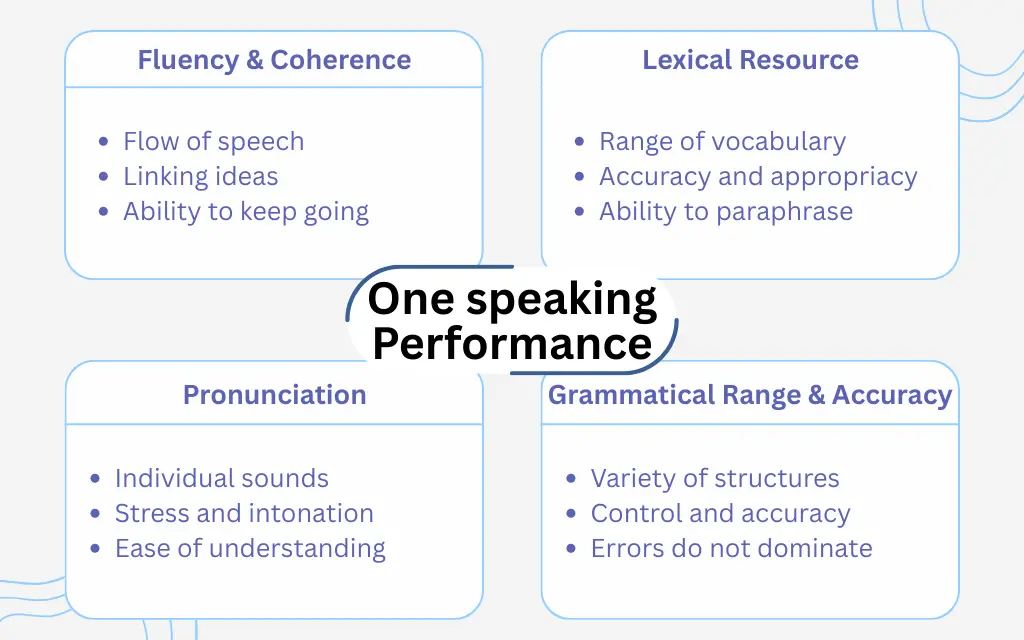
The four IELTS speaking marking criteria
Your IELTS Speaking score is based on four criteria, each worth twenty five percent of the total score.
These criteria are:
- Fluency and Coherence
- Lexical Resource
- Grammatical Range and Accuracy
- Pronunciation
The final speaking band score is the average of these four scores, rounded to the nearest half band.
This means you do not need to be perfect in every area to achieve a strong overall result. However, weakness in one criterion can limit the final band.
Fluency and coherence explained
Fluency and coherence are often misunderstood.
Fluency does not mean speaking quickly. It means speaking smoothly, with natural pacing and without excessive hesitation that interrupts communication.
Coherence refers to how clearly ideas are organised and connected over longer answers.
What examiners listen for
Examiners listen for natural pacing, meaningful pauses rather than constant hesitation, logical development of ideas, and clear referencing using words such as “this”, “that”, or “these”.
A common myth is that fillers like “um” or “uh” automatically lower scores. Occasional fillers are normal. The issue is whether they break meaning or flow.
Lexical resource in IELTS Speaking
Lexical resource refers to the range and accuracy of vocabulary, not how advanced words sound.
Examiners assess whether candidates can choose words naturally, avoid unnecessary repetition, use vocabulary appropriate to the topic, and control common collocations.
Using rare or academic vocabulary inaccurately lowers scores. Examiners are trained to recognise memorised or forced language.
Strong vocabulary performance often appears simple but precise. Clear, natural word choice is always safer than impressive but awkward alternatives.
Grammatical range and accuracy
Grammar is assessed on two dimensions: range and accuracy.
Range refers to the ability to use a mix of sentence structures. Accuracy refers to how reliably those structures are controlled.
Examiners do not count individual mistakes. They listen for patterns.
Occasional errors are acceptable, especially in longer or more complex sentences. What limits scores is frequent basic errors, errors that cause misunderstanding, or lack of control over simple structures.
A Band 7 speaker does not speak without mistakes. A Band 7 speaker shows consistent control.
Pronunciation and intelligibility
Pronunciation is not about having a British or American accent.
Examiners assess clarity of individual sounds, word stress, sentence rhythm, and intonation that supports meaning.
Accent is not penalised unless it interferes with understanding.
Many candidates lose marks not because of accent, but because words are unclear, stress is misplaced, or intonation makes meaning confusing. Clear pronunciation with a strong local accent often scores higher than unclear pronunciation with a so-called native accent.
How IELTS speaking band scores are calculated
After the test, the examiner assigns a band score for each of the four criteria.
These scores are averaged and rounded.
For example, if a candidate scores 7 for fluency, 6.5 for vocabulary, 7 for grammar, and 7 for pronunciation, the average becomes 6.875, which is rounded to Band 7.0.
This explains why small improvements in one area can raise the overall speaking score.
Why speaking scores feel unfair to candidates
Many candidates believe they performed well because they answered all questions, spoke continuously, or used advanced vocabulary.
Examiners, however, listen beneath the surface.
Common reasons scores do not improve include memorised answers that reduce fluency, repetitive vocabulary, limited sentence control, and lack of coherence in longer responses.
Understanding the band descriptors removes much of this frustration and makes improvement measurable.
How to use band descriptors to improve speaking
Band descriptors are not revision checklists. They are diagnostic tools.
The most effective way to use them is to record your speaking, assess one criterion at a time, and identify patterns rather than isolated mistakes.
This mirrors how examiners assess performance and leads to faster, more focused improvement.
Conclusion
IELTS Speaking is not subjective or mysterious.
It is marked using clear, consistent band descriptors that prioritise communication over perfection. Once you understand how IELTS Speaking is marked, preparation becomes targeted, realistic, and far less stressful.
Use this page as your reference point whenever you practise speaking or evaluate your performance.
Related IELTS Speaking Lessons
Glossary
Band descriptor (noun) — official description of performance at each IELTS band level
Fluency (noun) — ability to speak smoothly without excessive hesitation
Coherence (noun) — logical organisation and connection of ideas
Lexical resource (noun) — range and accuracy of vocabulary
Intelligibility (noun) — how easy speech is to understand
Comprehension & Practice Questions
- True or False: Examiners score speaking based on overall impression.
- Multiple choice: Which criterion measures vocabulary use?
A) Fluency
B) Lexical Resource
C) Pronunciation - Short answer: Does accent affect your score?
- True or False: Grammar mistakes automatically lead to a low band score.
- Short answer: Why are memorised answers risky?
Answers
- False
- B
- Only if it affects understanding
- False
- They reduce fluency and sound unnatural
Join 1,300+ English learners
Get free English lessons, IELTS tips and useful vocabulary by email.
No spam. Just practical English you can use.