
Introduction to Common IELTS Speaking Mistakes
Many IELTS Speaking candidates leave the test feeling confused rather than disappointed.
They felt confident. They spoke clearly. They answered every question. Yet the score comes back lower than expected, often stuck at Band 6 or 6.5.
In most cases, this is not because the candidate “cannot speak English”. It is because of a small number of common IELTS Speaking mistakes that quietly reduce the band score without being obvious to the speaker.
The IELTS Speaking test is not a normal conversation. It is a structured assessment marked against specific criteria. Certain habits that feel natural or safe to learners actually work against them in the exam.
This lesson explains the most frequent IELTS Speaking mistakes, why examiners notice them, and how to fix them without sounding unnatural or rehearsed.
Practise English every weekday with me
Get short Mon–Fri English practice in LINE with LEW Daily, plus regular feedback to help you improve.
Explore LEW DailyNT$399/month • Cancel anytime

Why IELTS Speaking mistakes are often invisible to candidates
One of the hardest parts of improving speaking is perception.
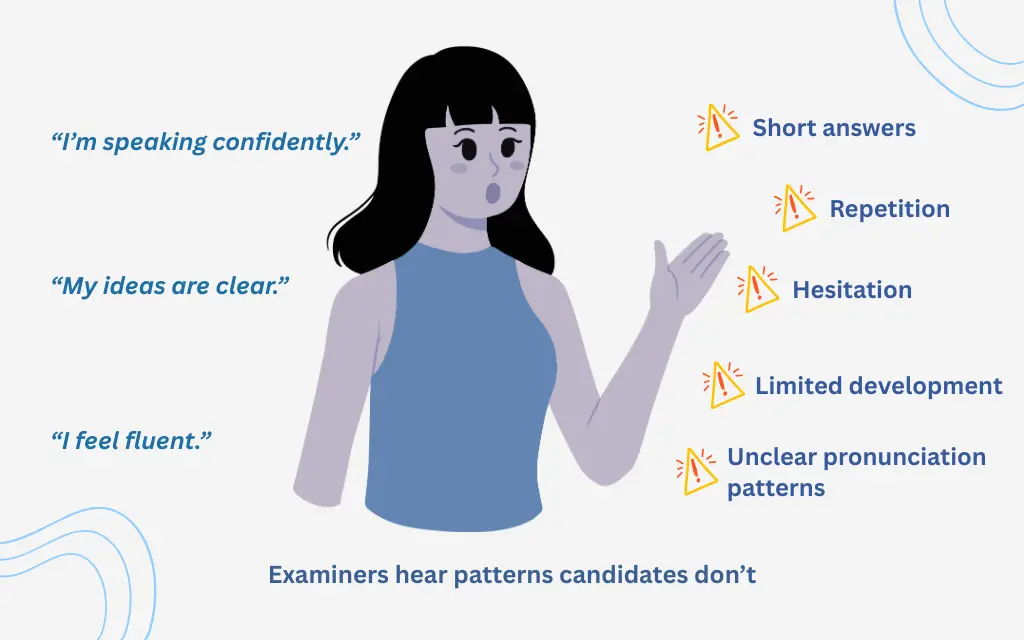
When you speak, your brain focuses on meaning and ideas. Examiners listen differently. They listen for patterns.
Repeated hesitation, vague development, limited grammar control, or unclear pronunciation become obvious very quickly to a trained ear, even if the speaker feels fluent.
This is why many candidates practise a lot but do not improve. They repeat the same habits, believing they are “safe”.
Mistake 1: Answering too briefly
One of the most common IELTS Speaking mistakes is giving answers that are correct but too short.
For example, in Part 1:
“Do you enjoy reading?”
“Yes, I do.”
This answer is accurate, but it gives the examiner almost nothing to assess. There is no evidence of fluency, grammar range, or vocabulary.
Short answers often cap scores because examiners cannot award what they cannot hear.
The fix is simple. Add one natural extension.
“Yes, I do. I usually read in the evening because it helps me relax after work.”
That single sentence changes the score potential.
Mistake 2: Memorised or scripted answers
Many candidates prepare answers in advance, especially for Part 2.
Preparation is sensible. Memorisation is not.
Memorised answers often sound unnatural in rhythm, slightly off-topic, or overly complex compared to the candidate’s normal level. Examiners recognise this very quickly.
When memorisation is suspected, fluency and coherence are affected.
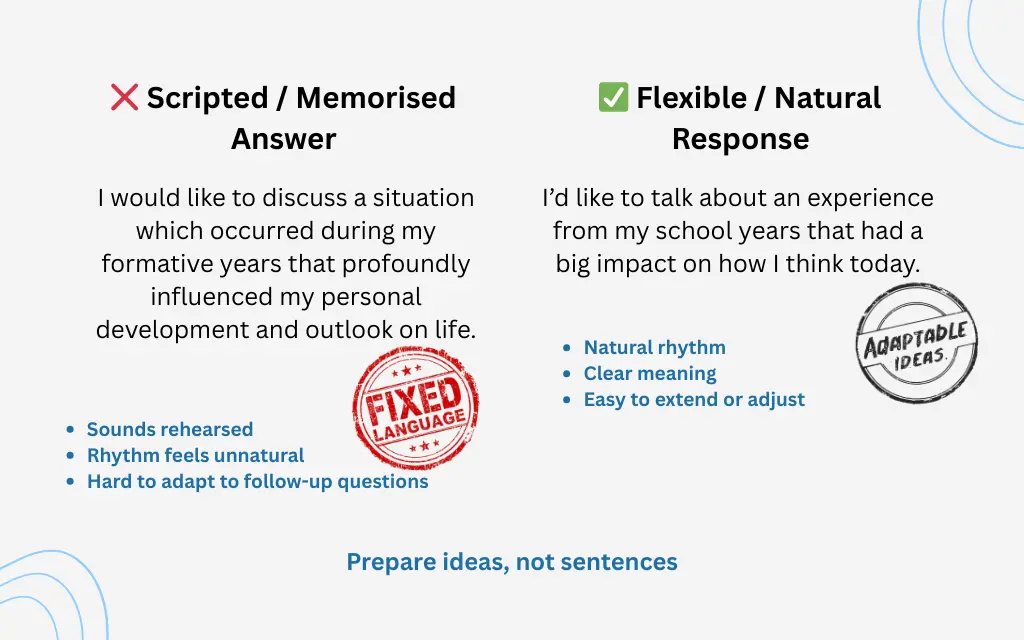
The fix is to prepare ideas and structure, not sentences. Flexibility matters more than polish.
Mistake 3: Over-correcting while speaking
Some candidates notice a small mistake and immediately stop to correct it.
Occasional self-correction is natural. Frequent self-correction breaks fluency.
For example:
“I have lived there since… since… actually, for about five years.”
This draws attention to the error rather than the message.
Examiners do not penalise minor slips. They do notice disrupted flow.
If the meaning is clear, continue speaking.
Mistake 4: Speaking too fast under pressure
Nervous candidates often speed up.
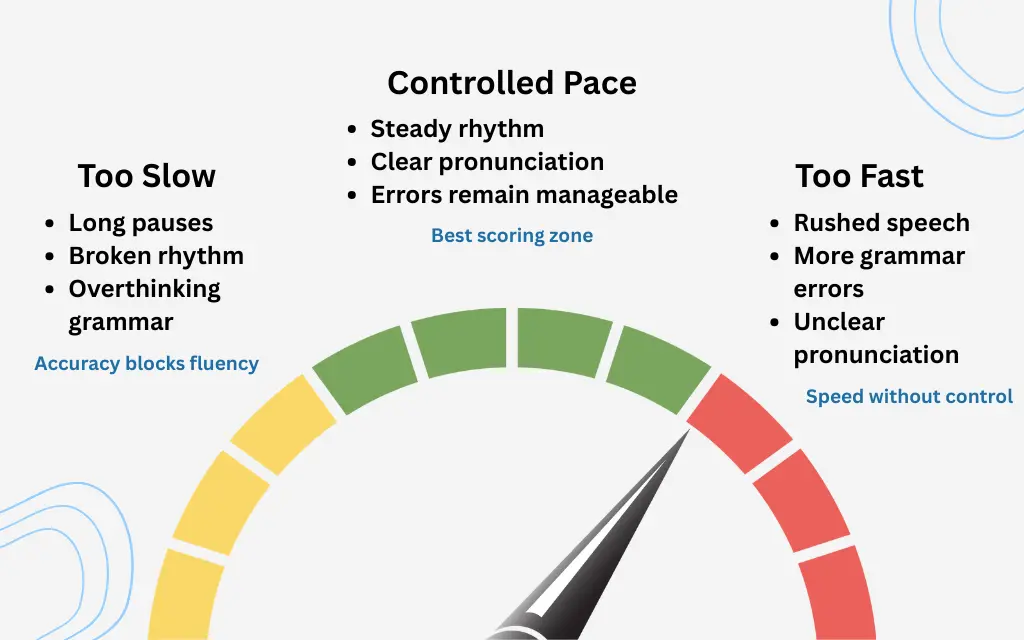
Fast speech increases grammar errors, weakens pronunciation, and makes stress and intonation unclear.
Fluency in IELTS is not speed. It is control.
Calm, steady speech consistently scores higher than rushed speech with mistakes.
Mistake 5: Repeating the same vocabulary
Vocabulary repetition is a quiet score-killer.
Many candidates rely on safe words such as good, nice, important, or interesting. These words are not wrong, but repeated use limits lexical resource.
“It was a good place. I had a good experience. It was good for me.”
This shows limited range.
The fix is not advanced vocabulary. It is natural variation.
Mistake 6: Weak development in Part 2
In Part 2, many candidates describe events but do not develop ideas.
They list actions without explaining reasons, feelings, or outcomes.
Examiners are not counting facts. They are listening for organisation and sustained speech.
A strong Part 2 response feels like a simple story, not a checklist.
Mistake 7: Not answering Part 3 questions directly
Part 3 often exposes Band 6.5 limitations.
Candidates speak fluently but give vague or circular answers.
“Why do people prefer living in cities?”
“Cities are popular and many people like them.”
This repeats the question instead of answering it.
Examiners want position plus explanation, even if the idea is simple.
Mistake 8: Pronunciation problems that affect clarity
Pronunciation is not accent.
It is intelligibility.
Common problems include dropped word endings, incorrect stress, and flat intonation. If the examiner has to work to understand you, the score is affected.
Clear pronunciation with a strong local accent often scores higher than unclear speech with a “native-like” accent.
Mistake 9: Sounding hesitant instead of thoughtful
Pauses are not the problem. Uncertain hesitation is.
Compare:
“Um… uh… maybe…”
with:
“That’s an interesting question. I think it depends…”
Both involve thinking time. Only one sounds controlled.
Mistake 10: Treating the test like an interview, not a conversation
Some candidates answer mechanically.
IELTS Speaking is formal, but it is still interactive. Natural tone, small reactions, and human delivery all help.
Examiners respond positively to speakers who sound real, not rehearsed.
Conclusion
Most IELTS Speaking mistakes are not about language level. They are about exam awareness.
By understanding how examiners listen and adjusting a few habits, many candidates improve their speaking score without learning new grammar or vocabulary.
If your score is not improving, the issue is rarely effort. It is focus.
Related IELTS Speaking Lessons
Glossary
Fluency (noun) — ability to speak smoothly and naturally
Coherence (noun) — logical flow and connection of ideas
Lexical resource (noun) — range and accuracy of vocabulary
Self-correction (noun) — correcting speech while speaking
Intonation (noun) — rise and fall of the voice in speech
Comprehension & Practice Questions
- True or False: Very short answers limit what examiners can assess.
- Multiple choice: Which habit most clearly signals memorisation?
A) Calm speech
B) Flexible answers
C) Unnatural rhythm - Short answer: Why is speaking too fast risky in IELTS Speaking?
- True or False: Pausing always lowers fluency scores.
- Short answer: What matters more than accent in pronunciation?
Answers
- True
- C
- It increases errors and reduces clarity
- False
- Clarity and intelligibility
Join 1,300+ English learners
Get free English lessons, IELTS tips and useful vocabulary by email.
No spam. Just practical English you can use.