Introduction to IELTS Reading question types
IELTS candidates often leave the Reading test feeling confused.
They recognise most of the vocabulary and understand large parts of the passages. Yet when the results arrive, the score is lower than expected.
This usually happens because IELTS Reading is not only a language test. It is also a pattern-recognition test.
Every paper follows the same structure. The same question types appear again and again. When you understand how these patterns work, the test becomes predictable.
This lesson explains the main IELTS Reading question types, how they are designed, and how to approach each one calmly and effectively.
Practise English every weekday with me
Get short Mon–Fri English practice in LINE with LEW Daily, plus regular feedback to help you improve.
Explore LEW DailyNT$399/month • Cancel anytime

Why understanding question types matters
Before looking at individual tasks, it is important to understand why question types matter so much.
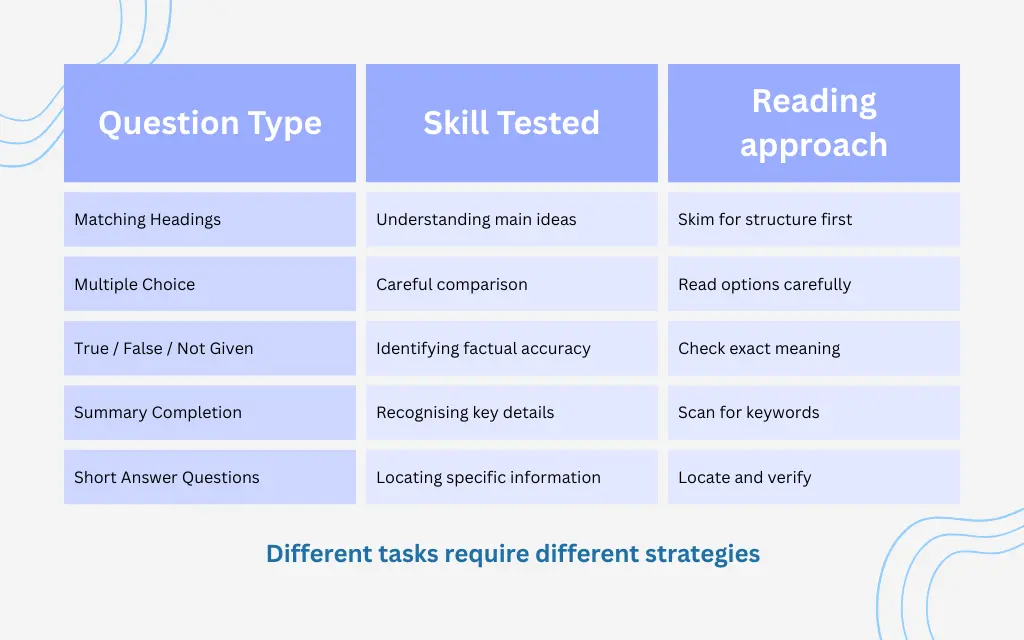
In IELTS Reading, each task tests a different skill. Some focus on detail. Others test overall meaning. Some require precise comparison. Others require logical reasoning.
If you use the same reading strategy for every question, you will waste time and lose marks.
Strong candidates adapt their reading style to the task in front of them rather than forcing one method onto every passage.
How IELTS Reading questions are created
Examiners do not write questions randomly.
They begin with a passage, identify key ideas, and then rewrite those ideas using different language. This process means that most questions involve paraphrasing.
For example, a passage may say that a policy led to economic growth, while a question refers to financial improvement. The wording changes, but the meaning remains the same.
Recognising this relationship is essential for consistent success.
Multiple choice questions
Multiple choice questions are among the most challenging for many candidates.
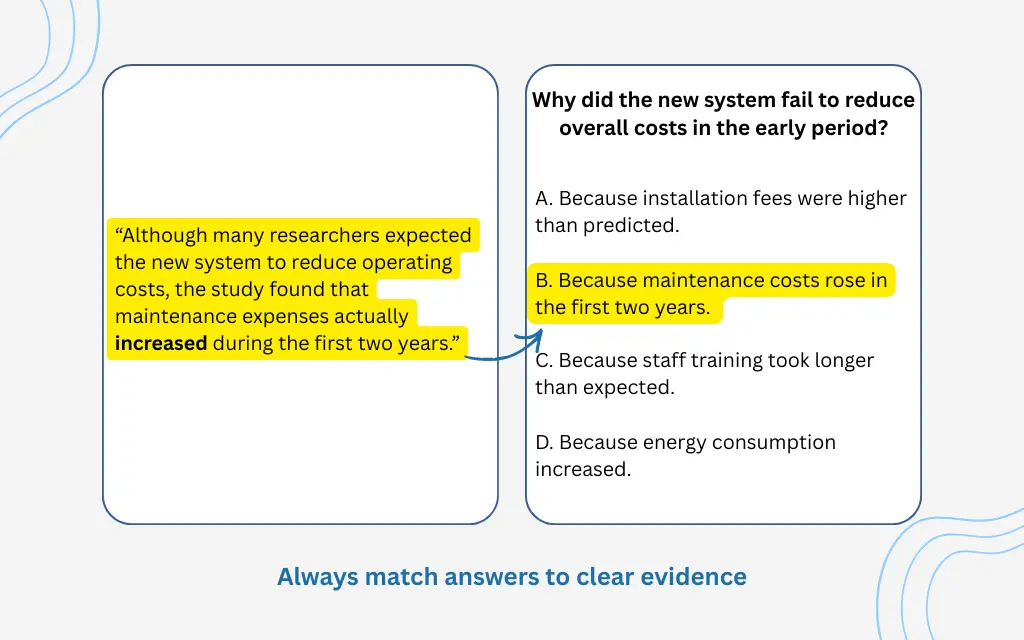
They usually test detailed understanding of specific parts of the passage. Each option often contains some correct information, but only one matches the text completely.
Wrong answers may exaggerate an idea, simplify it too much, mix two parts of the passage, or change cause and effect.
Strong candidates always check options against clear evidence in the text rather than relying on general impressions.
True, False, Not Given questions
This question type causes more mistakes than almost any other.
You must decide whether a statement agrees with the passage, contradicts it, or is not mentioned at all.
“Not Given” does not mean “probably false”. It means the passage gives no clear information about the statement.
If the text neither supports nor contradicts the idea directly, the answer is “Not Given”.
Careful comparison is far more important than speed in this task.
Matching headings questions
Matching headings focuses on main ideas rather than details.
You match short summaries to paragraphs. This requires you to understand what each paragraph is mainly about, not what it contains line by line.
Strong candidates usually focus on opening sentences, concluding lines, and repeated concepts. These often reveal the paragraph’s purpose.
Reading every word is rarely necessary.
Matching information and matching features
In these tasks, you connect statements to sections, paragraphs, or people.
You may match opinions to researchers, facts to paragraphs, or events to time periods.
These questions test scanning skills and organisational control. You locate key terms first and then read carefully around them.
Staying organised is essential. Losing track of locations quickly leads to repeated errors.
Sentence completion tasks
Sentence completion requires you to finish sentences using words from the passage.
Grammar matters here. Your answer must fit the sentence structure and follow the word limit.
Strong candidates always read the completed sentence in their head to check whether it sounds natural and accurate.
Copying words without checking grammar often results in unnecessary mistakes.
Summary, note, table, and flowchart completion
These tasks present information in visual form and require you to fill gaps using words from the text.
They test your ability to understand how ideas connect and how processes develop.
Flowcharts and tables are especially common in scientific or technical passages, where relationships between steps matter more than individual facts.
Careful reading usually produces better results than speed in these tasks.
Short answer questions
Short answer questions require brief written responses, usually one to three words.
Word limits are strict and must be followed exactly.
Even a correct idea becomes wrong if it exceeds the allowed number of words.
Always check the instruction line before answering.
Matching sentence endings
In this task, you match sentence beginnings to suitable endings.
Both halves usually appear logical on their own. Only one combination matches the meaning of the passage.
This question tests logical connection and cohesion.
Reading both parts slowly prevents many careless mistakes.
Identifying information in diagrams
Some papers include labelled diagrams.
You match parts of the diagram with information from the passage.
This tests technical vocabulary and spatial understanding and often appears in scientific or process-based texts.
Strong candidates move carefully between the diagram and the passage rather than relying on guesswork.
Choosing the right strategy for each task
Every question type rewards a different approach.
Trying to memorise one “perfect” method rarely works. Instead, experienced candidates adjust their reading behaviour.
For example, headings require broad understanding, matching tasks require scanning, and completion tasks require grammatical awareness.
Learning these patterns reduces stress and improves consistency.
Why students lose marks even when they understand
Many candidates understand passages but still lose points.
This usually happens because they rely on memory instead of checking evidence, guess too quickly, ignore instructions, misread paraphrases, or panic under pressure.
These are exam skills, not language problems. With focused practice, they can be corrected.
Building confidence with question types
Confidence grows when patterns become familiar.
Instead of practising tests randomly, it is more effective to master one task type at a time.
Focused practice builds accuracy faster than unfocused repetition.
Over time, strategies become automatic.
Conclusion
IELTS Reading becomes much easier when you understand how questions work.
Each task follows clear rules and tests a specific skill.
When you recognise these patterns, you stop guessing and start answering with confidence.
Related IELTS Reading Lessons
Glossary
Paraphrase (verb) — express the same meaning using different words
Scan (verb) — look quickly for specific information
Skim (verb) — read quickly for general meaning
Instruction (noun) — rule telling you how to answer
Evidence (noun) — part of the text that supports an answer
Comprehension & Practice Questions
True or False: All IELTS reading questions test the same skill.
Multiple choice: Which task mainly tests main ideas?
A) Sentence completion
B) Matching headings
C) Short answers
Short answer: What does “Not Given” mean?
True or False: Grammar matters in sentence completion.
Short answer: Why is paraphrasing important?
Answers
False
B
The information is not mentioned
True
Because questions use different wording from the passage
Join 1,300+ English learners
Get free English lessons, IELTS tips and useful vocabulary by email.
No spam. Just practical English you can use.