
Introduction to Time Expressions for IELTS Task 1
IELTS Task 1 responses lose clarity not because the data is misunderstood, but because time is described poorly. Candidates repeat the same basic phrases, mix tenses, or avoid time references altogether out of fear of making mistakes.
This is a missed opportunity.
IELTS Task 1 time expressions are not advanced vocabulary. They are simple, high-frequency language that helps examiners immediately understand when changes happen, how long trends last, and whether something is stable or changing.
In this lesson, you will learn how to describe time clearly and naturally in Task 1, using examiner-friendly language that supports accuracy, coherence, and task achievement.
Practise English every weekday with me
Get short Mon–Fri English practice in LINE with LEW Daily, plus regular feedback to help you improve.
Explore LEW DailyNT$399/month • Cancel anytime

Why Time Expressions Matter in Task 1
Task 1 is fundamentally about change over time, even when the visual does not explicitly show dates.
Examiners expect candidates to:
- Locate trends in time
- Compare earlier and later periods
- Describe duration, sequence, and stability
Without clear time expressions, descriptions feel vague. Examiners may struggle to follow the logic of your report, even if your grammar is correct.
Time expressions act as signposts. They guide the reader through the data.
Time Expressions vs Tense Choice
Time expressions and verb tense work together.
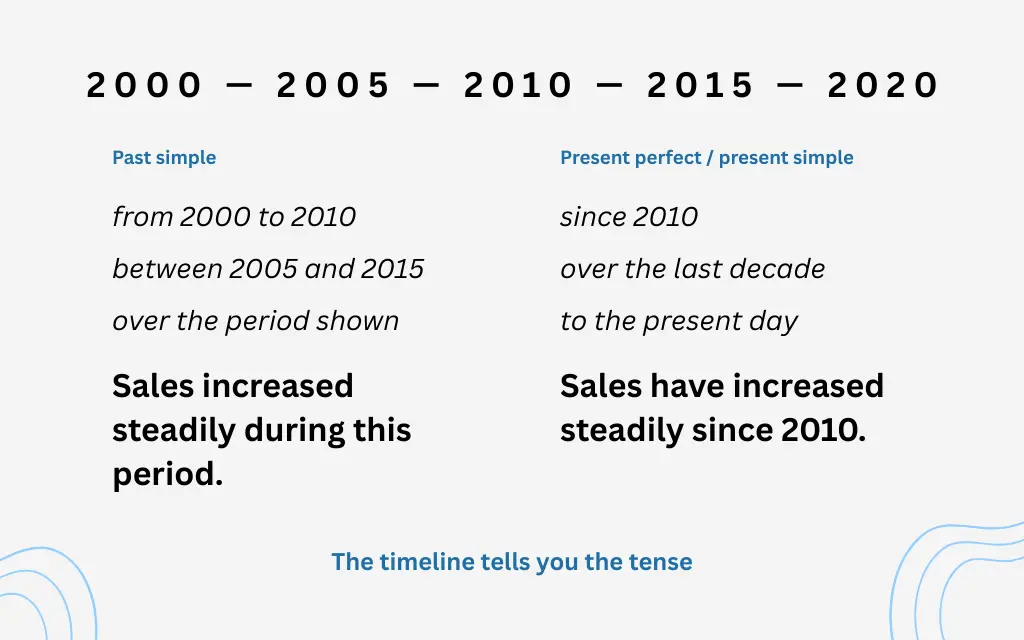
A clear time phrase often signals which tense should be used, helping you avoid common grammar mistakes. For example, when a chart shows finished periods, time expressions naturally support past tense. When data continues to the present, they guide you towards present perfect or present simple structures.
Describing Fixed Time Periods
Many Task 1 visuals show clear start and end points, such as a decade, a specific year range, or a finished period in the past.
In these cases, time expressions help anchor your description so the examiner knows exactly when something happened.
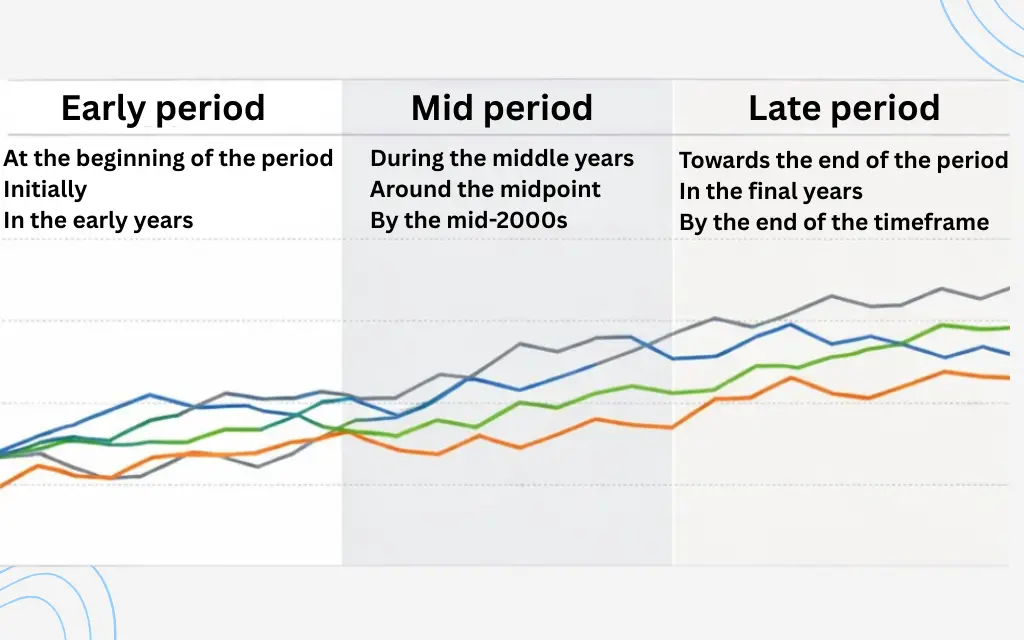
You might describe what occurred at the beginning of the period, how figures changed in the middle, and where they ended. This structure makes your response easier to follow and shows control over temporal language.
Referring to Trends Over Time
When describing trends, time expressions help show movement, not just direction.
Rather than repeatedly saying figures “increased” or “decreased”, time phrases allow you to explain when changes occurred and how they developed.
For example, a rise may happen gradually over several years, suddenly at one point, or steadily throughout the entire period. These distinctions matter in Task 1 and are only clear when time language is used effectively.
Showing Duration Clearly
Duration is a key feature in many Task 1 tasks.
Examiners want to know whether a trend:
- Lasted briefly
- Continued for several years
- Remained unchanged over a long period
Time expressions that indicate duration help you avoid vague statements and strengthen task achievement. They also reduce repetition by allowing variation in sentence structure.
Describing Early, Middle, and Late Stages
Strong Task 1 responses often divide the timeline naturally.
Instead of listing data points, candidates describe patterns that appear:
- At the start of the period
- During the middle years
- Towards the end
Time expressions make this structure explicit and help examiners follow the progression of ideas.
Time Expressions for Stability and Change
Not all data changes.
Many charts include periods where figures remain stable. These moments are just as important as increases or decreases.
Time expressions help you highlight stability without sounding repetitive. They also show examiners that you are selecting key features rather than describing every movement.
Avoiding Over-Precision With Time Language
A common mistake is being too specific.
If a chart does not show monthly or quarterly detail, avoid inventing it. Examiners penalise inaccurate reporting.
Time expressions allow you to stay general while remaining accurate. Phrases that describe approximate periods are safer than overly precise language when the data does not support it.
Time Expressions in Comparisons
When comparing two or more categories, time expressions help align changes.
Rather than describing each category separately, time phrases allow you to show what happened at the same time or during the same period, which improves coherence and comparison.
This is especially useful in line graphs and bar charts covering identical time ranges.
Linking Time Expressions to Overview Statements
The overview paragraph often summarises what happened across the entire time frame.
Time expressions are essential here. They help you describe overall patterns without repeating detailed data.
An overview that includes a clear time reference feels more complete and easier for examiners to assess.
Common Time Expression Errors in Task 1
Examiners frequently notice problems such as:
- Mixing past and present time references
- Using informal time phrases
- Repeating the same expression too often
These errors do not usually destroy a score, but repeated issues can limit grammar and coherence bands.
Keeping Time Language Natural and Repetitive-Free
One concern students have is repetition.
The solution is not to use complex synonyms, but to vary sentence structure. Time expressions are flexible and can appear at the beginning, middle, or end of sentences.
This natural movement helps your writing sound fluent rather than mechanical.
Time Expressions Across Different Task 1 Visuals
Although time expressions appear most often in line graphs, they are also relevant in:
- Bar charts with historical data
- Tables showing yearly figures
- Maps showing development stages
- Process diagrams with time sequences
Understanding how time is implied (even when not explicitly labelled) helps you apply these expressions confidently.
Examiner Perspective on Time Language
From an examiner’s point of view, time expressions:
- Improve clarity
- Support accurate tense use
- Make task achievement easier to judge
They are not looking for advanced phrases. They are looking for appropriate, controlled language that matches the data.
Practising Time Expressions Effectively
The most effective practice is contextual.
Rather than memorising lists, take a Task 1 chart and practise describing:
- One trend using early/middle/late references
- One trend focusing on duration
- One trend focusing on comparison across the same period
This builds exam-ready control rather than isolated vocabulary knowledge.
Conclusion
IELTS Task 1 time expressions are small pieces of language with a big impact.
They help examiners follow your ideas, support correct tense use, and make your writing sound organised and controlled. Used naturally, they strengthen both coherence and task achievement without adding unnecessary complexity.
To continue building this skill, explore related Task 1 grammar and comparison guides on Learn English Weekly, especially those focusing on sentence structure and examiner marking.
Related IELTS Task 1 Lessons
Glossary
Time expression (noun) — A word or phrase that shows when something happens
Duration (noun) — The length of time something continues
Trend (noun) — A general direction of change over time
Time frame (noun) — The period shown in a chart or graph
Stability (noun) — A period with little or no change
Practice Questions
- True or False: Time expressions help examiners follow trends more easily.
- Which is more important in Task 1: advanced time vocabulary or accurate time reference?
- Short answer: Name one reason to avoid over-precise time language.
- True or False: Time expressions are only useful in line graphs.
- Multiple choice: Time expressions mainly support
A) Opinion
B) Task achievement and clarity
C) Creativity
Answers
- True
- Accurate time reference
- The data may not support exact detail
- False
- B
Join 1,300+ English learners
Get free English lessons, IELTS tips and useful vocabulary by email.
No spam. Just practical English you can use.