
Introduction to IELTS Listening Map Labelling
Map questions make many candidates uneasy.
You are listening to someone give directions.
You are looking at a diagram.
The speaker moves through locations quickly.
And suddenly you feel lost.
However, IELTS listening map labelling is not designed to confuse you randomly. It is designed to test whether you can follow directions logically and maintain spatial awareness while listening.
This task appears most commonly in Section 2 and is one of the most error-prone formats in the Listening test. Yet once you understand how map questions in IELTS listening are structured, they become far more predictable.
In this lesson, you will learn:
- How map labelling works
- Why candidates lose marks
- How to follow directions confidently
- Practical strategies to improve accuracy
When approached correctly, this question type becomes manageable, even reliable.
Practise English every weekday with me
Get short Mon–Fri English practice in LINE with LEW Daily, plus regular feedback to help you improve.
Explore LEW DailyNT$399/month • Cancel anytime

What Is Map Labelling in IELTS Listening?
Map labelling requires you to listen to directions and identify specific locations on a map, plan, or diagram.
You may be given:
- A campus layout
- A park map
- A building floor plan
- A tourist site diagram
The speaker describes movement through the space, and you must label the correct positions.
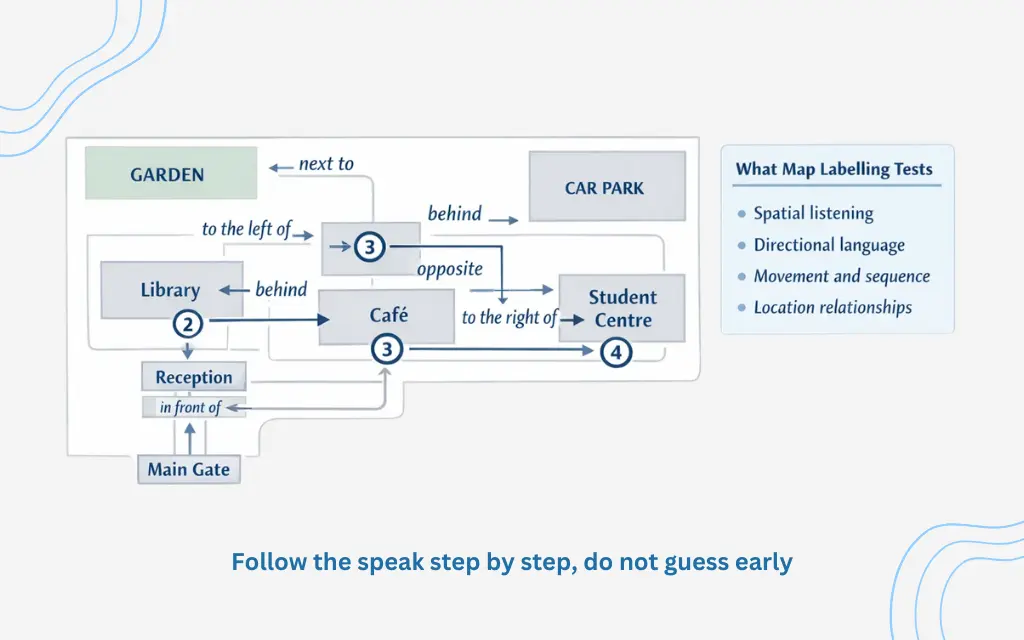
Unlike form completion, this task is not about spelling or numbers. It tests spatial listening and directional understanding. You must follow movement step by step.
Where Map Questions Usually Appear
Map labelling most commonly appears in Section 2 of the Listening test.
Section 2 typically features a monologue in a social context, such as:
- A tour guide explaining a museum layout
- A staff member describing university facilities
- A park manager outlining new developments
Because it is a monologue, there is no interaction or repetition. The speaker moves continuously from one point to another.
This is why concentration matters more here than in Section 1.
Why IELTS Listening Map Labelling Feels Difficult
The challenge is rarely vocabulary.
The difficulty lies in orientation.
Many candidates struggle because:
- They lose track of direction
- They confuse left and right
- They panic when the speaker moves forward quickly
Map labelling requires you to process language and location simultaneously.
However, the structure is predictable. The speaker almost always follows a logical route around the map. They do not jump randomly between locations. Understanding this reduces anxiety immediately.
Understanding Directional Language
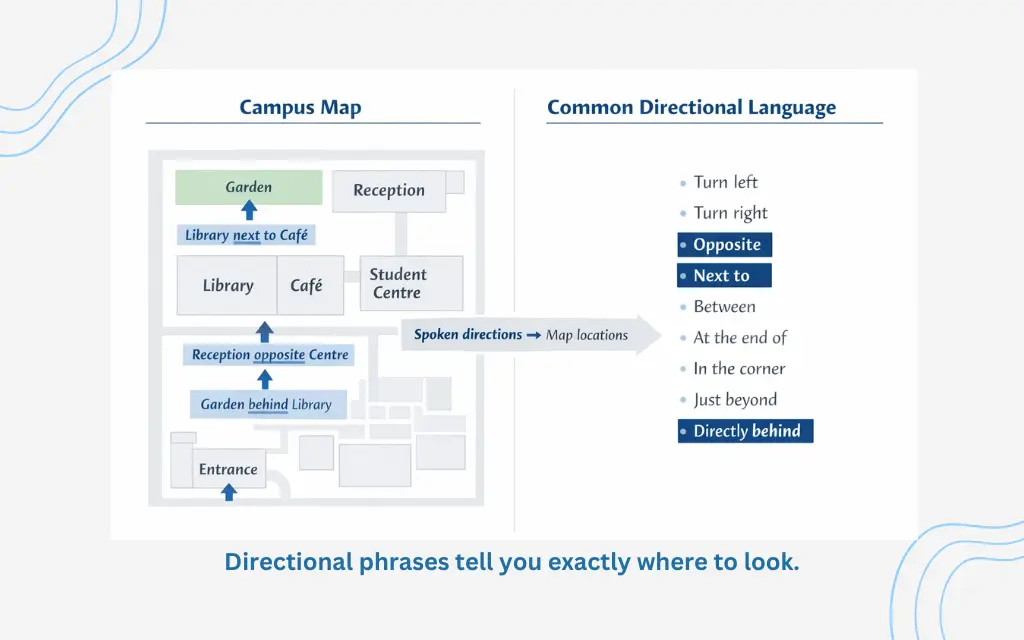
Success in IELTS listening map labelling depends on recognising directional phrases quickly.
Common expressions include:
Turn left / turn right
Opposite
Next to
Between
At the end of
In the corner
Just beyond
Directly behind
Before the recording begins, scan the map carefully:
Where is the entrance? Is north shown? Are there clear landmarks? Is there a starting point?
When the speaker says:
“As you enter the building, the reception desk is directly in front of you.”
You now have your starting orientation.
Everything else follows from that anchor point.
Following the Route Logically
Think of It as a Journey
Most map questions follow a physical route.
For example:
“Start at the main gate. Walk straight ahead. On your right, you’ll see the information centre. Continue past the café, and the exhibition hall is on the left.”
Notice the progression:
Main gate → Information centre → Café → Exhibition hall
The speaker is walking you through the space.
If you imagine physically moving through the location, comprehension improves dramatically.
Do not treat the map as static. Treat it as a journey.
Avoiding Common Map Labelling Traps
Map questions often include subtle distractors.
For example:
“The old library used to be next to the café, but it has now been replaced by the student lounge.”
The correct answer is the student lounge, not the old library.
Focus on current information, not historical details.
Another common mistake is writing labels for items that are not required. Only fill in the numbered spaces provided.
Map labelling rewards disciplined listening.
Using Preparation Time Strategically
Preparation time is critical.
Before the recording begins:
Study the map layout carefully.
Identify the entrance or starting point.
Notice any compass directions.
Observe the general flow of streets or corridors.
Try to predict possible vocabulary.
If the map shows open green space, you might hear:
Park
Garden
Playground
Pond
If it shows numbered rooms, expect:
Office
Conference room
Storage
Laboratory
Prediction makes your listening more focused.
Left and Right: A Practical Solution
Confusing left and right is common under pressure. Instead of translating directions into your first language, visualise them directly.
Imagine yourself standing at the entrance.
If the speaker says:
“Turn right at the fountain.”
Picture yourself physically turning right.
Spatial imagination is faster and more accurate than mental translation.
Managing Speed and Recovery
The recording will not pause. If you miss one location, do not stop listening. Move forward immediately. Because the speaker follows a route, you can often recover by focusing on the next clear directional signal.
Listening for words such as:
“Next”
“Then”
“After that”
“Finally”
helps you regain orientation. Map labelling tests calm concentration more than vocabulary range.
How Map Labelling Influences Your IELTS Listening Band Score
Although map labelling appears as only part of Section 2, it often causes unnecessary score loss. Candidates aiming for Band 7+ frequently lose marks here because of spatial confusion rather than language weakness.
Improving this one question type can noticeably raise your IELTS listening band score. Strong listeners approach map questions as structured direction-following tasks, not vocabulary tests.
A Practical Way to Practise Directions Listening
To strengthen your IELTS listening map labelling skills, practise following spoken directions outside exam materials.
Useful sources include:
Museum audio guides
Google Maps voice navigation
Campus tour videos
YouTube walking tours
Train your brain to connect spoken instructions with visual movement. The more comfortable you become with directions listening, the easier map questions feel.
Conclusion
IELTS listening map labelling is not about complex grammar or advanced vocabulary.
It is about:
Understanding directional language
Following a logical route
Maintaining orientation
Recognising distractors
Staying mentally steady
Once you understand how map questions in IELTS listening are structured, they become predictable rather than intimidating.
To continue building strong Listening performance, explore:
IELTS Listening Section 2 Explained
Form Completion in IELTS Listening
Common IELTS Listening Mistakes
Master spatial listening, and your overall band score strengthens naturally.
Related IELTS Listening Lessons
Glossary
Map Labelling (n.)
A Listening task where you label locations on a map or diagram.
Monologue (n.)
Speech by one person without interruption.
Orientation (n.)
Understanding direction and position in space.
Distractor (n.)
Incorrect information designed to mislead candidates.
Route (n.)
A path taken from one point to another.
Practice Section
(MCQ) Map labelling most commonly appears in:
A. Section 1
B. Section 2
C. Section 3
D. Writing Task 2
(True/False) Map questions usually involve two speakers.
(Short Answer) Why is understanding direction phrases important?
(MCQ) Which phrase indicates position?
A. However
B. Opposite
C. Therefore
D. Firstly
(True/False) The speaker usually jumps randomly across the map.
Answers
B
False
Because direction phrases help you identify the correct location on the map.
B
False
Join 1,300+ English learners
Get free English lessons, IELTS tips and useful vocabulary by email.
No spam. Just practical English you can use.