
Introduction to What IELTS Examiners Notice First
IELTS candidates assume that examiners read or listen carefully to every word before forming an opinion. In reality, that is not how assessment works. Examiners are human, highly trained, and working under time pressure. Within moments of engaging with a script or a spoken response, they begin forming an internal sense of the level.
This does not mean the final score is rushed or unfair. It means that first impressions matter, because they signal how smoothly the rest of the performance is likely to go.
Understanding IELTS examiner tips and what examiners notice first can change how you prepare. It shifts your focus away from chasing perfection and towards creating clarity, control, and confidence from the start.
This lesson explains what IELTS examiners notice first, why those signals matter, and how they influence writing and speaking assessment long before every detail is considered.
Practise English every weekday with me
Get short Mon–Fri English practice in LINE with LEW Daily, plus regular feedback to help you improve.
Explore LEW DailyNT$399/month • Cancel anytime

Why “First Notice” Matters in IELTS Assessment
IELTS marking is systematic, but it is not mechanical. Examiners do not start with a score and adjust it later. Instead, they read or listen while mentally mapping performance against the band descriptors.
Early signals help examiners decide where on the scale the performance is likely to sit. Later details confirm or slightly adjust that judgement.
This is why early clarity helps, and early confusion hurts.

Overall Clarity Comes Before Everything Else
The very first thing examiners notice is clarity.
In writing, this means:
- Is the task understood?
- Is the response easy to follow?
- Do sentences make sense immediately?
In speaking, it means:
- Can the speaker communicate comfortably?
- Are answers relevant and understandable?
- Is there unnecessary strain or hesitation?
If clarity is present, examiners relax. If it is missing, they become cautious.
This reaction happens before vocabulary level or grammar range is analysed in detail.
Task Understanding Is Spotted Almost Instantly
One of the earliest signals examiners notice is whether the task has been understood.
In writing, this is often clear from the introduction and first body paragraph. If the response drifts away from the question or addresses it too generally, examiners recognise this immediately.
In speaking, irrelevant answers or misunderstood prompts are noticed within seconds.
This is why what IELTS examiners look for starts with relevance, not sophistication.
Paragraphing and Structure (Before Language)
In writing, examiners notice paragraphing almost instantly.
Well-defined paragraphs signal control. A block of text with unclear structure raises concern, even before the language inside it is examined.
Clear paragraph structure suggests:
- Planning
- Logical thinking
- Awareness of academic writing conventions
This initial signal strongly influences how the rest of the script is read.
Sentence Control Is More Visible Than Complexity
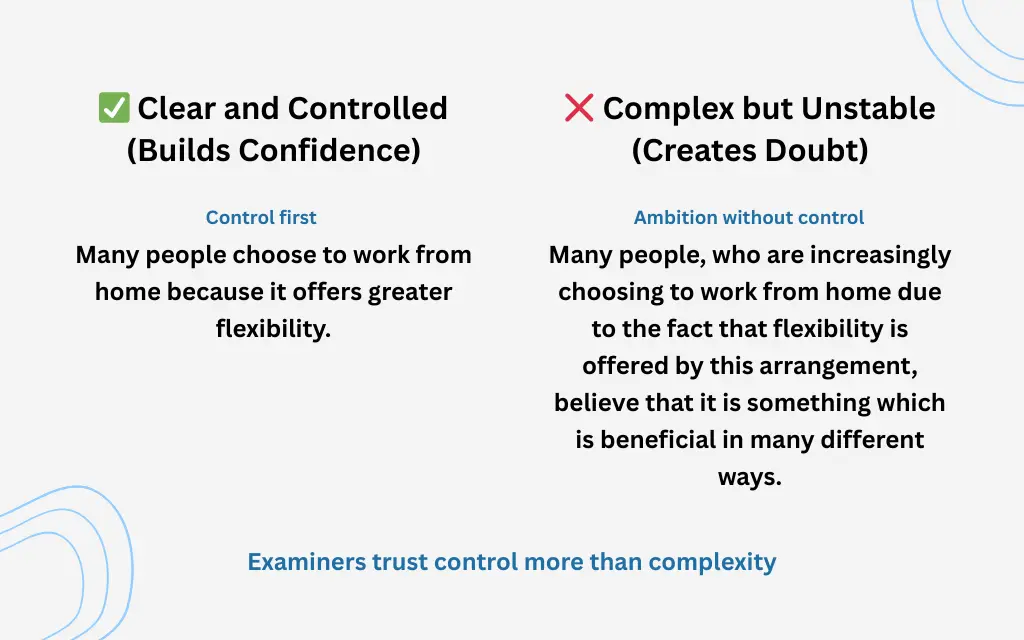
Examiners notice sentence control before they notice sentence complexity.
A simple sentence that works cleanly creates confidence. A long sentence that collapses creates doubt.
This is why writing that looks “simple” can score higher than writing that looks “advanced”. Examiners are trained to prioritise control over ambition.
Vocabulary Fit, Not Vocabulary Level
Examiners do not pause at impressive words. They pause at awkward ones.
Early vocabulary signals include:
- Does the word fit the context?
- Does it sound natural?
- Does it help the idea?
If vocabulary feels forced or memorised, examiners notice immediately. This affects trust before range is even considered.
This is especially important in the first few sentences.
Tone and Naturalness in Speaking
In the speaking test, examiners notice naturalness very quickly.
They are not looking for perfect pronunciation or advanced expressions. They are listening for:
- Willingness to communicate
- Comfortable pacing
- Natural responses
A speaker who sounds relaxed but imperfect often makes a stronger early impression than a speaker who sounds rehearsed but tense.
Fluency Signals Appear Early
Fluency is not about speed. It is about flow.
Examiners notice early:
- Excessive pausing
- Over-correction
- Memorised delivery
Fluent does not mean fast. It means ideas move forward without strain. This impression forms within the first answer.
Coherence Is Felt Before It Is Analysed
Coherence is not counted sentence by sentence. It is felt.
If writing or speaking flows logically, examiners sense it immediately. If ideas feel jumpy or disconnected, that feeling appears early and influences later judgement.
This is why mechanical linking words often fail. They look organised, but they do not feel coherent.
Repeated Errors vs Occasional Errors
Examiners notice patterns, not isolated mistakes.
A single error early on is rarely significant. A pattern of similar errors appearing early creates a lasting impression.
This is why reducing repeated errors matters more than eliminating rare ones.
Confidence Without Arrogance
Examiners notice confidence, not overconfidence.
In writing, this appears as clear positioning and steady development. In speaking, it appears as willingness to answer without overthinking.
Hesitation caused by fear of mistakes is often more damaging than the mistakes themselves.
What Examiners Do Not Notice First
It is equally important to understand what examiners do not prioritise early on.
They do not initially focus on:
- Rare vocabulary
- Complex grammar structures
- Perfect accuracy
These are assessed later. Early impressions are built on usability of language, not decoration.
Why First Impressions Do Not Mean Final Scores
A strong first impression does not guarantee a high score, and a weak one does not automatically mean failure.
Examiners continue assessing carefully throughout the test. However, early clarity makes it easier for the examiner to see strengths later.
Early confusion makes the examiner more alert to weaknesses.
How This Insight Should Change Your Preparation
Once you understand examiner behaviour, preparation becomes calmer and more strategic.
Instead of trying to impress, you focus on:
- Clear task understanding
- Controlled language
- Natural delivery
This approach aligns with how IELTS is actually marked.
Writing vs Speaking: Shared Examiner Behaviour
Although writing and speaking use different criteria, examiner psychology is similar.
In both:
- Clarity comes first
- Control matters early
- Natural communication builds trust
Understanding this creates consistency across your preparation.
Conclusion
Understanding IELTS examiner tips and what examiners notice first gives you a powerful advantage. IELTS assessment begins with clarity, relevance, and control, not complexity or perfection.
When your writing and speaking feel natural and easy to follow from the beginning, examiners are more receptive to your ideas and language throughout the test.
To deepen this insight, explore the related Learn English Weekly examiner and assessment guides linked below, where examiner thinking is applied directly to writing and speaking strategies.
Related Examiner Insight Lessons
Glossary
Memorised essay (noun) — A pre-written response learned by heart
Task response (noun) — How directly the writing answers the question
Examiner confidence (noun) — Trust in the writer’s language control
Generic language (noun) — Language that lacks task-specific relevance
Authentic writing (noun) — Natural writing produced in the exam
Practice Questions
- True or False: Examiners are unaware of memorised essays.
- Which criterion is most affected by memorisation?
A) Task Response
B) Spelling - Why does memorisation reduce examiner trust?
- Short answer: Name one sign of memorised writing.
- True or False: Memorisation guarantees higher bands.
Answers
- False
- A
- It sounds generic and unnatural
- Mismatched ideas / generic examples / sudden vocabulary jumps
- False
Join 1,300+ English learners
Get free English lessons, IELTS tips and useful vocabulary by email.
No spam. Just practical English you can use.