
Introduction to Reaching Band 7 in IELTS Reading
IELTS candidates normally work hard for months, complete countless practice tests, and memorise large amounts of vocabulary, yet still feel stuck at Band 5.5 or 6 in Reading.
They often ask:
“Why am I not improving?”
“I understand most of the passage.”
“I practise regularly. Why is my score still low?”
If this sounds familiar, you are not alone.
Reaching Band 7 in IELTS Reading is not about reading faster or learning more words. It is about changing how you read, how you manage time, and how you think during the exam.
This lesson explains what separates Band 7 readers from average candidates and shows you how to develop the habits that consistently lead to higher scores.
Practise English every weekday with me
Get short Mon–Fri English practice in LINE with LEW Daily, plus regular feedback to help you improve.
Explore LEW DailyNT$399/month • Cancel anytime

What Band 7 Really Means in IELTS Reading
Before talking about strategy, it is important to understand what Band 7 represents.
A Band 7 reader is not someone who understands every word. It is someone who can follow complex arguments, identify key ideas quickly, recognise paraphrasing accurately, avoid common traps, and maintain accuracy under pressure.
In practical terms, this usually means answering around 30 to 34 questions correctly out of 40.
That level of performance requires consistency, not perfection.
Examiners do not reward guessing, luck, or occasional strong performances. They reward reliable reading skills.
Why Many Candidates Stay Stuck Below Band 7
Most students who plateau around Band 6 have similar problems.
Common Habits That Block Progress
They read too slowly.
They overthink difficult questions.
They panic when vocabulary is unfamiliar.
They rely on word matching instead of meaning.
They waste time rereading.
These habits are rarely caused by lack of intelligence. They come from practising without a clear system.
Many learners simply do test after test, hoping improvement will happen automatically. Unfortunately, it usually does not.
Progress requires deliberate adjustment.
Building the Right Reading Mindset
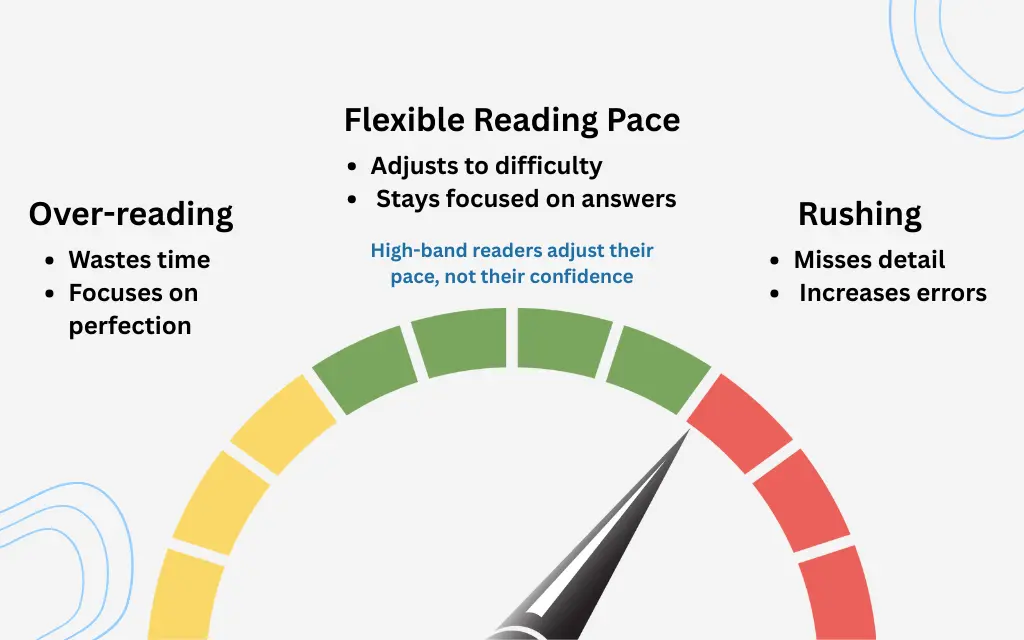
Band 7 readers approach the exam differently.
Thinking Like a High-Band Candidate
They do not try to understand everything.
They do not aim for perfection.
They do not emotionally react to difficulty.
Instead, they stay focused on one goal: finding correct answers efficiently.
When they meet a difficult passage, they slow slightly. When it is easier, they move faster. They constantly adjust.
This flexibility protects both time and accuracy.
How to Read for Meaning, Not Just Keywords
One of the biggest differences between Band 6 and Band 7 readers is how they process text.
From Word Matching to Idea Matching
Lower-band readers search for matching words.
Higher-band readers search for matching ideas.
Consider this example:
Text:
The government reduced expenditure on public transport.
Question:
The state spent less money on buses and trains.
There is no direct word match. Only meaning matches.
Band 7 readers constantly translate ideas, not words.
Developing Strong Skimming and Scanning Skills
Effective reading begins before answering any question.
Using Structure to Save Time
Skimming gives you the structure of the passage.
Scanning helps you locate specific information.
When done properly, skimming allows you to understand topic, paragraph purpose, author’s attitude, and logical flow.
This means you never feel lost.
Scanning then becomes faster because you know where information probably appears.
Together, these skills save enormous time.
Managing Time Like a Band 7 Candidate
Time management is one of the strongest predictors of success.
Smart Time Distribution
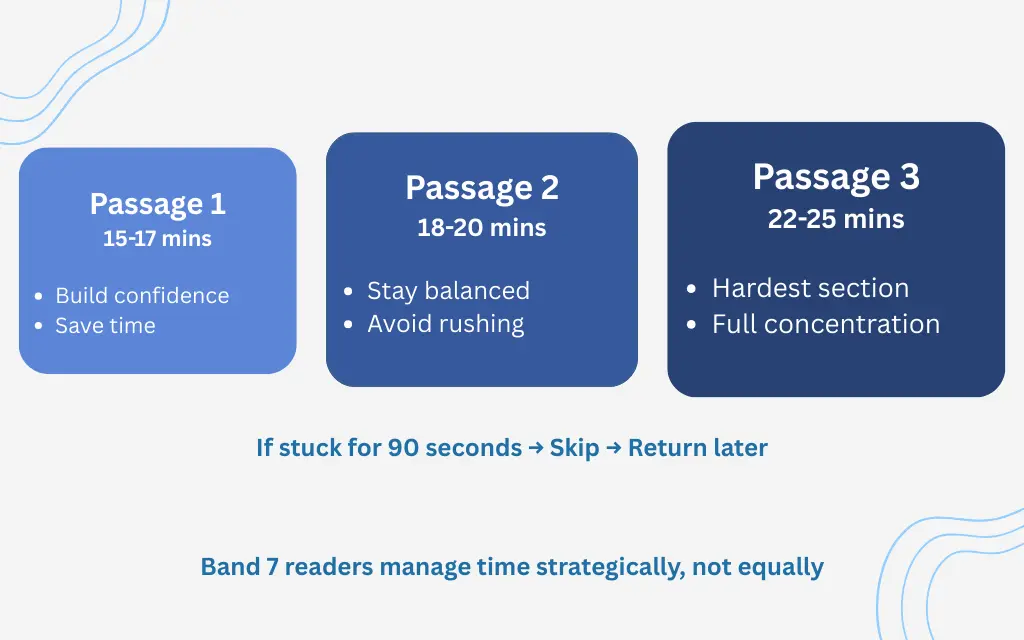
The Reading test gives you 60 minutes for three passages. Each passage becomes harder.
Band 7 candidates do not divide time equally.
They usually spend:
- Slightly less time on Passage 1
- Controlled time on Passage 2
- Maximum focus on Passage 3
More importantly, they avoid getting stuck.
If a question takes more than 90 seconds, they move on and return later.
This prevents panic and preserves energy.
Handling Difficult Vocabulary Without Losing Marks
Unknown vocabulary is unavoidable.
A Three-Step Response to Unknown Words
Band 7 readers use three steps.
First, they decide if the word matters.
Second, they use context.
Third, they move on if meaning is sufficient.
They never stop reading to worry.
For example:
The habitat was severely degraded by industrial activity.
Even if “degraded” is unfamiliar, “severely” and “industrial activity” show negative impact.
That is enough.
Recognising and Avoiding Reading Traps
IELTS questions are carefully designed to mislead careless readers.
Reading Critically, Not Passively
Common traps include:
- Statements that are partly true
- Options using extreme words
- Synonyms that change meaning
- Information from wrong paragraphs
Band 7 candidates ask:
“Does this match exactly?”
“Is this too strong?”
“Is this only partially correct?”
This analytical habit reduces careless mistakes.
Improving Accuracy Through Review and Analysis
Practice alone is not enough.
How High-Scorers Review Tests
After each test, strong candidates analyse:
- Why answers were wrong
- Which traps appeared
- Where time was lost
- Which skills failed
They keep notes and look for patterns.
Over time, weaknesses disappear.
A Weekly Training Structure for Band 7
A balanced weekly routine focuses on quality.
Example Training Framework
A typical structure may include:
- Two full reading tests
- Targeted question practice
- Vocabulary in context
- Strategy review
- Timed sections
More practice is not always better. Better practice is better.
Psychological Control on Exam Day
Many capable readers underperform because of stress.
Staying Calm Under Pressure
Band 7 candidates manage pressure well.
They breathe steadily.
They ignore difficult passages emotionally.
They trust their training.
When something feels hard, they do not panic. They adjust.
This mental control protects performance.
Conclusion
Reaching Band 7 in IELTS Reading is not about working harder. It is about working smarter.
It requires strategic reading, flexible timing, meaning-focused thinking, trap awareness, and consistent review.
When these habits become natural, your score rises.
Related IELTS Reading Lessons
Glossary
Skimming (noun/verb)
Reading quickly to understand overall meaning.
Scanning (noun/verb)
Searching for specific information.
Paraphrasing (noun)
Expressing ideas using different words.
Trap (noun)
A misleading option designed to cause mistakes.
Accuracy (noun)
The ability to choose correct answers consistently.
Practice Questions
- What score range usually represents Band 7?
- True or False: Band 7 readers understand every word.
- Why is skimming important?
- How should you handle time-consuming questions?
- What improves accuracy most?
Answers
- About 30–34 correct answers.
- False.
- It shows structure and topic.
- Skip and return later.
- Careful review and analysis.
Join 1,300+ English learners
Get free English lessons, IELTS tips and useful vocabulary by email.
No spam. Just practical English you can use.