
Introduction to Idea Development in IELTS Task 2 Essays
IELTS candidates feel confident about their English, yet their Task 2 writing score refuses to move beyond Band 6 or 6.5. The grammar is mostly accurate. The vocabulary looks appropriate. The word count is fine. And still, the result disappoints.
In most cases, the problem is not language level. It is IELTS Task 2 idea development.
Examiners often describe these essays as relevant but underdeveloped. The ideas are there, but they stop too early. This lesson will explain what idea development really means in IELTS Task 2, how examiners judge it as part of task response, and how to expand ideas naturally without padding or memorisation.
Practise English every weekday with me
Get short Mon–Fri English practice in LINE with LEW Daily, plus regular feedback to help you improve.
Explore LEW DailyNT$399/month • Cancel anytime

What “Idea Development” Means in IELTS Task 2
Idea development is not about having many ideas. It is about taking one clear idea and doing enough with it.
In Task 2, examiners expect each main idea to be:
- Clearly stated
- Explained
- Supported
When an idea is introduced and then immediately replaced by another, the paragraph feels shallow. When it is explained and illustrated, the paragraph feels complete.
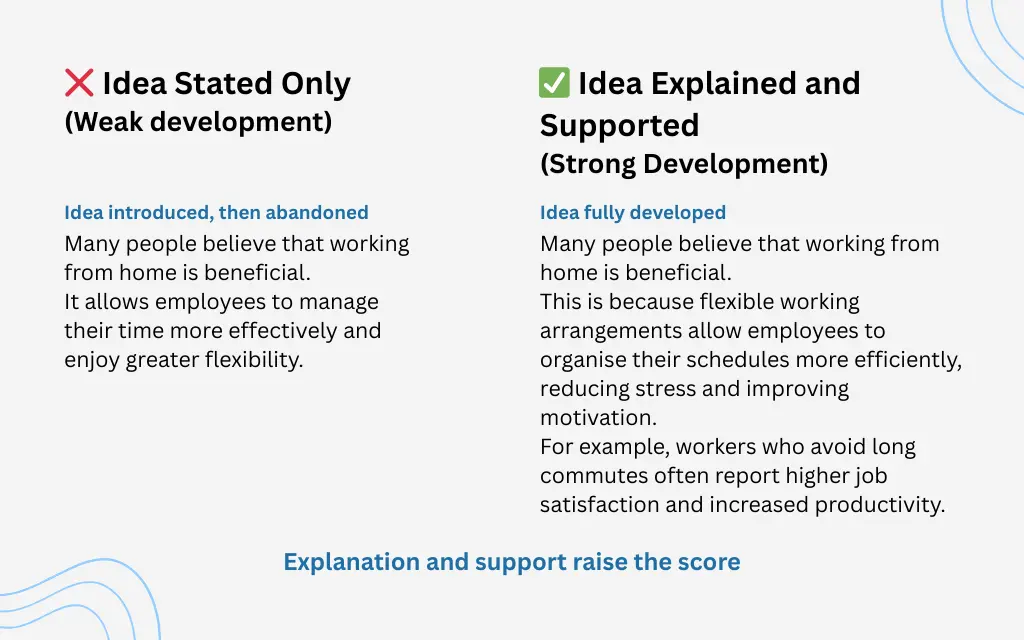
Why Weak Idea Development Caps Scores at Band 6–6.5
Band 6 and 6.5 essays often answer the question, but only on the surface.
Examiners see:
- Short paragraphs with little explanation
- Repeated statements instead of deeper reasoning
- Examples that are vague or irrelevant
This directly affects task response IELTS criteria. The examiner understands what you think, but not why or how.
Stronger bands show depth, not length. One well-developed idea is always better than three underdeveloped ones.
How Examiners Judge Idea Development
Examiners do not count explanations or examples. They judge sufficiency.
They ask themselves:
- Has this point been explained clearly?
- Does the reader understand why this idea matters?
- Is there enough support to make the idea convincing?
If the answer is “not really”, the paragraph feels incomplete, even if the English is accurate.
Common Reasons Ideas Stay Underdeveloped
Many candidates believe they have explained an idea when they have only rephrased it.
For example, a paragraph may restate the same opinion using different words, without adding new information. This creates length without development.
Another common issue is fear. Candidates worry about making mistakes, so they stop early. Ironically, this often lowers the score more than a small grammar error would.
Developing One Idea Properly
Strong idea development usually follows a natural pattern.
First, the idea is clearly introduced. Then it is explained in more detail, often by answering a simple “why” or “how” question. Finally, it is supported with an example or consequence that makes the explanation concrete.
This does not need to sound academic. It needs to sound clear.
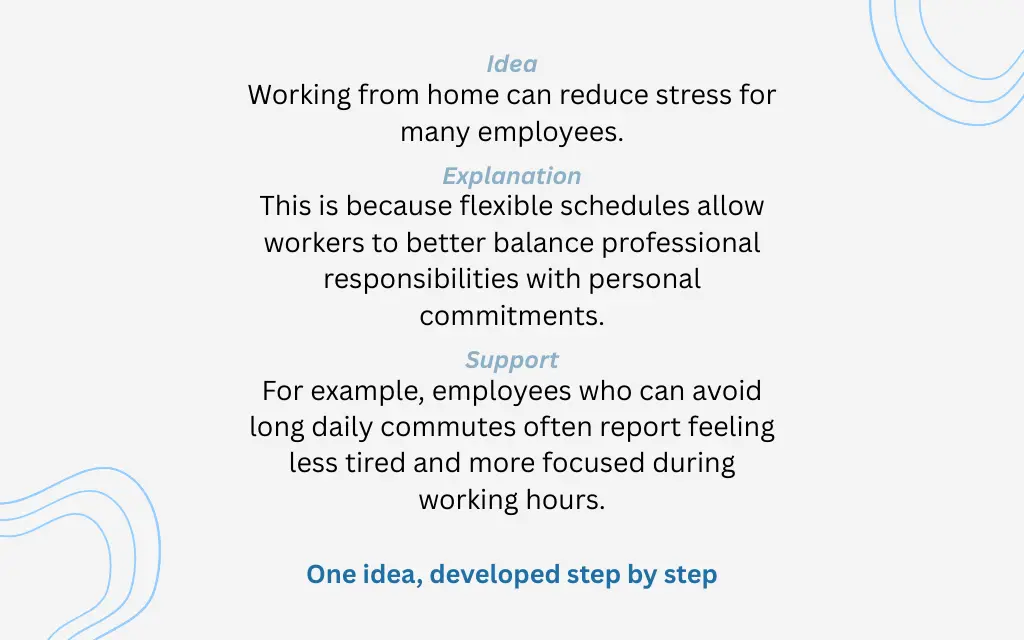
Explanation vs Example: Knowing the Difference
Many IELTS candidates rely too heavily on examples.
Examples alone do not develop ideas. They support explanations. Without explanation, an example feels random or superficial.
For instance, stating an example without explaining why it proves the point leaves the examiner unconvinced. Explanation gives the example purpose.
Balanced paragraphs include both, but explanation always comes first.
Developing Ideas Without Overwriting
Some candidates try to fix weak development by writing very long paragraphs. This often backfires.
Examiners are not impressed by length. They look for clarity and relevance. Overwriting can introduce repetition, unclear references, and grammatical problems.
Effective development is efficient. Each sentence adds something new.
How Idea Development Links to Coherence
Well-developed ideas naturally improve coherence.
When an idea is explained step by step, the paragraph flows logically. When ideas are rushed, coherence suffers because the reader has to guess connections.
This is why improving idea development often raises coherence scores at the same time, without adding extra linking words.
Developing Ideas Across Different Essay Types
Idea development looks slightly different depending on the task, but the principle is the same.
In opinion essays, ideas are developed by justifying your position.
In discussion essays, ideas are developed by exploring reasons on each side.
In problem-solution essays, development comes from explaining causes or effects clearly.
The structure adapts, but the expectation of depth remains constant.
How Planning Affects Idea Development
Underdeveloped ideas often begin with weak planning.
When candidates plan only keywords, they struggle to expand ideas later. Planning should include a direction for development, not just a topic.
A quick plan that includes one reason and one possible explanation for each paragraph makes development much easier during writing.
Reading Your Writing Like an Examiner
A simple way to test idea development is to stop after each paragraph and ask one question: Have I explained this enough for someone who disagrees with me?
If the answer is no, the idea probably needs more development.
This mindset shifts focus away from grammar anxiety and towards communication, exactly what examiners reward.
Typical Band 7 Improvement Pattern
Many candidates reach Band 7 not by learning more vocabulary, but by:
- Writing fewer ideas
- Explaining them more clearly
- Supporting them more precisely
This change often feels uncomfortable at first, but it aligns closely with examiner expectations.
Conclusion
Strong IELTS Task 2 idea development is one of the most reliable ways to break through the Band 6–6.5 ceiling.
By focusing on explanation and support (not memorisation or length) you can meet examiner expectations for task response and produce essays that feel complete, controlled, and convincing.
Related IELTS Task 2 Lessons
Glossary
Idea development (noun) — Expanding and explaining a main point clearly
Task response (noun) — How fully the essay answers the question
Explanation (noun) — Clarifying why or how an idea is valid
Support (noun) — Evidence or examples that strengthen an idea
Underdeveloped (adjective) — Not explained in enough depth
Practice Questions
- True or False: Writing more ideas always improves Task 2 scores.
- Short answer: Why do examiners describe some essays as “underdeveloped”?
- Multiple choice: Which best improves idea development?
A) Adding more linking words
B) Explaining why an idea matters
C) Using advanced vocabulary - True or False: Examples are more important than explanations.
- Short answer: How can planning help idea development?
Answers
- False
- Because ideas are stated but not explained or supported
- B
- False
- By giving direction for explanation before writing
Join 1,300+ English learners
Get free English lessons, IELTS tips and useful vocabulary by email.
No spam. Just practical English you can use.