
Introduction to Task 1 Trend Vocabulary
Many IELTS candidates finish Writing Task 1 feeling confident, only to be surprised by a lower band score than expected. They understood the chart, wrote more than 150 words, and avoided obvious grammar mistakes... so what went wrong?
The answer is usually simple: they do not fully understand how IELTS Task 1 is marked.
Examiners are not reading your response as a teacher correcting homework. They are applying very specific marking criteria, quickly and consistently, to decide which band your writing fits into. Small weaknesses that feel minor to candidates can have a clear impact on the final score.
This lesson explains how IELTS examiners mark Task 1, what they are trained to look for, why candidates lose marks even with “good English”, and how understanding the marking process helps you write more strategically.
Practise English every weekday with me
Get short Mon–Fri English practice in LINE with LEW Daily, plus regular feedback to help you improve.
Explore LEW DailyNT$399/month • Cancel anytime

What Happens When an Examiner Reads Your Task 1 Answer
IELTS examiners follow a standardised system. They do not guess, compare candidates, or adjust scores subjectively. Every Task 1 response is judged using the same official criteria, known as the IELTS writing band descriptors.
When an examiner reads your answer, they are not asking, “Is this impressive?”
They are asking, “Which band does this most closely match?”
This is an important mindset shift. IELTS is a classification system, not a competition. Your job is to show clear evidence that your writing fits the descriptors for a higher band.
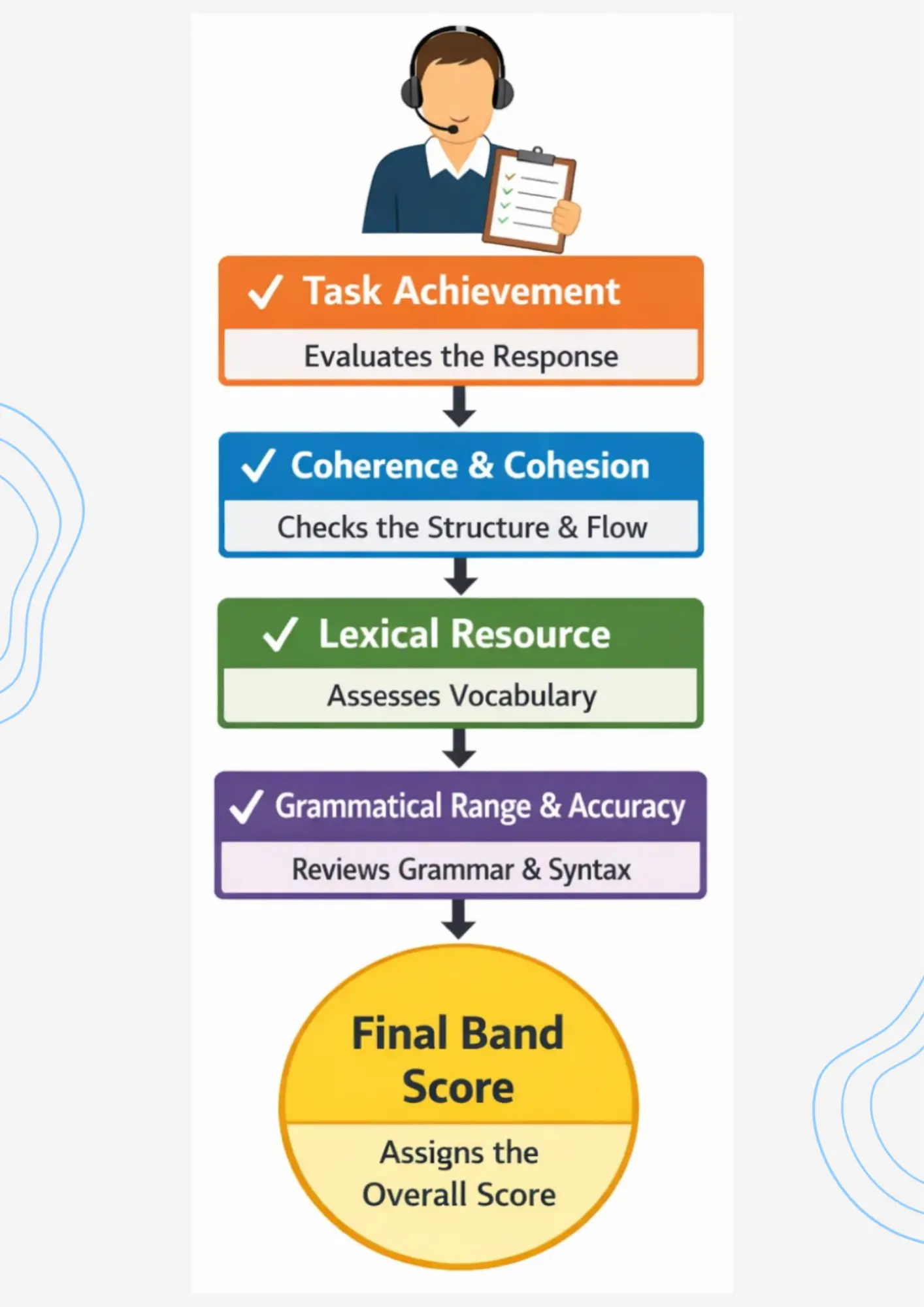
The Four Criteria Used to Mark Task 1
IELTS Task 1 is marked using four equally weighted criteria. Each criterion contributes 25% of the score.
These criteria are:
- Task Achievement
- Coherence and Cohesion
- Lexical Resource
- Grammatical Range and Accuracy
Examiners assess each area separately, then combine them to produce your final Task 1 band score. Strength in one area cannot fully compensate for weakness in another.
Task Achievement: Did You Do What the Task Asked?
Task Achievement is often the main reason candidates remain at Band 6.
Examiners use this criterion to judge whether you:
- Identified the main features
- Presented a clear overview
- Selected relevant data
- Avoided unnecessary detail
Many candidates misunderstand this criterion and assume it refers only to accuracy. In reality, it is about judgement.
A weaker response may describe many details correctly but fail to highlight what matters most. A stronger response guides the examiner by clearly identifying trends, comparisons, or stages.
For example, describing every data point without explaining overall patterns often signals Band 6 performance. Highlighting key changes while ignoring minor fluctuations aligns more closely with Band 7 and above.
This is why missing or weak overviews have such a strong negative impact.
Coherence and Cohesion: How Clearly Is the Information Organised?
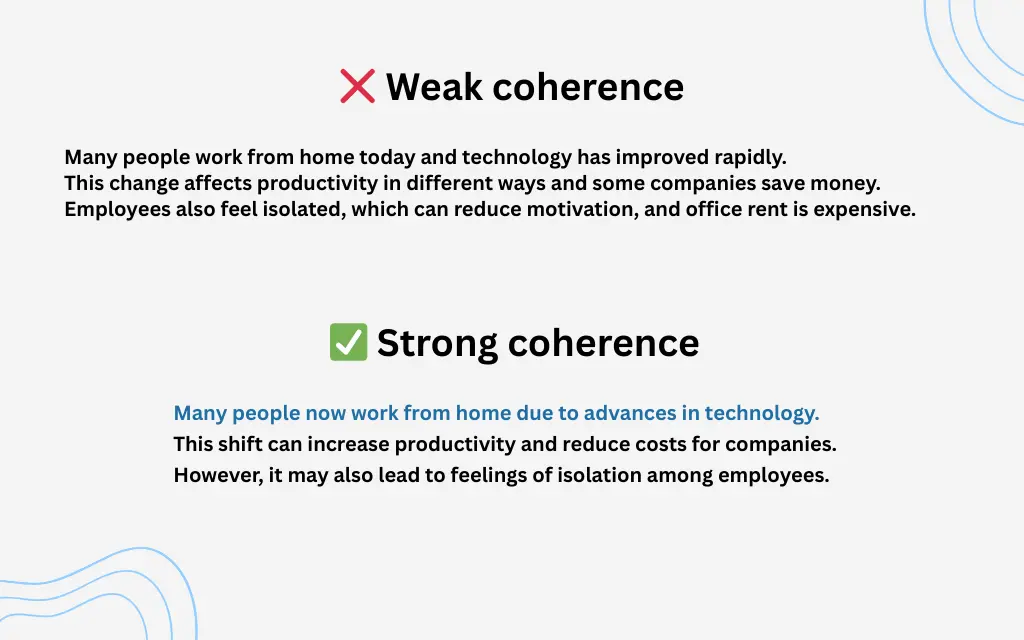
Coherence refers to how logically your ideas are organised. Cohesion refers to how well they are connected.
Examiners are asking:
- Is the information grouped logically?
- Do paragraphs have clear roles?
- Are linking words used naturally, not mechanically?
A common misconception is that more linking words lead to a higher score. In reality, overuse of connectors often makes writing feel forced.
Band 6 writing often includes all the information but presents it in a confusing order. Ideas may jump between time periods or categories, making the report harder to follow.
Band 7+ writing feels calm and predictable. Each paragraph has a clear purpose, and connections between ideas feel natural rather than rehearsed.
Lexical Resource: How Appropriately Is Vocabulary Used?
Lexical Resource is not about using “advanced” vocabulary. It is about range, accuracy, and appropriacy.
Examiners consider whether you:
- Use a suitable range of task-specific vocabulary
- Avoid repetition where possible
- Use words accurately and naturally
In Task 1, vocabulary errors are often subtle. Candidates may use a word that roughly fits the meaning but does not match the data precisely.
For example, exaggerating trends with dramatic vocabulary or misusing words like fluctuate can quietly lower the score.
Band 6 writing often relies on a narrow vocabulary range, especially for trends and comparisons. Band 7 writing shows variety, but only where it fits naturally.
Control matters more than ambition.
Grammatical Range and Accuracy: How Well Is Grammar Controlled?
This criterion causes the most anxiety, but it is also the most misunderstood.
Examiners are not counting errors. They are assessing:
- The range of sentence structures
- How accurately those structures are used
A response with frequent errors in complex sentences may score lower than a response using mostly simple structures accurately.
Band 6 candidates often attempt complex grammar before they can fully control it. Band 7 and Band 8 candidates use a mix of simple and complex sentences, choosing clarity over risk.
Examiners notice when candidates avoid errors by writing clearly and confidently. This signals grammatical control.
How the Final Task 1 Band Score Is Calculated
Each criterion is scored separately, then averaged to produce your Task 1 band score.
For example, a candidate might score:
- Task Achievement: 6
- Coherence and Cohesion: 7
- Lexical Resource: 6
- Grammatical Range and Accuracy: 6
The final Task 1 band would still be 6.
This explains why small weaknesses across multiple areas can prevent improvement, even if no single area feels “bad”.
Understanding this system helps you diagnose problems more accurately.
Why “Good English” Is Not Always Enough
Many candidates believe their English level should guarantee a higher score. However, IELTS writing tests exam performance, not general proficiency.
Candidates with strong spoken English often lose marks because they:
- Include irrelevant detail
- Miss clear overviews
- Write descriptively rather than analytically
Task 1 rewards clarity, selection, and structure more than fluency or creativity.
Once candidates align their writing with examiner expectations, scores often improve quickly, even without learning much new grammar or vocabulary.
How Examiners Are Trained and Standardised
IELTS examiners do not mark independently without guidance. They receive detailed training and regularly standardise their marking using sample scripts.
This ensures consistency across test centres and exam dates.
What this means for candidates is important: there are no surprises. The criteria are stable, predictable, and well documented. If your writing matches the descriptors for a higher band, examiners are trained to recognise it.
Conclusion
Understanding how IELTS Task 1 is marked changes how you prepare and how you write. Instead of guessing what examiners want, you can write with their criteria in mind.
Task Achievement, coherence, vocabulary, and grammar all matter equally. Improvement comes from addressing weaknesses across all four areas, not chasing complexity in one.
To apply this knowledge practically, explore Learn English Weekly’s Task 1 guides on common mistakes, sentence structures, and chart-specific strategies, which show how examiner criteria work in real responses.
Related IELTS Task 1 Lessons
Glossary
Band descriptor (noun) – Official criteria describing each IELTS band
Task Achievement (noun) – How well the task requirements are fulfilled
Coherence (noun) – Logical organisation of ideas
Cohesion (noun) – Use of language to link ideas smoothly
Lexical Resource (noun) – Range and accuracy of vocabulary used
Practice Questions
- True or False: Examiners compare candidates to each other when marking Task 1.
- Which criterion assesses overviews and data selection?
A) Lexical Resource
B) Task Achievement - Why can strong English still result in a low Task 1 score?
- Short answer: Name one criterion related to organisation.
- True or False: Grammar complexity is more important than grammar accuracy.
Answers
- False
- B
- Because the writing does not meet examiner criteria
- Coherence and Cohesion
- False
Join 1,300+ English learners
Get free English lessons, IELTS tips and useful vocabulary by email.
No spam. Just practical English you can use.