
Introduction to Band 7 vs Band 9 IELTS Essays
We all dream of a Band 9 essay. IELTS candidates imagine it is filled with complex vocabulary, flawless grammar, and sophisticated ideas. At the same time, they often feel frustrated with Band 7 writing, believing it is “not good enough” or “too simple”.
The reality is more nuanced. The real differences between band 7 vs band 9 IELTS writing are not about intelligence, memorised phrases, or showing off advanced English. They are about control, consistency, and judgement.
This lesson will explain what genuinely separates Band 7 and Band 9 IELTS Task 2 essays. You will see how examiners interpret band descriptors in practice, why Band 9 writing feels effortless rather than impressive, and why aiming for Band 9 often requires less force, not more.
Practise English every weekday with me
Get short Mon–Fri English practice in LINE with LEW Daily, plus regular feedback to help you improve.
Explore LEW DailyNT$399/month • Cancel anytime

Why Comparing Band 7 and Band 9 Is Often Misunderstood
Band 7 is already a strong score. Essays at this level usually answer the question, show clear organisation, and use a good range of language. Because of this, many candidates assume that Band 9 must simply be “Band 7 plus more”.
This assumption causes problems. Candidates try to push their writing beyond their control by forcing complex grammar, abstract vocabulary, or overly long sentences. Ironically, this often pushes their writing down, not up.
The key difference is not quantity. It is quality under pressure.
How Examiners Use Band Descriptors in Reality
Examiners do not sit with two essays and decide which one sounds more impressive. They assess each script against the band descriptors and ask a simple question for each criterion: How consistently does this performance meet the standard?
Band 7 writing meets the requirements most of the time.
Band 9 writing meets them almost all of the time, with very few weaknesses.
This distinction is subtle but important. Band 9 is not about brilliance. It is about reliability.
A useful visual here would show two progress bars: one labelled “Band 7 – consistent but uneven”, and one labelled “Band 9 – consistent and controlled”.
Task Response: Clear Answer vs Complete Control
In Band 7 essays, the question is usually answered clearly. The writer addresses the task and stays mostly on topic. However, there may be moments where ideas drift slightly or feel underdeveloped.
Band 9 essays go further. They do not just answer the question — they frame it. The writer shows a precise understanding of what is being asked and shapes the essay tightly around that interpretation.
For example, in a question asking for evaluation, a Band 7 essay may describe both sides well. A Band 9 essay does the same, but also makes it clear why those sides matter in relation to the question.
The difference is subtle, but examiners notice it immediately.
Paragraph Development: Adequate vs Fully Resolved
Paragraphs are one of the clearest places to see the difference between bands.
Band 7 paragraphs usually have a clear main idea and some explanation. However, they may feel slightly unfinished. The reader understands the point, but senses there was room to go deeper.
Band 9 paragraphs feel resolved. Each idea is introduced, explained, and supported in a way that feels complete. There is no sense that something important was left unsaid.
This does not mean Band 9 paragraphs are longer. They are often similar in length, but more focused.
Coherence: Logical vs Seamless
Band 7 essays are generally well organised. Paragraphs follow a sensible order, and linking words are used correctly.
Band 9 essays feel seamless. Ideas flow naturally without the reader noticing the structure. Transitions feel intuitive rather than signposted.
One key difference is restraint. Band 9 writers rely less on obvious connectors and more on logical sentence progression. This creates a smoother reading experience.
Examiners associate this ease of reading with very high band scores.
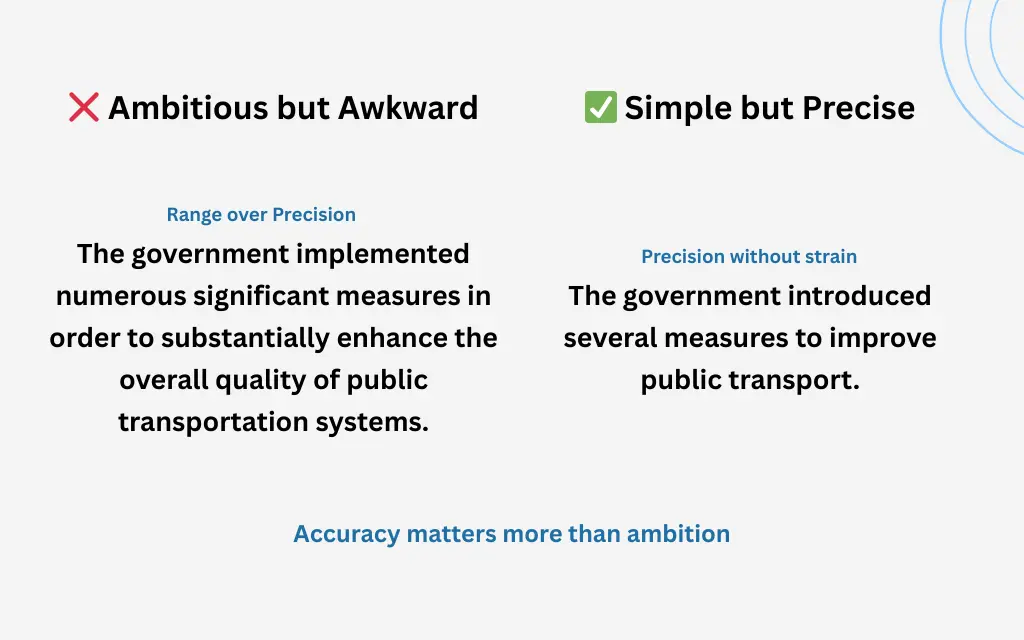
Vocabulary: Range vs Precision
Vocabulary is one of the most misunderstood areas in IELTS writing band comparison.
Band 7 essays often show good lexical range. Writers use a variety of topic-specific words and attempt more advanced expressions. However, these words are sometimes slightly awkward or imprecise.
Band 9 essays prioritise precision over range. The vocabulary is accurate, natural, and perfectly suited to the context. There is very little strain.
This is why Band 9 writing sometimes appears “simple” at first glance. Every word earns its place.
Grammar: Flexibility vs Control
Band 7 grammar is generally accurate, especially in simple and moderately complex sentences. Errors appear more often when the writer attempts complex structures.
Band 9 grammar shows flexible control. Complex sentences are used naturally and selectively, without an increase in errors.
Importantly, Band 9 writers do not try to prove their grammar ability. They use complexity only when it serves clarity. This results in fewer visible mistakes and a calmer tone overall.
Tone: Confident vs Effortless
Tone is difficult to teach, but examiners sense it immediately.
Band 7 writing often sounds confident, but slightly effortful. The reader can feel the writer working hard to maintain quality.
Band 9 writing sounds effortless. Not because it is easy to produce, but because decisions have already been made before writing begins. The writer is not searching for language or structure mid-sentence.
This calm control is one of the strongest signals of Band 9 performance.
Common Myths About Band 9 Essays
Many candidates believe Band 9 essays must:
- Use very advanced vocabulary
- Contain long, complex sentences
- Include original or creative ideas
In reality, none of these are required.
Band 9 essays succeed because they are clear, accurate, and controlled from start to finish. They avoid unnecessary risk.
Understanding this often reduces anxiety and improves writing quality at all levels.
Why Most Candidates Plateau at Band 7
Band 7 is a natural plateau because it rewards effort. Candidates who study hard, practise regularly, and learn essay structures often reach it.
Moving beyond Band 7 requires a shift in mindset. Improvement comes not from adding more, but from removing weakness. This means:
- Fewer forced phrases
- Fewer unnecessary words
- Fewer risky structures
Band 9 is about refinement, not expansion.
What to Aim for Realistically
Not every candidate needs Band 9. For many academic or immigration purposes, Band 7 or 7.5 is more than sufficient.
However, understanding the real differences between bands helps all candidates write better essays. Even aiming towards Band 9 often improves Band 7 performance.
The goal is not perfection. It is consistency under exam conditions.
Conclusion
The real differences between band 7 vs band 9 IELTS writing are not dramatic or mysterious. They are subtle, practical, and rooted in control.
Band 7 essays are strong but slightly uneven. Band 9 essays are calm, precise, and reliable from beginning to end. They don't try to impress, they simply work.
By focusing on clarity, paragraph resolution, precise vocabulary, and controlled grammar, you can move closer to the highest bands without forcing your writing beyond its limits.
To explore this further, review the related Learn English Weekly guides linked below, which break these differences down into practical writing strategies.
Related IELTS Task 2 Lessons
Glossary
Band descriptor (noun) — Official criteria used to assess IELTS writing
Precision (noun) — Accuracy and exactness in language use
Coherence (noun) — Logical flow and organisation of ideas
Control (noun) — Ability to use language consistently and accurately
Plateau (noun) — A stage where progress slows or stops
Practice Questions
- True or False: Band 9 essays must use very advanced vocabulary.
- Which quality most clearly separates Band 9 from Band 7?
A) Length
B) Consistency - Why can forcing complex grammar lower a score?
- Short answer: Name one feature of Band 9 writing.
- True or False: Band 7 is already a strong IELTS score.
Answers
- False
- B
- It reduces control and increases errors
- Precision / control / seamless coherence
- True
Join 1,300+ English learners
Get free English lessons, IELTS tips and useful vocabulary by email.
No spam. Just practical English you can use.