
Introduction to Giving Opinions in IELTS Speaking Part 3
For many candidates, expressing opinions sounds simple until IELTS Speaking Part 3 begins.
This lesson explains why opinions in Part 3 often cause hesitation, unclear answers, or stalled band scores. Candidates may give an opinion but stop too early, overthink their wording, or try to sound academic instead of natural.
IELTS speaking opinions are not about being clever, persuasive, or controversial. They are about clarity, explanation, and control under exam conditions.
We will break down how to give opinions naturally in IELTS Speaking Part 3, what examiners are listening for, and how to avoid the habits that prevent candidates from reaching Band 7.
Practise English every weekday with me
Get short Mon–Fri English practice in LINE with LEW Daily, plus regular feedback to help you improve.
Explore LEW DailyNT$399/month • Cancel anytime

Why opinions matter in IELTS Speaking Part 3
Part 3 exists to assess higher-level speaking skills.
Unlike Part 1, which focuses on familiar topics, Part 3 requires you to:
- express viewpoints
- justify ideas
- respond to broader, less personal questions
This is why giving opinions in IELTS Speaking Part 3 closely overlaps with Writing Task 2 logic. The thinking skills are very similar, but the language must sound spoken rather than written.
What examiners actually listen for in opinion answers
Examiners do not judge whether your opinion is correct or impressive.
They listen for:
- a clear position
- logical explanation
- ability to extend ideas naturally
A simple opinion explained clearly will always score higher than a complex opinion expressed awkwardly.
Why candidates struggle with expressing opinions
Most problems come from incorrect assumptions.
Many candidates believe:
- opinions must sound academic
- strong opinions score higher than balanced ones
- longer answers are always better
None of these beliefs reflect how IELTS Speaking is marked. Part 3 rewards controlled discussion, not speeches.
Having an opinion vs developing one
Giving an opinion is only the starting point.
In IELTS Speaking Part 3, examiners expect you to develop your opinion by explaining:
- why you think that way
- what effect it has
- whether there are limits or exceptions
This development is what separates Band 6 from Band 7 performance.
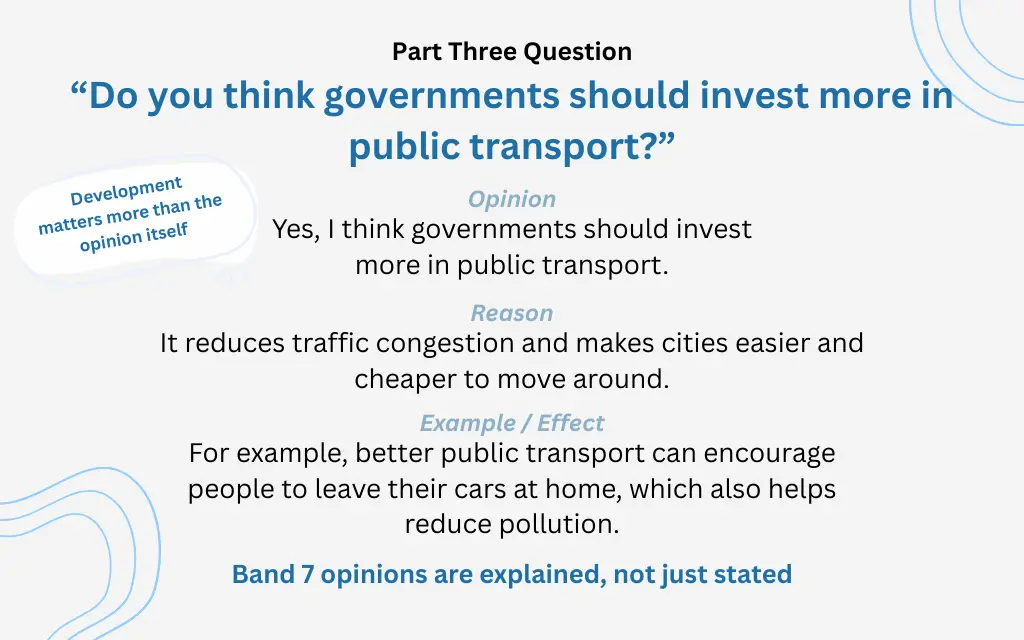
A natural structure for IELTS speaking opinions
You do not need a rigid template, but strong opinion answers usually follow a clear pattern:
- Give a direct opinion
- Explain your reasoning
- Add a short supporting idea, example, or consequence
This structure mirrors natural conversation and works for most Part 3 questions.
Common opinion question forms in Part 3
Opinion questions often begin with:
- “Do you think…”
- “In your view…”
- “Would you agree that…”
Although the wording changes, the task remains the same. You must take a position and explain it.
Strong vs weak opinion responses
Weak opinion responses often stop too early.
For example:
“I think it’s important.”
A stronger response develops the idea:
“I think it’s important because it influences how people make long-term decisions, especially in education and work.”
The improvement comes from explanation, not vocabulary.
Agreeing and disagreeing naturally
You do not need to fully agree or fully disagree.
Balanced opinions sound realistic and allow natural explanation. Partial agreement helps you explore ideas without sounding uncertain or confused.
Handling unfamiliar or difficult topics
You may be asked about topics you have never considered before.
This does not require expert knowledge. You can:
- generalise
- speak from observation
- explain uncertainty calmly
Examiners value how you manage uncertainty more than what you know.
Avoiding memorised opinion language
Examiners are trained to recognise memorised expressions.
Over-polished phrases often sound unnatural in spoken English. Clear, simple phrasing delivered confidently is far more effective in IELTS Speaking.
Linking opinions to real-world thinking
Strong Part 3 answers often sound practical rather than theoretical.
Candidates explain opinions by connecting them to:
- everyday behaviour
- social trends
- personal observation
This creates a controlled, authentic response.
Extending opinions without rambling
A common concern is speaking too little or too much.
A good rule is to explain one idea clearly, then stop. Once your point is developed, the examiner will guide the conversation forward.
Responding when the examiner challenges your opinion
Follow-up questions are normal.
They are not criticism. They allow you to:
- clarify your view
- adjust your position slightly
- acknowledge another perspective
This flexibility is a strong Band 7 signal.
How opinions in Part 3 differ from Part 2
In Part 2, you speak alone and organise a short talk.
In Part 3, opinions are interactive. You respond, explain, and adapt based on the examiner’s prompts. Treat it as a discussion, not a speech.
Common mistakes that lower opinion scores
The most damaging mistakes include:
- giving opinions without explanation
- trying to sound academic
- memorising opinion phrases
- panicking when unsure
All of these reduce clarity and fluency.
Practising IELTS speaking opinions effectively
Effective practice focuses on thinking, not memorisation.
Useful practice includes:
- answering unfamiliar questions aloud
- explaining one idea in two or three sentences
- recording and listening for clarity
This builds confidence and control over time.
Conclusion
Giving opinions in IELTS Speaking Part 3 is not about sounding impressive.
It is about expressing ideas clearly, explaining your reasoning, and responding calmly to follow-up questions. If you can explain why you think something in a natural, organised way, you already have the core skill this part of the test is designed to assess.
Related IELTS Speaking Lessons
Comprehension & Practice Questions
- True or False: IELTS Speaking Part 3 opinions must sound academic.
- Multiple choice: What matters most in an opinion answer?
A) Vocabulary complexity
B) Accent
C) Clear explanation - Short answer: Why are balanced opinions useful in Part 3?
- True or False: Examiners judge whether your opinion is correct.
- Short answer: What is one effective way to practise opinion answers?
Answers
- False
- C
- They sound natural and allow explanation
- False
- Practising unfamiliar questions aloud
Join 1,300+ English learners
Get free English lessons, IELTS tips and useful vocabulary by email.
No spam. Just practical English you can use.