
Introduction to IELTS Listening Section 4
If you are aiming for Band 7 or above in Listening, Section 4 is often the decisive stage.
Many candidates perform well in Sections 1 and 2. Some manage Section 3 with preparation. But IELTS Listening Section 4 frequently determines whether your final score rises, or remains just below your target.
This lesson explains how section 4 listening IELTS works, why it feels more demanding than earlier sections, and how to approach it strategically rather than reactively. Once you understand its structure, it becomes significantly more predictable.
Practise English every weekday with me
Get short Mon–Fri English practice in LINE with LEW Daily, plus regular feedback to help you improve.
Explore LEW DailyNT$399/month • Cancel anytime

Why Section 4 Is a High-Band Differentiator
Section 4 tests sustained listening comprehension.
You must:
- Follow extended explanations
- Recognise academic structure
- Understand denser vocabulary
- Maintain concentration for several minutes
There are no conversational cues such as agreement or correction to guide you. The lecturer may introduce a concept, define it, provide evidence, compare it with another idea, and move on without clearly repeating the key phrase.
Stronger candidates recognise organisation. Weaker candidates attempt to listen word by word and quickly fall behind. The difference is not vocabulary size alone. It is structural awareness.
Understanding Academic Lecture Listening
In section 4 listening IELTS, information is usually organised logically.
A lecture often follows a clear progression:
- Introduction to the topic
- Definition of key terms
- Explanation of main ideas
- Supporting evidence or examples
- Brief conclusion
If you recognise this structure, you can anticipate answers.
For example:
“Today we will examine three major causes of urban migration.”
Immediately, you expect three separate points. If the question sheet shows three gaps under that heading, you already know how the lecture will unfold.
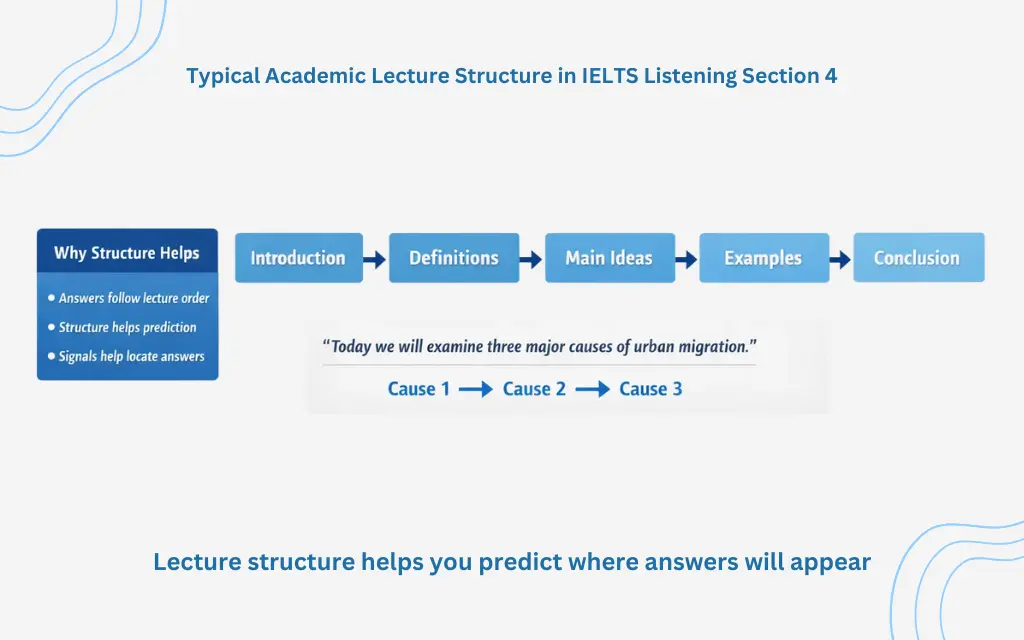
This reinforces how answers mirror lecture organisation.
Common Question Types in IELTS Listening Section 4
Section 4 most commonly includes note completion, sentence completion, or summary completion tasks.
The layout of the notes usually reflects the structure of the lecture. This is deliberate. Examiners are not testing memory randomly. They are assessing your ability to follow structured academic speech.
Spelling and word limits are especially important here. If the instruction states “NO MORE THAN TWO WORDS”, exceeding that limit results in losing the mark, even if the content is correct.
Precision becomes crucial at higher bands.
The Real Challenge: Information Density
Many students describe Section 4 as “too fast”. In reality, the speed is similar to earlier sections. The difficulty comes from information density.
Academic lectures include:
- Complex noun phrases
- Abstract vocabulary
- Cause-and-effect relationships
- Formal transitions
For example:
“A significant contributing factor to rural decline has been the gradual reduction in agricultural employment opportunities.”
If the answer required is “reduction in agricultural employment”, you must identify it within a longer, formal sentence.
Listening for meaning, rather than individual words, is essential.
Recognising Signposting Language
Effective lecturers organise their ideas clearly. They signal transitions using structured language.
Common signposts include:
- Firstly
- Another key factor
- In contrast
- It is important to note
- To summarise
These signals indicate that important information is about to follow. When you train yourself to recognise signposting, you begin to anticipate answers rather than chase them.
Avoiding Subtle Distractors
Distractors in IELTS Listening Section 4 are more conceptual than in earlier sections.
The lecturer may refer to older theories before presenting the current conclusion.
For example:
“Early researchers assumed economic growth was the primary cause. However, recent data suggests population density plays a more significant role.”
If the question asks for the current conclusion, the answer is “population density”.
The word “however” signals the shift. Contrast words often introduce the correct answer. Listening for these transitions is critical.
Managing Concentration During the Lecture
Section 4 demands sustained focus.
There are no natural breaks between speakers. If concentration slips for even a few seconds, you may miss consecutive answers.
To maintain control:
Keep your attention on the current question.
Avoid reading too far ahead.
If you miss one answer, refocus immediately rather than mentally replaying what you missed. Recovery is part of effective exam technique.
How Section 4 Influences Your IELTS Listening Band Score
Section 4 frequently determines whether candidates reach Band 7 or higher.
Lower-band candidates often lose several marks in this section because they struggle with structure and sustained attention.
High-band candidates are not perfect listeners.
They are organised listeners. They anticipate patterns, recognise transitions, and understand how ideas develop logically.
When you strengthen these skills, your overall IELTS listening band score improves significantly.
A Practical Strategy for IELTS Listening Section 4
Before the recording begins:
Study headings carefully.
Identify patterns in numbering or grouping.
If three points are listed, expect three main ideas.
During the lecture:
Listen for transition phrases.
Write answers clearly and within the word limit.
Move forward immediately after each answer.
Section 4 rewards calm, structured listening rather than frantic note-taking.
Conclusion
IELTS Listening Section 4 presents an academic lecture designed to test sustained comprehension.
It feels demanding because:
- There is only one speaker
- The speech is continuous
- Information is dense and structured
- Distractors are subtle
However, when you understand lecture organisation and signposting language, Section 4 becomes manageable rather than intimidating.
To continue strengthening your Listening skills, explore:
- IELTS Listening Section 3 Explained
- Common IELTS Listening Mistakes
- How IELTS Listening Is Marked
Progress at higher bands comes from structural awareness, not memorised shortcuts.
Related IELTS Listening Lessons
-
- IELTS Listening – Complete Guide to Sections and Question Types
- Sentence Completion in IELTS Listening
- Distractors in IELTS Listening (Why Answers Change)
- IELTS Listening – Complete Guide to Sections and Question Types
Glossary
Academic Lecture (n.)
A formal university-style talk.
Signposting (n.)
Words or phrases that indicate structure in speech.
Density (n.)
A high concentration of information in a short space.
Contrast (n.)
A difference between ideas, often signalled by words such as “however”.
Band Score (n.)
Your IELTS score from 1 to 9.
Practice Section
(MCQ) IELTS Listening Section 4 involves:
A. A phone conversation
B. A group discussion
C. An academic lecture
D. A map description
(True/False) Section 4 contains pauses between speakers.
(Short Answer) Why is signposting language important in Section 4?
(MCQ) Which word often signals a change in idea?
A. Firstly
B. However
C. Also
D. Similarly
(True/False) Section 4 often determines whether candidates reach Band 7 or higher.
Answers
C
False
It helps you recognise structure and anticipate important information.
B
True
Join 1,300+ English learners
Get free English lessons, IELTS tips and useful vocabulary by email.
No spam. Just practical English you can use.