
Introduction to IELTS Speaking Part 3
For many candidates, confidence drops as soon as IELTS Speaking Part 3 begins.
The questions feel less familiar, the topics become more general, and the examiner appears to stop supporting the conversation. This lesson explains why that shift happens and what Part 3 is actually designed to test.
IELTS Speaking Part 3 is not a separate test or a trick section. It extends the conversation from Part 2 and gives you the opportunity to show higher-level speaking skills, particularly your ability to explain, compare, and discuss ideas calmly.
This lesson breaks down how IELTS speaking Part 3 works, how discussion questions are structured, and how to respond clearly without sounding memorised or uncertain.
Practise English every weekday with me
Get short Mon–Fri English practice in LINE with LEW Daily, plus regular feedback to help you improve.
Explore LEW DailyNT$399/month • Cancel anytime

What IELTS Speaking Part 3 is really testing
IELTS Speaking Part 3 follows directly from Part 2, but the task changes.
In Part 2, you speak independently about one topic. In Part 3, you discuss broader ideas related to that topic with the examiner.
The aim is not to give expert or academic opinions. Examiners are listening for whether you can:
- respond to abstract questions
- explain and justify ideas
- keep a discussion going naturally
This is why Part 3 often has a strong influence on Band 7 and above.
Why Part 3 feels harder than Parts 1 and 2
Part 3 feels more difficult because familiar support disappears.
There is no cue card, and the questions are no longer about your personal life. Instead, you are asked to think more generally.
This change is deliberate. Examiners want to hear how you handle:
- opinions
- comparisons
- causes and effects
- future possibilities
The challenge is conceptual rather than linguistic.
How Part 3 questions connect to Part 2
Part 3 questions are not random.
They are logically linked to your Part 2 topic. If you spoke about a place, Part 3 might explore cities, tourism, or development. If you spoke about education, Part 3 may focus on social attitudes or change over time.
Recognising this connection helps you stay focused and reduces surprise.
Common types of IELTS Speaking Part 3 questions
Although the wording changes, most Part 3 questions follow familiar patterns.
You may be asked to:
- give an opinion
- compare past and present
- discuss advantages and disadvantages
- explain causes or effects
- speculate about the future
Once you recognise the pattern, the thinking process becomes predictable.
Why “abstract questions” cause anxiety
Candidates often panic when they hear the term abstract.
In practice, abstract simply means less personal. You are not expected to sound academic or technical. You are expected to explain ideas logically in spoken English.
An abstract question is still a conversation prompt, not a theory test.
How examiners listen in Part 3
Examiners are not checking facts or knowledge.
They listen for:
- clear opinions
- logical explanation
- ability to respond without long hesitation
They also notice whether you can extend answers naturally rather than stopping after one sentence. Explanation matters more than complexity.
The biggest mistake candidates make in Part 3
The most common mistake is trying to sound advanced.
Candidates often use memorised phrases or overly formal language because they believe Part 3 requires it. This usually reduces clarity and fluency.
Examiners consistently prefer clear, natural discussion to impressive but forced language.
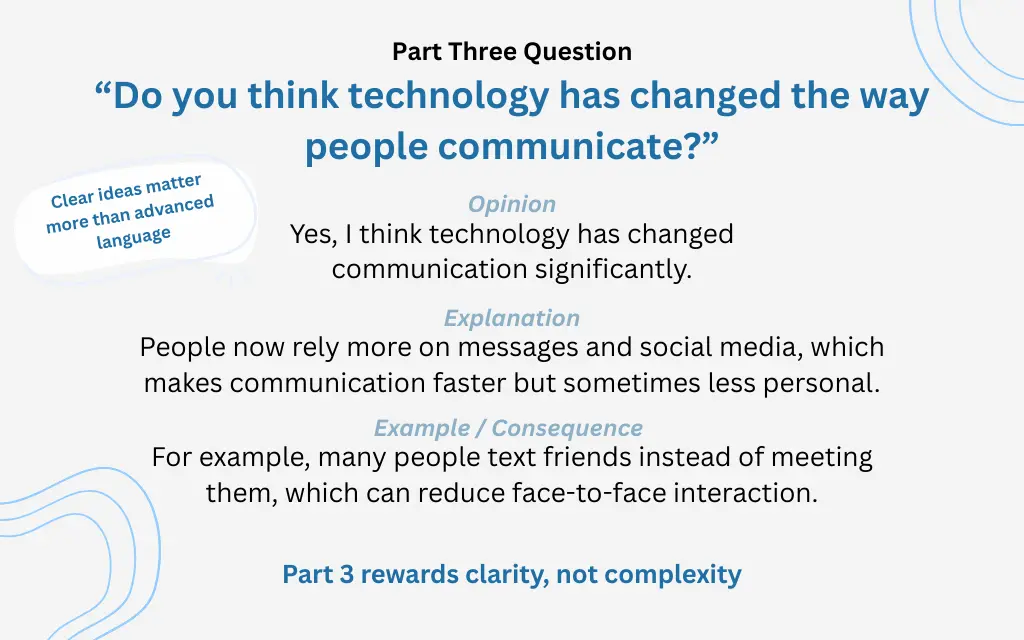
A natural structure for Part 3 answers
You do not need a rigid template, but strong answers usually include three elements:
- a clear position or idea
- an explanation or reason
- a short example or consequence
This structure mirrors real conversation and works for almost any Part 3 question.
Answering opinion questions confidently
Opinion questions often begin with phrases such as:
- “Do you think…”
- “In your opinion…”
- “Would you say that…”
The key is to answer directly first, then explain. A simple opinion supported with reasoning scores higher than a vague or over-developed response.
Comparing past and present effectively
Comparison questions are very common in Part 3.
A safe approach is to:
- describe one clear difference
- explain why the change happened
- mention one effect of the change
You do not need to cover every aspect or time period.
Talking about the future without guessing
Future questions worry candidates because they feel uncertain.
IELTS does not test prediction accuracy. It tests how you express possibility. Using cautious language such as “it’s likely” or “it may become” sounds natural and appropriate.
What to do if you do not understand a question
You are allowed to ask for clarification.
This does not lower your score. It shows communication awareness. Asking politely for repetition is always better than guessing and answering off-topic.
How long Part 3 answers should be
Part 3 answers should be longer than Part 1 but shorter than Part 2.
A good response usually includes:
- one main idea
- extended explanation
- a natural pause for the examiner to continue
You do not need to fill silence. The examiner controls the discussion.
Handling follow-up questions calmly
Examiners may challenge your answer or ask follow-up questions.
This is normal and does not mean your answer was wrong. Treat follow-ups as opportunities to explain further, not as criticism.
Why Part 3 separates Band 6 from Band 7+
Candidates around Band 6 often answer Part 3 questions briefly.
Candidates at Band 7 and above:
- explain ideas clearly
- connect points logically
- speak with calm confidence
The difference is depth of response, not vocabulary level.
Practising IELTS Speaking Part 3 effectively
Effective practice focuses on thinking rather than memorisation.
Useful practice includes:
- answering unfamiliar questions aloud
- explaining one idea in two or three sentences
- recording and reviewing your answers
This builds flexibility and confidence over time.
Conclusion
IELTS Speaking Part 3 is not an academic debate.
It is a guided discussion that allows you to show how well you can explain ideas, respond thoughtfully, and keep a conversation moving. When you focus on clear explanation rather than trying to impress, Part 3 becomes far easier to manage.
If you can explain one idea calmly and logically, you already meet the core requirements of this section.
Related IELTS Vocabulary Lessons
Glossary
Abstract question (noun) — a question about general ideas rather than personal experience
Discussion (noun) — an exchange of ideas with explanation and response
Follow-up question (noun) — a question that builds on a previous answer
Opinion (noun) — what someone thinks about an issue
Speculation (noun) — talking about possible future situations
Comprehension & Practice Questions
- True or False: IELTS Speaking Part 3 tests factual knowledge.
- Multiple choice: What is the main difference between Part 2 and Part 3?
A) Accent
B) Topic difficulty
C) Level of abstraction - Short answer: What should you do first when answering an opinion question?
- True or False: Asking for clarification lowers your band score.
- Short answer: Why does Part 3 affect higher band scores more?
Answers
- False
- C
- Give a clear opinion
- False
- Because it tests explanation and depth of ideas
Join 1,300+ English learners
Get free English lessons, IELTS tips and useful vocabulary by email.
No spam. Just practical English you can use.