Introduction to Matching Headings in IELTS Reading
IELTS candidates sometimes leave the Reading test feeling confident about their vocabulary and grammar, yet disappointed by their final score.
Very often, the reason is Matching Headings questions.
Students frequently say that they understood the passage, recognised most of the words, and still lost several marks in this section. This can feel especially frustrating because the task looks simple at first.
In reality, matching headings IELTS questions are not about understanding individual sentences. They are about recognising main ideas.
This lesson breaks down how examiners design matching headings tasks, how you can identify paragraph purpose, and how to avoid the traps that cause unnecessary mistakes.
Once you understand what the task is really testing, it becomes logical rather than confusing.
Practise English every weekday with me
Get short Mon–Fri English practice in LINE with LEW Daily, plus regular feedback to help you improve.
Explore LEW DailyNT$399/month • Cancel anytime

Why Matching Headings Feels So Difficult
At first glance, this task looks straightforward. You read a paragraph and choose a heading.
But several skills are being tested at the same time.
You must decide what the paragraph is mainly doing, ignore examples and background information, compare similar-looking headings, and resist attractive distractors.
Many candidates focus too much on vocabulary and detail. As a result, they miss the overall message.
This is why even strong readers struggle with this task.
What Matching Headings Questions Really Test
Before learning techniques, it is important to understand the examiner’s purpose.
These questions are designed to test whether you can recognise central themes, summarise information accurately, and distinguish main points from minor points.
They do not test speed reading. They do not test memory. They test conceptual understanding.
If you treat this task as “find similar words”, you will lose marks.
Examiners reward candidates who understand what the writer is doing in each paragraph.
How Matching Headings Questions Are Designed
Examiners follow clear patterns when creating this task.
Each paragraph is written with one dominant idea. Supporting details are added to explain, illustrate, or develop that idea.
Headings are then created to reflect possible interpretations. Some headings paraphrase the main idea accurately. Others match only part of the paragraph. Some include misleading keywords.
Only one heading fits the paragraph completely.
When you understand this design process, you stop guessing and start analysing.
A Reliable Method for Matching Headings
A clear method removes confusion and saves time.
Reading the Headings First
Begin with the list of headings. Read them carefully and try to understand the theme of each one. Do not match anything yet.
You are building an overview of possible ideas.
Identifying Key Concepts
Notice the main concept in each heading.
For example, “causes”, “effects”, and “solutions” describe very different purposes, even if they share vocabulary.
Recognising this early helps you avoid confusion later.
Reading the Paragraph for Purpose
When you read a paragraph, do not search for matching words.
Ask yourself what the writer is mainly doing. Are they explaining a problem, comparing ideas, describing change, or presenting evidence?
This question is more important than vocabulary.
Ignoring Supporting Material
Most paragraphs include statistics, examples, stories, or research findings.
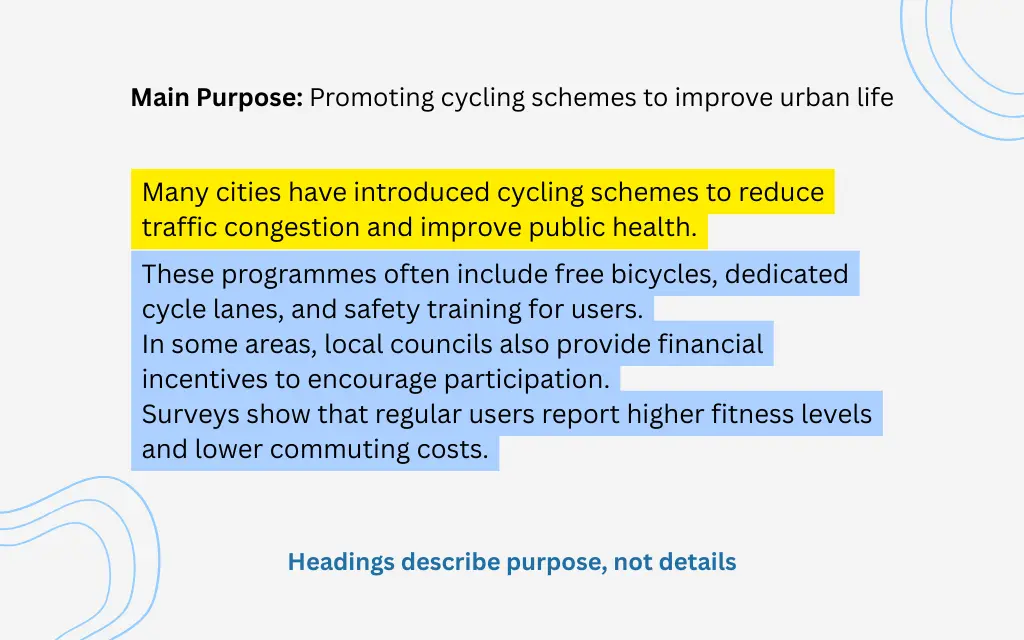
These exist to support the main idea. They are not the main idea.
Headings describe purpose, not evidence.
Matching Using Overall Meaning
Choose the heading that summarises the whole paragraph.
Not half of it. Not one sentence. All of it.
If a heading fits only part of the paragraph, it is wrong.
Main Ideas and Supporting Details
Understanding the difference between main ideas and details is central to this task.
Consider this example:
“The company expanded rapidly in Asia during the 1990s. It opened offices in Singapore, Seoul, and Tokyo. By 2000, profits had doubled.”
The main idea is geographical expansion. The cities and profits are supporting details.
A heading about financial growth may seem tempting, but it misses the paragraph’s real focus.
Strong candidates always prioritise purpose over facts.
Why Keyword Matching Leads to Mistakes
Many candidates match vocabulary instead of meaning.
For example:
Paragraph: “Children today spend less time outdoors.”
Heading: “The importance of outdoor activity”
Both contain similar words, but the paragraph describes a problem. The heading expresses value.
The meanings do not match.
This type of mistake happens when students focus on surface language instead of intention.
Common Traps in Matching Headings Tasks
Examiners use predictable traps.
One trap involves partial matches. A heading fits part of the paragraph but ignores another key point.
Another involves example-based matches. The heading describes an illustration rather than the main idea.
Some headings reverse meaning using similar vocabulary. Others reuse themes across several paragraphs with different focuses.
Recognising these patterns improves accuracy quickly.
Managing Time in Matching Headings Questions
This task can consume too much time if you are not careful.
Strong candidates match clear paragraphs first and leave difficult ones for later. They avoid forcing decisions too early.
Often, later paragraphs provide context that makes earlier matches clearer.
Patience saves time in the long run.
Example Walkthrough
Consider this paragraph:
“In recent years, online education has grown rapidly. Universities now offer degrees through digital platforms, making learning more accessible.”
Possible headings include problems of online learning, expansion of digital education, and traditional university systems.
The paragraph focuses on growth and access. It is about expansion. The correct answer is “Expansion of digital education”.
This decision comes from meaning, not keywords.
Paraphrasing in Headings
Headings rarely repeat wording from the passage.
Instead, they paraphrase.
For example, “a sharp decline in wildlife” may become “loss of biodiversity”.
Training yourself to recognise these relationships makes matching easier and faster.
Building Accuracy Through Practice
Random practice leads to slow improvement.
Better progress comes from focused training. Spend time practising main idea identification, paraphrase recognition, and timed exercises separately.
Accuracy should come before speed.
When understanding becomes automatic, speed follows naturally.
Psychological Control in the Test
Many errors occur because of anxiety.
Candidates doubt correct answers and change them unnecessarily.
If your choice is based on clear reasoning, trust it.
Second-guessing often causes more harm than mistakes.
How Examiners Mark Matching Headings
Markers follow strict rules.
They accept only headings that accurately summarise paragraph purpose.
“Almost right” answers are marked wrong.
This is why precision matters more than impression.
Developing Long-Term Mastery
With consistent practice, you begin to recognise common structures such as problem–solution, cause–effect, and comparison patterns.
At this stage, matching becomes intuitive rather than stressful.
You are no longer translating. You are interpreting.
Conclusion
Matching Headings questions are challenging because they test understanding of ideas rather than words.
When you learn to identify purpose, ignore detail, and compare meanings carefully, your accuracy improves quickly.
With the right approach, this task becomes one of the most manageable parts of IELTS Reading.
Related IELTS Reading Lessons
Glossary
Heading (noun) — a short title summarising a paragraph
Main idea (noun) — the central message of a text
Paraphrase (verb) — express meaning using different words
Detail (noun) — supporting information
Theme (noun) — the main topic or concept
Comprehension & Practice Questions
True or False: Matching Headings mainly tests vocabulary knowledge.
Multiple choice: What should you focus on most?
A) Keywords
B) Examples
C) Main ideas
Short answer: Why are examples usually ignored?
True or False: Partial matches are acceptable.
Short answer: What should you do if you are unsure?
Answers
False
C
Because they support the main idea but do not define it
False
Skip and return later
Join 1,300+ English learners
Get free English lessons, IELTS tips and useful vocabulary by email.
No spam. Just practical English you can use.