
Introduction to Sentence Complexity for IELTS Writing
IELTS candidates believe that higher scores require longer sentences, heavier grammar, and more complicated structures. As a result, they often try to “sound advanced” by forcing complexity into every paragraph. Unfortunately, this approach usually leads to more errors and lower confidence from examiners.
The truth is that sentence complexity IELTS writing is not about showing off grammar. It is about control. Examiners are not impressed by complicated sentences that barely work. They are impressed by writing that uses complexity when it is needed and simplicity when it is clearer.
This lesson will explain what sentence complexity really means in IELTS writing, how examiners interpret grammar range, and how to use complex sentences without damaging accuracy or clarity.
Practise English every weekday with me
Get short Mon–Fri English practice in LINE with LEW Daily, plus regular feedback to help you improve.
Explore LEW DailyNT$399/month • Cancel anytime

What Sentence Complexity Actually Means in IELTS
Sentence complexity refers to how ideas are connected inside a sentence. A sentence becomes complex when it includes more than one idea, relationship, or clause.
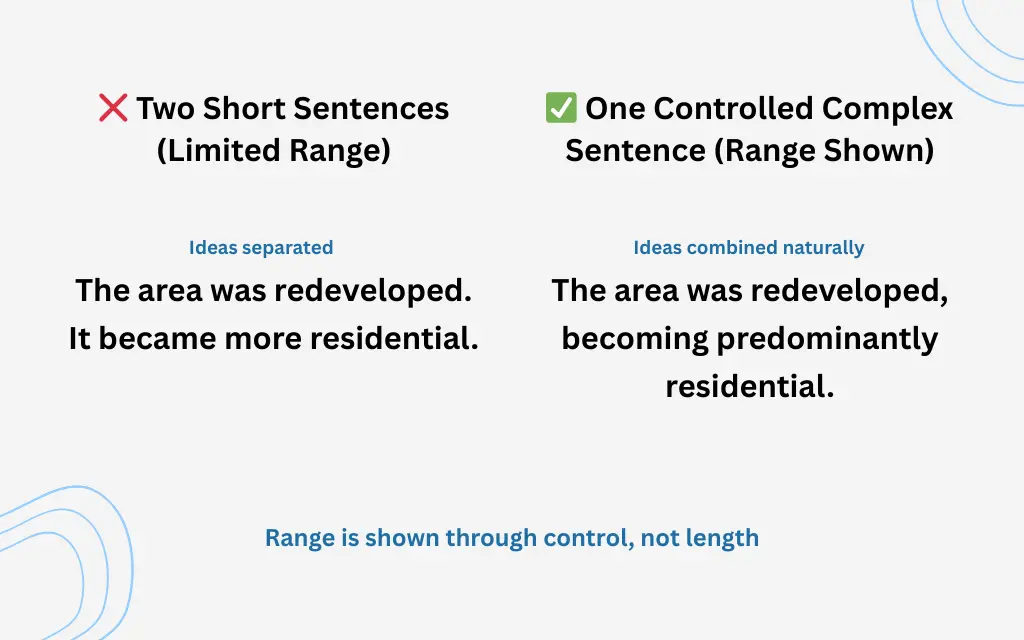
In IELTS, complexity is not measured by sentence length. A short sentence can be complex, and a long sentence can be simple. What matters is whether ideas are logically linked and grammatically controlled.
Examiners look for a mix of sentence types across your writing. This mix shows flexibility and confidence rather than mechanical repetition.
How Sentence Complexity Is Assessed by Examiners
Sentence complexity is assessed under Grammatical Range and Accuracy, but it also affects Coherence and Cohesion.
Examiners ask two key questions:
- Can the candidate use a range of sentence structures?
- Can they do so without frequent breakdowns?
This means complexity is valuable only when it remains accurate. When errors increase as complexity increases, examiners become cautious about awarding higher bands.
Simple Sentences Are Not a Problem
One of the biggest misconceptions in IELTS writing is that simple sentences are “bad”.
Simple sentences are essential. They allow ideas to land clearly and give the reader time to process information. Strong writers use simple sentences deliberately, often after more complex ones.
For example, explaining a trend or making a conclusion often benefits from clarity rather than complexity.
Examiners do not penalise simple sentences. They penalise monotony: using only one sentence type throughout an essay.
What Makes a Sentence “Complex” in IELTS Terms
A sentence becomes complex when it connects ideas using:
- Cause and effect
- Contrast
- Conditions
- Time relationships
- Explanations
These connections usually appear naturally when ideas are developed properly. They do not need to be forced.
A complex sentence that clearly shows a relationship between ideas often scores higher than several short sentences that feel disconnected.
Complex Sentences and Grammar Range
Grammar range IELTS writing is demonstrated by variety, not density.
Examiners want to see that you can:
- Combine ideas within a sentence
- Shift between sentence types
- Adapt structure to meaning
This usually results in writing where complexity appears naturally in explanations and comparisons, especially in Task 2, and in descriptions and contrasts, especially in Task 1.
Where Candidates Go Wrong with Complexity
Most grammar problems linked to complexity come from trying to do too much at once.
Writers often combine:
- Too many clauses
- Too many linking ideas
- Too many grammar features
The sentence may start well, but by the end, structure collapses. Examiners notice this immediately.
This is why fewer, clearer connections usually outperform ambitious but unstable grammar.
Complexity in Task 1 Writing
In Task 1, sentence complexity often appears through comparison and description.
Candidates try to combine multiple data points into one sentence, especially when describing trends or changes. This is effective only when the structure remains clear.
A controlled complex sentence comparing two figures often scores well. A sentence that compares four figures with shifting tense and unclear reference often creates errors.
Clarity is more important than compression.
Complexity in Task 2 Writing
In Task 2, complexity is most valuable when explaining reasons, results, and contrasts.
Complex sentences help show logical thinking. They allow you to explain why something happens or how one idea leads to another.
However, long argument sentences that try to include opinion, explanation, and example all at once often break down.
Strong Task 2 writing usually alternates between complex explanation sentences and simpler support sentences.
Sentence Variety Across a Paragraph
Examiners respond positively to writing that sounds natural. Natural writing includes variation.
A paragraph with only long sentences feels heavy. A paragraph with only short sentences feels basic. A mix feels controlled and confident.
This balance is one of the clearest signs of higher-band writing, even when vocabulary remains simple.
Why Forced Complexity Lowers Scores
Forced complexity increases the risk of:
- Grammar errors
- Unclear reference
- Awkward phrasing
When examiners see repeated breakdowns, they assume grammar range exceeds grammar control. This limits the band score, even if ideas are strong.
This is why many Band 6.5–7 writers improve simply by reducing sentence length and improving reliability.
How to Practise Sentence Complexity Effectively
Effective practice focuses on control, not invention.
Instead of learning new structures, improve:
- Sentences you already use
- Patterns you rely on
- Transitions between ideas
This builds confidence under exam pressure and reduces error frequency.
A useful visual here would show a sentence revised for clarity rather than complexity.
What Higher Bands Do Differently
Higher-band writers do not aim for complexity. They aim for precision.
They choose the simplest structure that clearly expresses the idea. If complexity helps, they use it. If not, they avoid it.
This judgement is what examiners associate with strong grammar range.
Conclusion
Sentence complexity IELTS writing is not about sounding advanced. It is about making smart grammatical choices that support meaning.
Complex sentences are valuable when they are controlled, clear, and purposeful. Simple sentences are valuable when they improve clarity. Strong writing uses both.
By focusing on balance, reliability, and natural sentence variety, you can improve grammar range without increasing errors or stress.
To continue developing this skill, explore the related Learn English Weekly sentence and writing guides linked below, where sentence complexity is shown in real Task 1 and Task 2 contexts.
Related IELTS Grammar Lessons
Glossary
Sentence complexity (noun) — Use of multiple ideas within a sentence
Complex sentence (noun) — A sentence with more than one clause
Grammar range (noun) — Variety of grammatical structures used
Accuracy (noun) — Correct and reliable grammar use
Clause (noun) — A unit of grammar with a subject and verb
Practice Questions
- True or False: Longer sentences always score higher in IELTS.
- Which matters more for complex sentences?
A) Length
B) Control - Why does forced complexity lower scores?
- Short answer: Name one benefit of sentence variety.
- True or False: Simple sentences are acceptable in Band 8+ writing.
Answers
- False
- B
- It increases errors and reduces clarity
- Improved flow / clarity / examiner confidence
- True
Join 1,300+ English learners
Get free English lessons, IELTS tips and useful vocabulary by email.
No spam. Just practical English you can use.