
Introduction to Grammar for IELTS Speaking
Grammar is one of the biggest sources of stress in IELTS Speaking.
Candidates speak very cautiously because they are afraid of making mistakes. Others try to force advanced structures into every answer, hoping this will impress the examiner. Many feel stuck somewhere in between, unsure whether their grammar is “good enough” to move to the next band.
The reality is that IELTS speaking grammar is not about perfection or complexity for its own sake. It is about control, accuracy, and appropriateness, used naturally in real communication.
This lesson will explain how grammar is actually assessed in IELTS Speaking, how much grammar you really need for different band scores, and how to improve without damaging fluency or confidence.
Practise English every weekday with me
Get short Mon–Fri English practice in LINE with LEW Daily, plus regular feedback to help you improve.
Explore LEW DailyNT$399/month • Cancel anytime

How grammar is assessed in IELTS Speaking
Grammar is assessed under the criterion Grammatical Range and Accuracy. Examiners are not separating these two ideas. They listen to them together.
In simple terms, examiners are asking two questions at the same time. Can you use more than basic sentence patterns, and can you do so without losing control while speaking naturally?
Advanced grammar used inaccurately does not score well. At the same time, very simple grammar used accurately but repetitively can limit the score. Strong speaking sits between these extremes.
Why grammar feels harder in speaking than writing
Many candidates are comfortable with grammar in writing but struggle to use it while speaking. This is completely normal.
Speaking grammar is produced in real time. It is affected by nerves, speed, and the need to keep ideas moving. You cannot stop, plan, and rewrite sentences the way you can in writing.
Examiners understand this difference. They do not expect spoken grammar to look like written grammar. They expect it to sound controlled, natural, and communicative.
Grammar mistakes are expected in spoken English
Even native speakers make grammar slips when they speak. IELTS examiners know this and allow for it.
Occasional errors are not a problem. What matters is the pattern. Grammar starts to affect the band score when errors are frequent, repeated, or confusing for the listener.
A few mistakes spread across a fluent answer rarely lower a score significantly. A steady pattern of basic errors usually does.
Accuracy vs range: finding the real balance
Many candidates misunderstand what “range” means in IELTS Speaking.
Range does not mean using every tense or structure you know. It means showing that you can move beyond very basic sentence patterns when needed, without losing control.
Accuracy refers to how often your grammar works correctly while you speak. Examiners consistently prefer controlled variety over risky complexity.
This is why grammar improvement in speaking is usually about refinement, not expansion.
What grammar typically looks like at different band levels
At lower bands
At lower bands, candidates often rely heavily on simple present and past tense, short sentences, and limited clause structures.
This is not automatically wrong, but it can restrict meaning and development. Progress comes from expanding grammar slightly and safely, not dramatically.
Around Band 6
At Band 6, grammar is generally understandable, but errors appear regularly. More complex structures may be attempted, but control is inconsistent, and sentence patterns often repeat.
This is where many candidates plateau. They know more grammar than they can use comfortably while speaking.
At Band 7
At Band 7, grammar shows a mix of simple and complex sentences with generally good control. Errors still occur, but they do not usually cause misunderstanding.
Importantly, grammar supports ideas rather than interrupting them. Speech sounds natural, not rehearsed.
Why forcing “advanced grammar” can lower speaking scores
Trying to force advanced grammar into speaking often backfires.
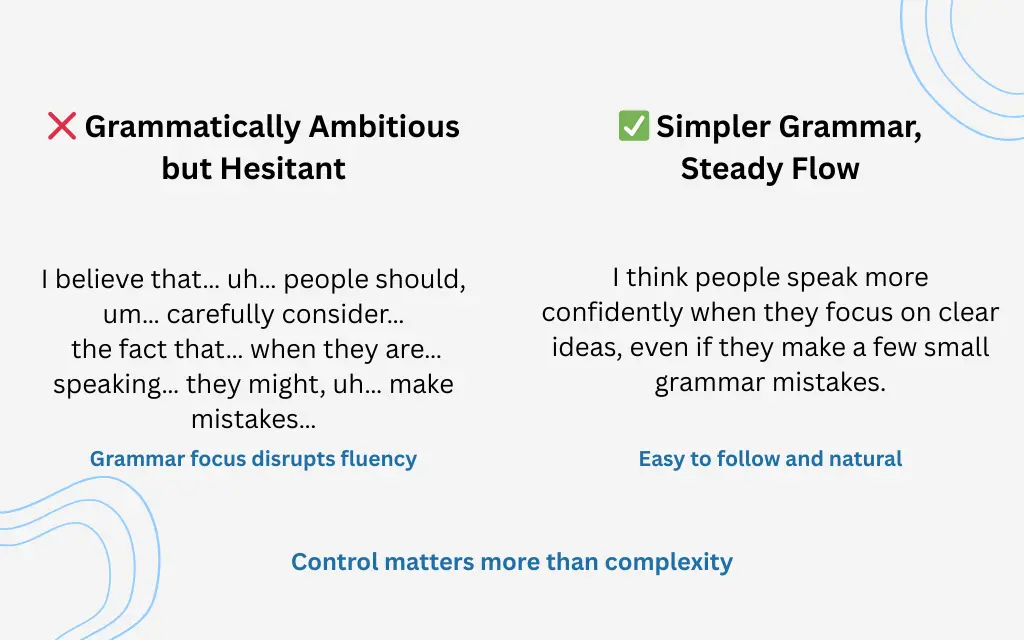
Candidates may pause unnaturally to plan structures, abandon sentences halfway through, or self-correct excessively. These behaviours damage fluency and coherence, which affects the overall speaking band score.
Grammar should serve communication, not dominate it.
Common grammar problems examiners notice
Grammar issues usually reduce scores when they appear consistently rather than occasionally. The most common problems include:
- incorrect verb tense control during storytelling
- missing articles that affect clarity
- sentence fragments caused by hesitation
- overuse of one structure, such as repeated “I think that…” openings
These patterns matter more than rare, minor mistakes.
Grammar and fluency work together
Grammar and fluency are closely connected in speaking.
When candidates feel tense about grammar, they often slow down, shorten answers, or rely on memorised phrases. Examiners notice this immediately.
Clear, flowing speech with occasional grammar errors often scores higher than hesitant, over-controlled speech that sounds unnatural.
Grammar across the three speaking parts
Grammar expectations shift slightly across the test.
In Part 1, examiners listen for basic control and comfort.
In Part 2, they expect grammar that supports longer narratives.
In Part 3, they expect flexibility when discussing more abstract ideas.
Across all three parts, progression matters more than perfection.
Using complex grammar naturally
Complex grammar does not mean long or complicated sentences.
It includes things like relative clauses used naturally, conditionals when they fit the idea, passive forms where appropriate, and varied sentence openings.
The key word is natural. If a structure feels forced, it probably is.
When grammar errors matter (and when they do not)
Grammar errors usually do not matter if meaning remains clear, communication continues smoothly, and the error is not repeated constantly.
They do matter when they change meaning, confuse the listener, or appear again and again. These patterns suggest a lack of control rather than normal spoken slips.
Improving grammar for speaking without memorising rules
The fastest way to improve grammar for speaking is to practise it in use, not in theory.
Speaking aloud in full sentences, practising extended answers rather than isolated drills, and recording yourself to notice patterns all help far more than memorising rules.
Grammar improves fastest when it is trained in context.
Listening to grammar like an examiner
When reviewing your speaking, try listening the way an examiner would.
Does the speech sound natural? Do sentences feel complete? Do errors interrupt the message?
This mindset shift helps you focus on communication rather than perfection.
Conclusion
Grammar for IELTS Speaking is not about complexity, perfection, or showing off.
It is about using the grammar you already know clearly, accurately, and naturally while speaking. When grammar supports your ideas instead of interrupting them, you are meeting examiner expectations.
With calm practice and the right focus, grammar becomes a strength rather than a source of stress.
Related IELTS Speaking Lessons
Glossary
Grammar (noun) — the structure of sentences in a language
Accuracy (noun) — how correct something is
Range (noun) — variety in language use
Fluency (noun) — smooth, continuous speech
Clause (noun) — a group of words with a subject and verb
Comprehension & Practice Questions
True or False: Grammar mistakes are not allowed in IELTS Speaking.
Multiple choice: What do examiners value more?
A) Advanced grammar only
B) Perfect accuracy only
C) Controlled range with clarity
Short answer: Why can forcing complex grammar lower a score?
True or False: Grammar and fluency are connected.
Short answer: What should grammar do in spoken answers?
Answers
False
C
It disrupts fluency and natural speech
True
Support communication
Join 1,300+ English learners
Get free English lessons, IELTS tips and useful vocabulary by email.
No spam. Just practical English you can use.