
Introduction to IELTS Speaking Part 2 Cue Cards
For many candidates, IELTS Speaking Part 2 feels like the most intimidating moment of the entire test.
You are given an unfamiliar topic, just one minute to prepare, and then expected to speak continuously for up to two minutes. There is no interaction, no guiding questions, and no chance to restart if you lose control of your ideas. When this happens, fluency breaks down quickly and confidence disappears.
This lesson explains how IELTS speaking Part 2 cue cards actually work, what examiners are listening for during the long turn, and how to approach cue cards in a calm, structured way. The goal is not to sound impressive, but to show clear organisation, steady fluency, and reliable language control.
Practise English every weekday with me
Get short Mon–Fri English practice in LINE with LEW Daily, plus regular feedback to help you improve.
Explore LEW DailyNT$399/month • Cancel anytime

What is IELTS Speaking Part 2?
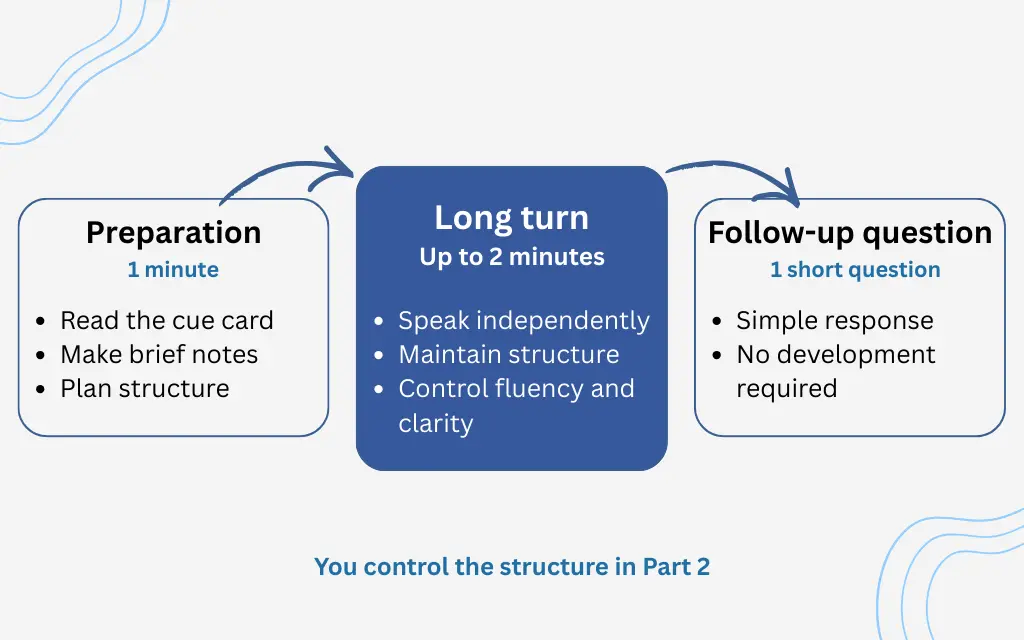
IELTS Speaking Part 2 is commonly referred to as the long turn.
In this part of the test, you receive:
- one cue card with a topic
- several bullet-point prompts
- one minute to prepare
- up to two minutes to speak
After you finish, the examiner may ask one brief follow-up question.
Part 2 is designed to assess whether you can speak independently at length. Unlike Parts 1 and 3, the examiner does not support you with questions while you are speaking. You are responsible for maintaining structure, fluency, and clarity on your own.
What a cue card is really testing
Although cue cards look simple, they test several skills simultaneously.
Examiners are listening for:
- the ability to sustain speech
- logical organisation of ideas
- stable control of grammar and vocabulary
- focus on the given topic
Importantly, cue cards are not testing memory or knowledge. They are testing control under pressure.
The bullet points are prompts, not strict requirements. You are not penalised for adjusting them or changing the order if your response remains clear and relevant.
Understanding the structure of a cue card
Most IELTS speaking Part 2 cue cards follow a predictable pattern.
They usually include:
- a main instruction, such as describe or explain
- three or four prompts that suggest directions for your ideas
Typical topics include people, places, experiences, activities, or objects. Strong candidates treat the prompts as a framework rather than a checklist. This allows their answer to sound natural instead of mechanical.
How to use the one-minute preparation time
The one-minute preparation time is short, but it plays a critical role in your performance.
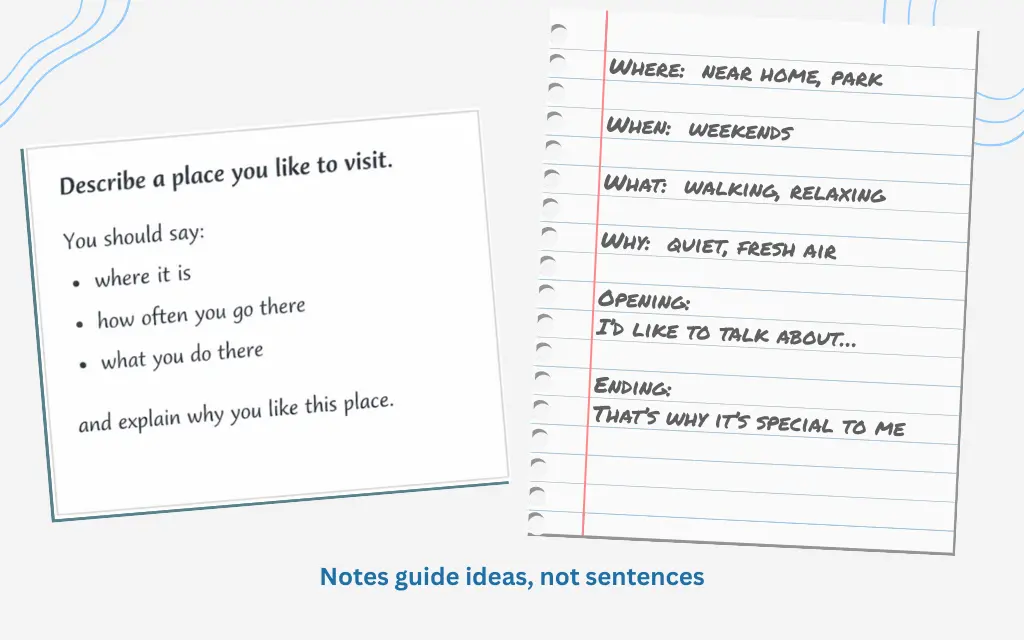
You should not write full sentences. Doing so often leads to hesitation, as candidates try to read or remember exact wording.
Instead, use this minute to:
- note key ideas or stages
- decide a simple order
- think of a clear opening and a natural ending
A simple structure that works for most cue cards
While cue cards vary, a simple spoken structure works reliably for most topics.
You can:
- introduce the topic briefly
- describe the main details
- explain why it matters or how you felt
- close the answer naturally
This approach helps you avoid stopping too early and keeps your response organised without sounding rehearsed.
Applying structure to a cue card topic
Consider a cue card asking you to describe a memorable event.
A controlled response would:
- set the context at the start
- explain what happened
- describe why it was memorable
- end with a short reflection
You do not need dramatic language or complex grammar. Clear sequencing and steady delivery are far more effective for examiners.
How long should you speak in Part 2?
Ideally, you should speak for between 1 minute 30 seconds and 2 minutes.
Stopping too early suggests limited development. Speaking far beyond two minutes is unnecessary and often increases mistakes.
If the examiner stops you, this is normal and does not affect your score.
What examiners really listen for in Part 2
Despite how it feels, Part 2 is not judged as storytelling.
Examiners focus on:
- a steady speaking pace
- minimal disruptive hesitation
- clear links between ideas
- consistent grammar accuracy
Using a mix of simple and slightly longer sentences naturally is enough for a strong score.
Common mistakes with IELTS Speaking Part 2 cue cards
Several patterns repeatedly limit scores.
Candidates often:
- memorise answers for common topics
- over-plan and then hesitate
- panic when they forget a word
- stop speaking instead of paraphrasing
Examiners recognise memorised language quickly. Natural delivery with small errors is always safer than rehearsed speech.
What to do if you run out of ideas
Running out of ideas is normal.
If this happens, you can:
- return to an earlier point
- add a simple example
- explain why something was important to you
You are assessed on language control, not originality.
Handling the follow-up question
After your long turn, the examiner may ask a short follow-up question.
This does not require a long response. One or two clear sentences are enough. Stay relaxed and respond naturally.
How Part 2 affects your overall speaking score
IELTS Speaking Part 2 contributes strongly to:
- fluency and coherence
- lexical resource
- grammatical range
A weak Part 2 can pull down an otherwise solid test. A controlled Part 2 often lifts borderline scores.
How to practise cue cards effectively
Effective practice focuses on structure, not repetition.
You should:
- practise different cue card types
- time yourself accurately
- record and listen back
- focus on organisation and flow
Consistency matters more than practising the same topic repeatedly.
Conclusion
IELTS speaking Part 2 cue cards are demanding, but they are also predictable.
Once you understand the timing, structure, and examiner focus, Part 2 becomes manageable rather than intimidating. Clear organisation, steady fluency, and natural language matter far more than impressive vocabulary.
With the right approach, Part 2 can become one of your strongest sections.
Related IELTS Speaking Lessons
Glossary
Cue card (noun) — a task card with a topic and prompts for Part 2
Long turn (noun phrase) — the extended speaking section in IELTS Speaking
Fluency (noun) — ability to speak smoothly without frequent pauses
Prompt (noun) — a guiding point that helps generate ideas
Paraphrase (verb) — to express an idea using different words
Comprehension & Practice Questions
- True or False: You must answer every bullet point on the cue card exactly.
- Multiple choice: How long is the preparation time in Part 2?
A) 30 seconds
B) 1 minute
C) 2 minutes - Short answer: What is the main purpose of the cue card prompts?
- True or False: Examiners stop you because you are speaking badly.
- Short answer: What should you focus on more — ideas or language control?
Answers
- False
- B
- To help organise ideas
- False
- Language control
Join 1,300+ English learners
Get free English lessons, IELTS tips and useful vocabulary by email.
No spam. Just practical English you can use.