
Introduction to Grammar Errors That Cost IELTS Marks
Many IELTS candidates leave the exam feeling that their grammar was “mostly fine”, yet their writing score comes back lower than expected. They remember only a few small mistakes and assume grammar was not the issue. In reality, it often was, just not in the way they imagined.
The problem is not usually a lack of grammar knowledge. It is the presence of IELTS grammar mistakes that quietly reduce clarity, consistency, and examiner confidence. These errors rarely destroy meaning completely, but they accumulate. Over the course of an essay, they signal weak control.
This lesson will explain the grammar errors that actually cost IELTS marks, why examiners notice them, and how to reduce them without forcing complex structures or memorising rules.
Practise English every weekday with me
Get short Mon–Fri English practice in LINE with LEW Daily, plus regular feedback to help you improve.
Explore LEW DailyNT$399/month • Cancel anytime

How Grammar Errors Affect Your IELTS Score
Grammar is assessed under the criterion Grammatical Range and Accuracy. Examiners are not looking for perfection. They are looking for reliability.
A small number of errors will not dramatically lower a score. Repeated errors of the same type, however, suggest limited control. When errors appear most often in complex sentences, examiners become cautious about awarding higher bands.
This is why grammar matters even when meaning is clear. Errors affect how comfortable the writing feels to read.
Why These Errors Happen So Often
Most grammar errors in IELTS writing are not random. They appear because candidates are:
- Writing under time pressure
- Trying to sound more advanced than they feel
- Managing ideas, structure, and vocabulary at the same time
As pressure increases, grammar accuracy drops, especially in sentences that are too long or overloaded with ideas.
Understanding this helps you fix errors at their source, rather than endlessly revising rules.
Sentence Overload: Too Much in One Sentence
One of the most common grammar errors IELTS writing candidates make is sentence overload.
This happens when a sentence tries to do too many jobs at once: explain an idea, give an example, add contrast, and show complex grammar. The result is often a sentence that loses structure halfway through.
A weaker sentence might feel breathless or confusing. A stronger version often splits the idea into two clearer sentences.
Examiners do not reward long sentences. They reward controlled sentences.
Tense Confusion Across the Essay
Tense errors are particularly common because IELTS tasks require different time references.
In Task 1, candidates often shift between past and present without noticing. In Task 2, tense changes sometimes happen mid-paragraph when examples are introduced.
These errors rarely make the essay unreadable, but they signal instability. When tense use feels inconsistent, examiners lower their confidence in the writing.
Article Errors That Accumulate Quickly
Articles (a, an, the) are a frequent source of common IELTS grammar errors, especially for learners whose first language does not use them.
A single article mistake is minor. Repeated article mistakes across almost every paragraph are not.
Examiners notice patterns. When article errors appear regularly, they suggest that accuracy is not fully controlled, even if vocabulary is strong.
This is why reducing one repeated error type often improves scores more than learning new grammar.
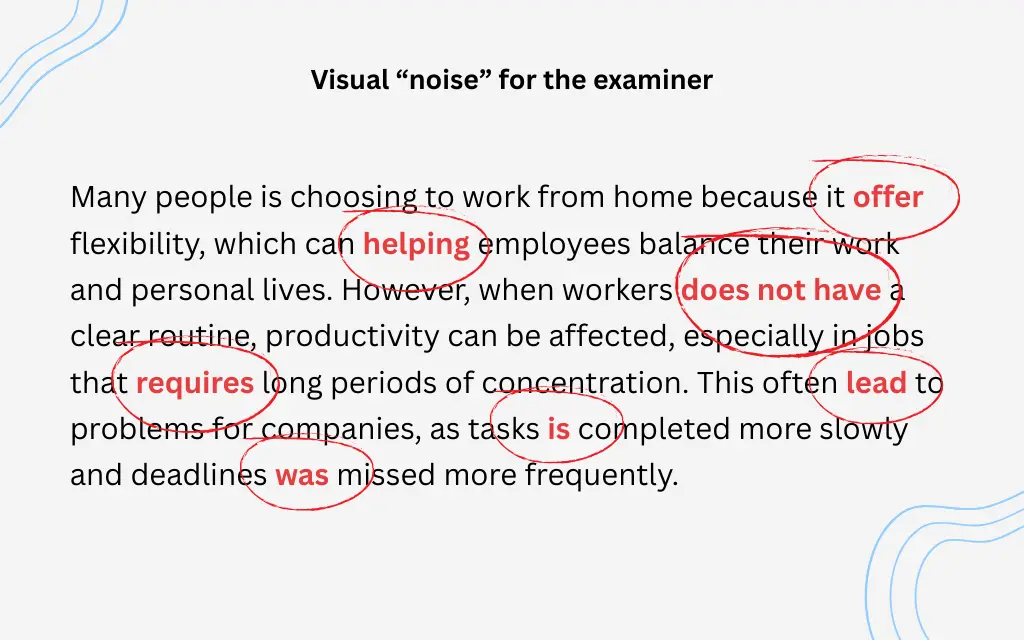
Subject–Verb Agreement Slips
Subject–verb agreement errors usually appear when sentences become long or complex.
The writer starts correctly, but by the end of the sentence the verb no longer matches the subject. This happens most often with:
- Long noun phrases
- Relative clauses
- Abstract subjects
These errors are subtle but noticeable. They interrupt the smooth rhythm of the sentence, which affects readability.
Inconsistent Plural Forms
Plural errors often go unnoticed by the writer but not by the examiner.
Problems appear with uncountable nouns, generalisations, or topic-specific vocabulary. For example, adding plural endings where they are not needed or forgetting them where they are required.
Again, a single error is not serious. Repetition is.
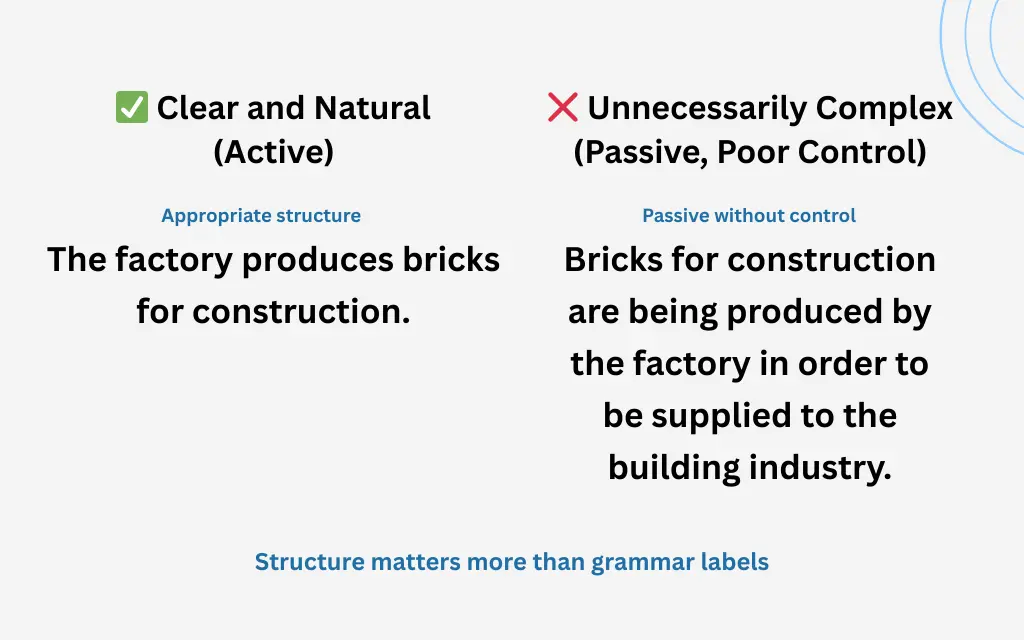
Passive Voice Used Without Control
The passive voice is useful in IELTS, particularly in Task 1. However, many candidates overuse it or apply it incorrectly.
When the passive is forced into sentences that do not need it, word order becomes awkward and grammar errors increase.
Examiners do not reward passive voice on its own. They reward appropriate use.
Conditionals and Complex Structures That Break Down
Conditionals, relative clauses, and multi-clause sentences often appear in Band 6–7 writing. They are good signs, until they stop working.
When a complex structure begins well but ends incorrectly, examiners see ambition without control. Too many of these errors suggest that grammar range exceeds grammar accuracy.
This is why controlled simplicity often outperforms risky complexity.
Why Repeated Errors Matter More Than Rare Ones
Examiners do not penalise every mistake equally.
A rare error in an otherwise stable essay has little impact. A repeated error type, however, becomes a pattern. Patterns signal limits.
Reducing just one repeated grammar problem can lift an essay more than adding new structures.
Grammar Errors Across Task 1 and Task 2
Some grammar errors affect both tasks equally, such as sentence overload and tense confusion.
Others appear more strongly in one task. Task 1 often exposes tense and passive voice issues. Task 2 often reveals problems with long sentences and agreement.
Being aware of where errors appear helps you target practice more efficiently.
How to Reduce Grammar Errors Without Slowing Down
The goal is not to write more slowly. It is to write more predictably.
Writers who use familiar sentence patterns make fewer mistakes under pressure. This is why refining existing grammar is more effective than learning new rules just before the exam.
A calm, controlled approach leads to fewer errors and higher examiner trust.
Conclusion
IELTS grammar mistakes rarely destroy meaning, but they quietly reduce scores by signalling weak control. The errors that cost marks most often are not dramatic. They are repeated, subtle, and avoidable.
By reducing sentence overload, stabilising tense use, and controlling familiar structures, you can significantly improve your writing score without forcing advanced grammar.
To continue improving, explore the related Learn English Weekly grammar and writing guides linked below, where these errors are addressed in real IELTS contexts.
Related IELTS Grammar Lessons
Glossary
Grammar error (noun) — Incorrect use of sentence structure or form
Accuracy (noun) — Correct and reliable grammar use
Tense (noun) — Verb form showing time
Agreement (noun) — Matching subjects and verbs correctly
Control (noun) — Ability to use grammar consistently
Practice Questions
- True or False: One grammar error automatically lowers your band.
- Which causes more score damage?
A) A rare mistake
B) A repeated mistake - Why do long sentences often create errors?
- Short answer: Name one common IELTS grammar error.
- True or False: Passive voice always improves IELTS writing.
Answers
- False
- B
- They overload structure and control
- Tense confusion / article errors / sentence overload
- False
Join 1,300+ English learners
Get free English lessons, IELTS tips and useful vocabulary by email.
No spam. Just practical English you can use.