
Introduction to IELTS Task 1 Band Descriptors
Most IELTS candidates practise Task 1 repeatedly but still feel unsure why their score stays the same. They may improve vocabulary, add more data, or write longer responses, yet the band does not rise. The reason is usually simple: they are practising writing, not practising what examiners score.
This is where IELTS Task 1 band descriptors matter.
Band descriptors are not abstract rules. They are the framework examiners use to judge every Task 1 response. When you understand what each descriptor is actually checking, your preparation becomes clearer and far more effective.
This lesson will explain the Task 1 band descriptors in plain language, shows how examiners apply them, and helps you understand what separates one band from another.
Practise English every weekday with me
Get short Mon–Fri English practice in LINE with LEW Daily, plus regular feedback to help you improve.
Explore LEW DailyNT$399/month • Cancel anytime

What Are IELTS Task 1 Band Descriptors?
Band descriptors are official descriptions of performance at each band level. Examiners use them to decide scores consistently across thousands of scripts.
For Task 1, examiners assess four areas:
- Task Achievement
- Coherence and Cohesion
- Lexical Resource
- Grammatical Range and Accuracy
Each area is scored separately, then averaged to produce the final Task 1 band score.
A useful visual here would show the four criteria as equal pillars supporting the final band score.
How Examiners Use Band Descriptors in Practice
Examiners do not tick boxes or count errors mechanically. They read your response while comparing what they see to the descriptors.
They ask themselves:
- Does this performance mostly match Band 6 descriptions?
- Does it consistently show Band 7 features?
- Where does it fall short?
Importantly, examiners think in ranges, not precise numbers, before settling on a final score.
Task Achievement: The Core of Task 1 Scoring
Task Achievement carries significant weight in Task 1.
Examiners assess whether you:
- Identify the main features
- Compare data where relevant
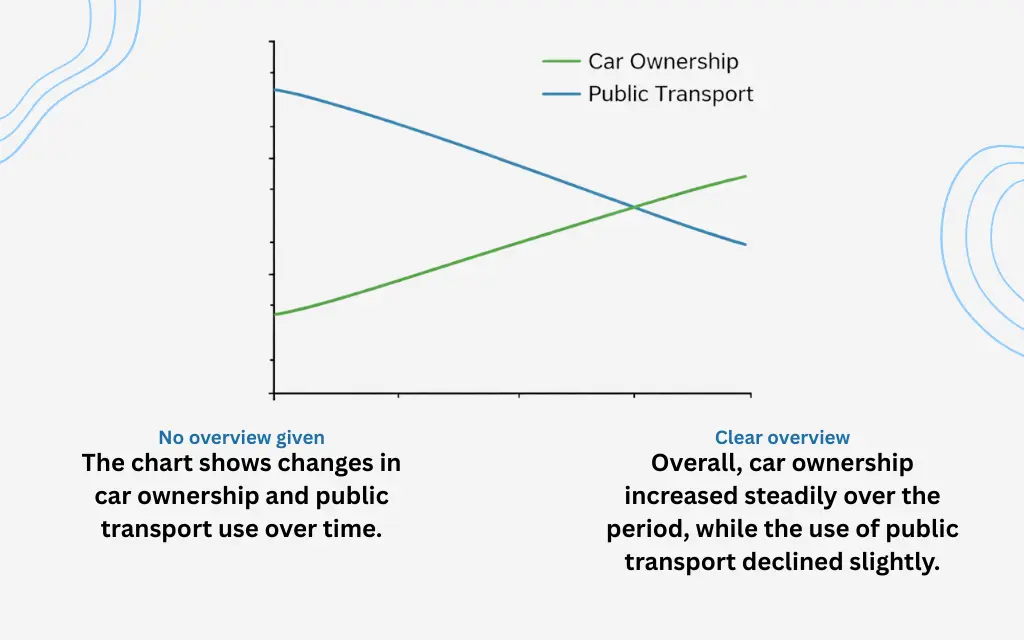
- Provide an accurate overview
- Avoid unnecessary detail or opinion
Many candidates lose marks here because they describe everything without prioritising.
For example, a weaker response might list figures mechanically, while a stronger response highlights overall trends and key contrasts. The difference is not length, but judgement.
Why Overviews Matter So Much
The overview is a central signal for Task Achievement.
Examiners look for a clear summary of the main trends or features. Without it, scores are capped, even if the rest of the writing is accurate.
Coherence and Cohesion: How Your Writing Feels to Read
This criterion focuses on organisation and flow.
Examiners notice:
- Logical paragraphing
- Clear progression of ideas
- Natural linking between sentences
They do not reward excessive linking words. In fact, overuse often makes writing feel mechanical.
A response with simple, logical flow often scores higher than one filled with connectors but lacking clarity.
Paragraph Structure in Task 1
In Task 1, paragraphing should support comparison.
Typically, this means grouping information logically rather than describing each category separately. Examiners notice whether paragraphs help the reader understand relationships between data.
If paragraph purpose is unclear, coherence scores suffer.
Lexical Resource: Precision Over “Advanced” Vocabulary
Lexical Resource is often misunderstood.
Examiners assess:
- Accuracy of word choice
- Appropriateness for data description
- Range used naturally
They are not impressed by rare words if they are misused. Simple terms like increase, remain stable, or decline score well when used accurately.
A weaker response may force unusual vocabulary, while a stronger one uses familiar language precisely.
Repetition vs Control
Repetition is not automatically negative.
Examiners tolerate repeated vocabulary when it is accurate and appropriate. What lowers scores is awkward paraphrasing that distorts meaning.
This is why memorised synonym lists often hurt Task 1 performance.
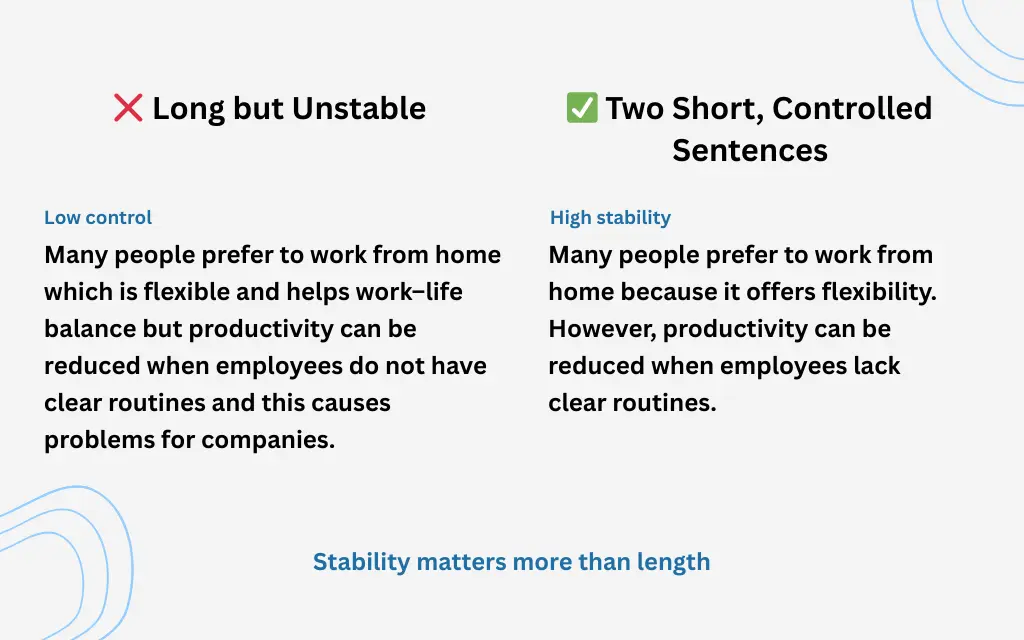
Grammatical Range and Accuracy: Stability Matters Most
Examiners assess both range and control.
They look for:
- A mix of sentence types
- Mostly accurate structures
- Errors that do not impede understanding
A common misconception is that complex sentences are required everywhere. In reality, unstable complexity lowers scores faster than simple, accurate grammar.
How Bands Differ in Real Terms
Understanding Task 1 band score criteria means recognising patterns.
At lower bands, writing may describe data but miss key features. Mid bands show understanding but lack consistency. Higher bands demonstrate control, clarity, and confident selection of information.
Examiners are not looking for perfection. They are looking for reliability.
Why Small Improvements Raise Bands
Because band descriptors are about consistency, reducing repeated weaknesses often matters more than adding new skills.
Improving overviews, stabilising grammar, and organising paragraphs more clearly can raise scores even without expanding vocabulary.
Common Misunderstandings About Band Descriptors
Many candidates believe:
- One mistake ruins the score
- Advanced vocabulary guarantees higher bands
- Longer writing scores better
None of these are true. Band descriptors reward quality of judgement, not quantity of language.
Using Band Descriptors to Guide Practice
Rather than guessing your level, use descriptors as a lens.
After writing Task 1:
- Check which descriptor you consistently meet
- Identify which criterion limits your score
- Focus practice on that area only
This targeted approach is far more efficient than rewriting endlessly.
How Task 1 Descriptors Differ From Task 2
Although criteria names are similar, Task 1 prioritises accuracy and data handling, while Task 2 prioritises argument and development.
Understanding this prevents applying the wrong strategies to Task 1 writing.
Examiner Confidence and Descriptor Alignment
When writing aligns smoothly with descriptors, examiners feel confident awarding higher bands.
When performance fluctuates between descriptors, examiners become cautious. This is why consistency is so important.
Conclusion
Understanding IELTS Task 1 band descriptors transforms how you prepare. Instead of writing blindly, you begin writing with examiner criteria in mind.
When you focus on clear overviews, logical organisation, precise vocabulary, and controlled grammar, your writing naturally aligns with higher bands.
To deepen this understanding, explore the related Learn English Weekly Task 1 and examiner-focused guides linked below.
Related IELTS Task 1 Lessons
Glossary
Band descriptor (noun) — Official description of performance at each IELTS band
Task Achievement (noun) — How well the task is fulfilled
Coherence (noun) — Logical organisation of ideas
Lexical Resource (noun) — Vocabulary use and control
Grammatical Range (noun) — Variety and accuracy of sentence structures
Comprehension / Practice Questions
- True or False: Examiners count grammar mistakes to decide the band.
- Which element is essential for Task Achievement?
A) Opinion
B) Overview - Why does overusing linking words lower coherence?
- Short answer: Name one Task 1 scoring criterion.
- True or False: Complex sentences always improve scores.
Answers
- False
- B
- They make writing feel mechanical
- Task Achievement / Coherence and Cohesion / Lexical Resource / Grammar
- False
Join 1,300+ English learners
Get free English lessons, IELTS tips and useful vocabulary by email.
No spam. Just practical English you can use.