Introduction to Paragraph Structure for IELTS and ESL Essays
Great essays aren’t built sentence by sentence, they’re built paragraph by paragraph. If your paragraph structure essay is weak, your argument will feel unclear, even if your grammar is good.
In this lesson prepared by Learn English Weekly, we'll show IELTS and ESL writers how to plan and write high-impact paragraphs with step-by-step models you can adapt immediately.
In IELTS Writing Task 2 and in general academic writing, examiners look for clear organisation, logical development, and accurate support. Strong paragraphs use a predictable pattern so readers can follow your reasoning quickly. Below, you’ll learn a simple structure, see model paragraphs, and get classroom-ready activities.
Why paragraph structure matters
- Clarity: Readers understand your main idea quickly and know where the paragraph is going.
- Coherence & Cohesion: Each sentence connects logically to the next with helpful signposting.
- Task Response: Your argument develops fully, staying relevant to the question.
- Efficiency: A repeatable template frees your mind to focus on ideas and precise vocabulary.
One paragraph = one controlling idea. If you feel tempted to add another big idea, start a new paragraph.
Practise English every weekday with me
Get short Mon–Fri English practice in LINE with LEW Daily, plus regular feedback to help you improve.
Explore LEW DailyNT$399/month • Cancel anytime

The TEEAL pattern (a reliable structure)
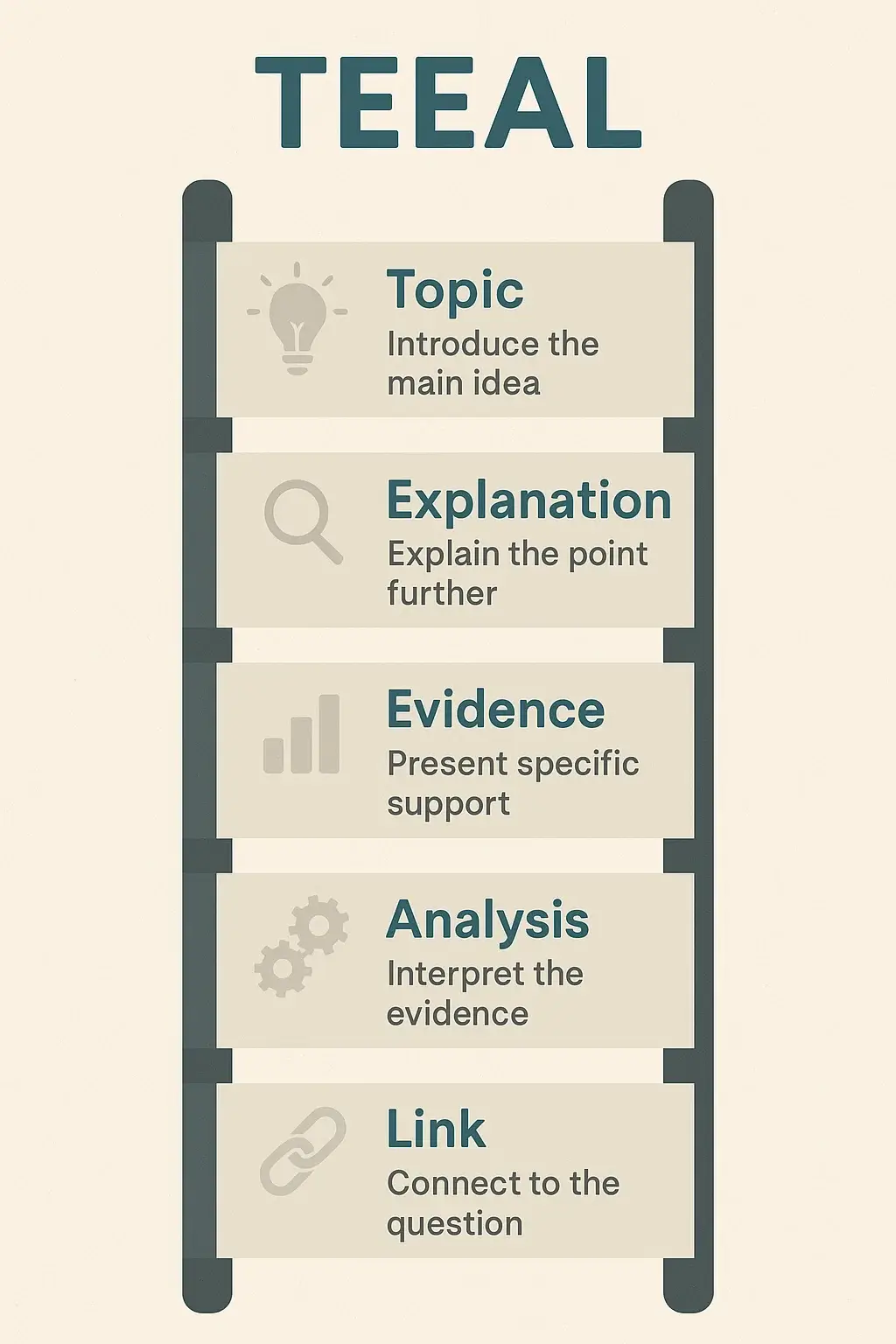
Use TEEAL to plan any paragraph for IELTS or academic writing:
- T – Topic sentence: states the controlling idea clearly.
- E – Explanation: clarifies what you mean / narrows the scope.
- E – Evidence/Example: adds data, illustration, or case.
- A – Analysis: interprets the evidence and links it to your claim.
- L – Link: closes the paragraph and/or transitions to the next idea.
Quick cues you can paste into notes
- Topic: “One major reason is…”
- Explanation: “This means that…” / “In practical terms…”
- Evidence: “For example…” / “A recent programme shows…”
- Analysis: “This suggests…” / “As a result…”
- Link: “Therefore…” / “Consequently…” / “Overall…”
Model paragraphs (IELTS & ESL friendly)
The following models show how the same paragraph structure works across common essay purposes. Adapt the vocabulary to your topic.
1) Opinion/Argument (IELTS Task 2)
Question (shortened): Governments should invest more in public transport than in roads. To what extent do you agree or disagree?
Model (TEEAL):
T: One major reason public transport deserves extra funding is its effect on urban congestion.
E: When buses and trains are reliable and frequent, commuters have a genuine alternative to driving.
E: For example, after a city in northern England introduced bus-priority lanes and capped fares, peak-hour traffic fell and average journey times improved.
A: These results indicate that targeted spending shifts behaviour rather than simply expanding road capacity, which often fills up again.
L: Therefore, prioritising high-quality public transport is a more sustainable way to keep cities moving.
2) Discussion (both views + your view)
Question (shortened): Some argue homework is essential; others believe it is unnecessary.
Model:
T: Supporters of homework claim it strengthens memory through spaced practice.
E: Short, focused tasks can remind learners of key ideas and prepare them for the next lesson.
E: For instance, a weekly vocabulary review helps students recycle words in new contexts.
A: Because the effort is brief and repeated, recall improves without overwhelming students.
L: Nevertheless, the benefits depend on careful design rather than the volume of tasks assigned.
3) Advantages & Disadvantages (evaluate)
Topic: Online learning
Model:
T: A clear advantage of online courses is flexibility for adult learners.
E: Many students balance employment and family responsibilities, so time-shifted lessons reduce dropout rates.
E: A local college reported higher completion on modules that offered recorded lectures plus discussion boards.
A: This format allows learners to study during quiet periods while still participating in academic dialogue.
L: However, without reliable devices and internet access, such flexibility is unevenly distributed.
4) Problem–Solution
Topic: Urban air pollution
Model:
T: One effective way to reduce air pollution is to price high-emission vehicles during peak hours.
E: Congestion charges make driving less attractive and fund improvements to public transport.
E: After a trial in a European capital, the city expanded bus fleets using the revenue and NO₂ levels fell.
A: By aligning costs with environmental impact, the policy shifts behaviour without banning cars outright.
L: As a result, targeted pricing should be paired with reliable alternatives so residents can change habits.
5) Two-Part Question (answer both directly)
Question (shortened): Why do fewer teenagers read newspapers, and how can we encourage reading?
Model:
T: Teenagers read fewer newspapers mainly because digital platforms deliver faster, personalised updates.
E: Social feeds summarise events within minutes and prioritise topics users already follow.
E: A school pilot that provided curated mobile news digests saw reading time increase.
A: When access is immediate and relevant, students are more willing to read longer pieces later.
L: Schools could therefore combine media-literacy lessons with subsidised e-subscriptions to rebuild habits.
Building a paragraph with sentence stems (teacher tool)
Use these stems to scaffold weaker writers. Encourage students to replace them with their own phrasing as confidence grows.
- Topic: One significant reason / factor / benefit is…
- Explanation: In practical terms, this means…
- Evidence: For example / For instance / A recent programme shows…
- Analysis: This suggests / This leads to / This results in…
- Link: Therefore / Consequently / Overall…
Common mistakes and quick fixes
- Two ideas in one paragraph.
Fix: Split into two paragraphs; give each a fresh topic sentence. - Evidence without analysis.
Fix: After the example, add “This suggests…” and explain the significance. - Vague topic sentence.
Fix: Name the idea precisely (who/what/where). Avoid “there are many reasons”. - No link to the question.
Fix: Echo a keyword from the task in your topic sentence or link sentence. - Over-quoting sources.
Fix: Summarise the evidence; focus on your analysis.
Paragraph planning in 60 seconds
- Write the topic sentence first.
- Add one explanatory line to narrow the scope.
- Choose one strong example (realistic or illustrative).
- Explain why it matters (impact on the question).
- Finish with a link that closes the idea and prepares the next paragraph.
Model paragraph pair (cohesion across paragraphs)
Paragraph 1 (benefit):
Public libraries deserve stable funding because they reduce barriers to learning for low-income families. In many towns, libraries provide quiet study space and free internet access that students cannot find at home. For example, weekend revision clubs hosted by librarians regularly attract pupils who lack laptops and textbooks. These sessions not only improve exam outcomes but also create trusted study routines. Consequently, councils that sustain library budgets support educational equality at relatively low cost.
Paragraph 2 (concession + balance):
Critics argue that digital materials make physical libraries less essential; however, this view overlooks access and guidance. While e-books are convenient, families still need devices, connectivity, and help choosing reliable resources. Librarians curate age-appropriate collections and teach search skills, which protects learners from misinformation. Therefore, rather than cutting investment, councils should modernise library spaces with study hubs and digital lending alongside trained staff.
Notice: The link sentence in Paragraph 1 leads naturally into the concession in Paragraph 2.
Classroom practice ideas (for IELTS & ESL)
- Rebuild the paragraph: Give students a scrambled TEEAL paragraph; they must reorder the sentences.
- Replace the stems: Provide a model paragraph with stems; students rewrite using their own vocabulary.
- One example, two analyses: Keep the same evidence but produce two different analyses to show how interpretation drives argument.
- Timed drill: 6 minutes to write one full paragraph from a prompt; peer-check using the TEEAL checklist.
Conclusion
Strong essays rely on strong paragraphs. Use the TEEAL pattern to organise ideas, show logic, and stay focused on the task. With practice, your paragraph structure essay will feel natural: clear topic sentence, tight explanation, convincing evidence, purposeful analysis, and a confident link.
Next step: Explore more Writing Skills guides and download our one-page TEEAL checklist for classroom or home use.
Learn more about IELTS Writing Task 1.
Learn more about IELTS Writing Task 2.
Glossary Section
- paragraph (n.) — a group of sentences developing one main idea.
- topic sentence (n.) — the sentence stating the paragraph’s controlling idea.
- explanation (n.) — a clarifying sentence that narrows or defines the idea.
- evidence (n.) — data, example, or illustration supporting the claim.
- analysis (n.) — interpretation showing how evidence proves the point.
- link (n./v.) — a sentence connecting the paragraph to the essay question or next paragraph.
- coherence (n.) — overall logical flow.
- cohesion (n.) — the linguistic glue (linkers, referencing) connecting sentences.
- concession (n.) — acknowledgement of an opposing point.
- controlling idea (n.) — the specific focus that the paragraph develops.
Practise What You Learned
Questions
- True/False: A good paragraph usually develops one controlling idea.
- In TEEAL, what does the second E stand for?
A. Evaluation
B. Evidence/Example
C. Emphasis
D. Elaboration without proof - Which sentence would best function as a topic sentence?
A. “Buses and trains are used by many people.”
B. “Public transport reduces congestion when it is frequent and reliable.”
C. “A city introduced bus lanes last year.”
D. “NO₂ levels fell in certain streets.” - What is the purpose of the Analysis step? (Short answer)
- Rewrite this weak topic sentence to make it precise:
“There are many problems with social media.”
Answers below.
Answers
- True.
- B — Evidence/Example.
- B — It states a clear, arguable idea.
- To explain how/why the evidence supports the main claim and links back to the question.
- Sample: “Social media harms teenagers’ sleep and concentration by encouraging late-night screen time.”
Practise English every weekday with me
Get short Mon–Fri English practice in LINE with LEW Daily, plus regular feedback to help you improve.
Explore LEW DailyNT$399/month • Cancel anytime