
Introduction to IELTS Reading Multiple Choice Questions
Many IELTS candidates feel confident when they see multiple choice questions in the Reading test. After all, the answer is already there. You do not need to write anything. You simply choose A, B, C, or D.
Yet in real exams, these questions often cause unexpected problems.
Students rush. They recognise familiar words. They choose quickly. Then, later, they realise they were wrong.
This is why IELTS reading multiple choice questions are not as easy as they first appear.
They are designed to test your understanding of meaning, not your ability to spot keywords. They check whether you can follow ideas, evaluate information, and ignore attractive wrong answers.
This lesson explains how multiple choice questions really work in the IELTS Reading test, why so many candidates lose marks here, and how you can answer them calmly and accurately on exam day.
Practise English every weekday with me
Get short Mon–Fri English practice in LINE with LEW Daily, plus regular feedback to help you improve.
Explore LEW DailyNT$399/month • Cancel anytime

Understanding Multiple Choice in the IELTS Reading Test
Multiple choice questions appear in both Academic and General Training IELTS Reading papers. They may ask you to choose one correct answer, or sometimes two correct answers, from a list.
At first glance, this format feels familiar. It looks similar to school exams or online quizzes. However, IELTS uses multiple choice in a very specific way.
What These Questions Really Test
These questions are not testing isolated facts. They are testing whether you understand:
- The writer’s main idea
- A specific opinion
- A reason or explanation
- A conclusion
- An implied meaning
In other words, they are testing comprehension, not memory.
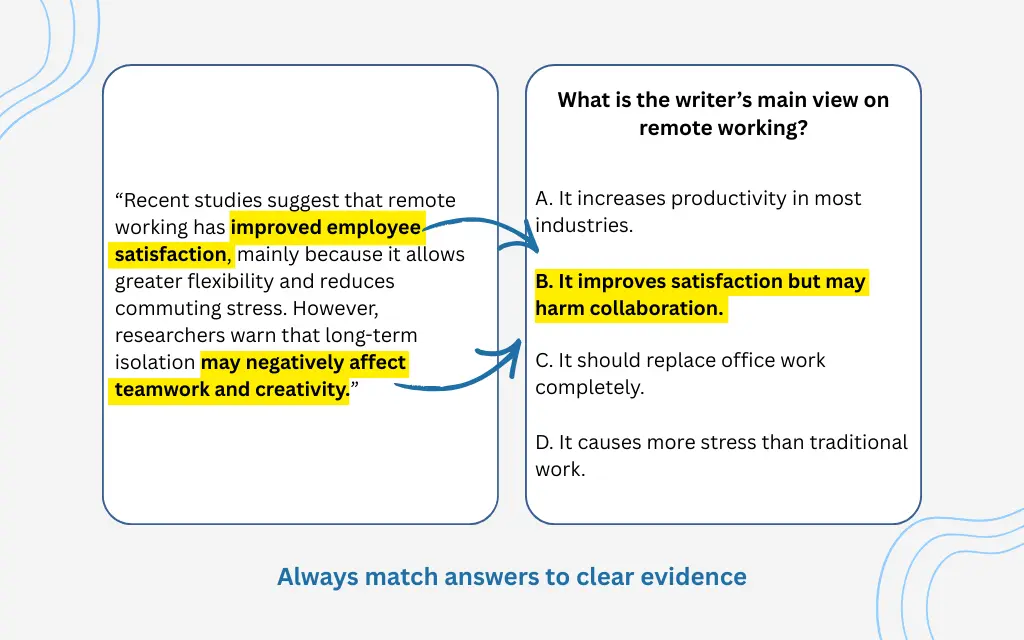
Why Multiple Choice Questions Are Often Difficult
Many students are surprised when they repeatedly lose marks on multiple choice questions. This usually happens for predictable reasons.
Common Causes of Lost Marks
The first is overconfidence. Because the answers are visible, candidates assume the task is easy and do not read carefully enough.
The second is distraction. IELTS writers include options that look correct on the surface but do not fully match the passage.
The third is time pressure. When you feel rushed, you are more likely to choose the first “reasonable” option and move on.
These problems are not about English ability alone. They are about exam technique.
Understanding this is the first step towards improving your score.
How IELTS Designs Multiple Choice Options
Before learning strategies, it is important to understand how answer options are created.
In IELTS Reading, wrong answers are not random. They are carefully designed to attract weak or rushed candidates.
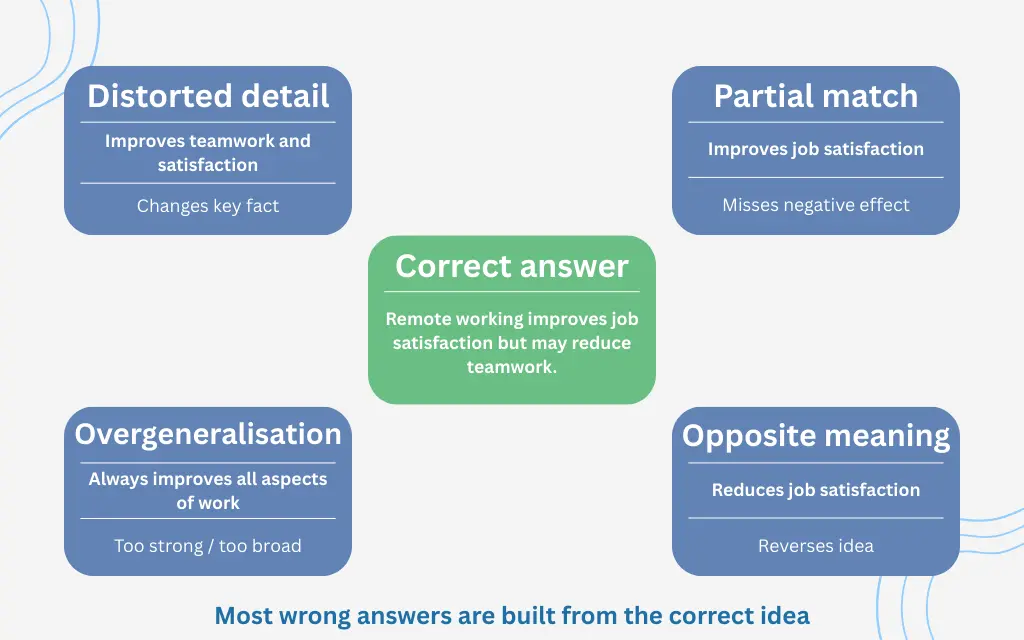
Common Types of Wrong Options
Most incorrect options follow clear patterns.
One common type is the partial match. This option is partly true but misses an important detail.
Another type is the opposite meaning. It uses similar vocabulary but reverses the idea.
A third type is overgeneralisation. It makes the idea too broad or too strong.
Finally, there is often a distorted detail. One small fact is changed, such as a date, number, or reason.
Step-by-Step Approach to Multiple Choice Questions
Strong candidates do not guess. They follow a clear mental process.
Step 1: Read the Question Carefully First
Before reading the options, focus on the question itself.
Ask yourself what information you are looking for. Is it a reason, an opinion, a conclusion, or a comparison?
This prepares your mind to read actively.
Step 2: Locate the Relevant Part of the Passage
Multiple choice questions usually follow the order of the text.
Use keywords from the question to find the right paragraph. Then read that section slowly.
Meaning is often spread across several lines.
Step 3: Understand the Passage Before Looking at Options
Before reading A, B, C, and D, try to answer the question in your own words.
For example:
“The passage says the main reason is financial pressure.”
Now you are matching ideas, not words.
Step 4: Compare Each Option With the Passage
Read each option carefully.
Ask:
Does this fully match the meaning?
If one part is wrong, the whole option is wrong.
Step 5: Eliminate Wrong Answers Actively
Good candidates remove wrong answers deliberately.
They think:
“This exaggerates.”
“This changes the reason.”
“This is not mentioned.”
Elimination reduces pressure and improves confidence.
Reading Strategies for Multiple Choice Questions
Technique works best when supported by strong reading habits.
Reading for Meaning, Not Words
Many students match vocabulary instead of meaning.
Example:
Passage: “The policy failed due to insufficient funding.”
Option: “It failed because there was too much money.”
Same topic. Opposite meaning.
Always focus on ideas.
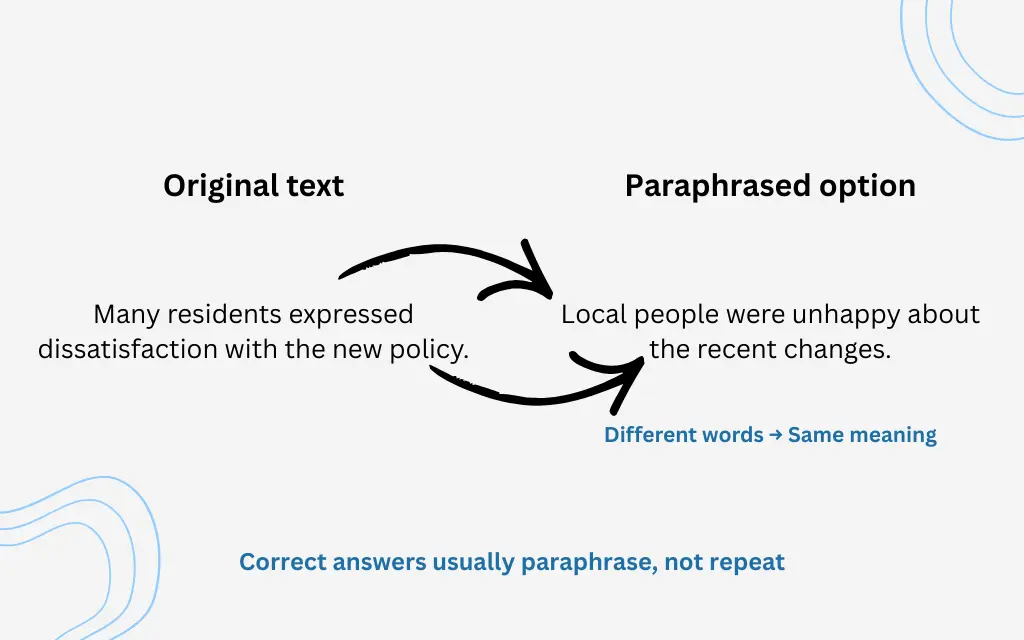
Understanding Paraphrasing in MCQs
The correct answer is rarely copied directly.
Instead, IELTS uses paraphrasing.
Example:
Passage: “Many residents expressed dissatisfaction.”
Option: “Local people were unhappy.”
Different words. Same meaning.
Managing Time With Multiple Choice Questions
Time management is critical.
Multiple choice questions often take longer than expected.
Typical Timing Problems
Some candidates analyse one question for too long.
Others rush and lose easy marks.
Both damage scores.
Practical Time Strategy
A balanced approach works best.
As a guide:
- Spend no more than 90 seconds on one MCQ
- If unsure, move on
- Return later if time allows
This protects your overall pace.
Common Mistakes in IELTS Reading Multiple Choice
Certain errors appear again and again.
Choosing Based on Familiar Words
Students see matching vocabulary and choose immediately.
This is exactly what IELTS expects weak candidates to do.
Never choose based on words alone.
Ignoring Small Details
Words like “only”, “mainly”, “always”, “rarely”, and “partly” change meaning.
Ignoring them leads to wrong answers.
Relying on Memory Instead of Checking
Answering from memory is risky under stress.
Always return to the text.
Overthinking Clear Answers
Some students doubt correct answers.
If meaning matches clearly, trust it.
How Strong Candidates Think During MCQs
High scorers think calmly and logically.
“I know what the question wants.”
“I found the paragraph.”
“I understand the idea.”
“This option matches.”
“The others change meaning.”
No panic. No guessing.
This mindset comes from training.
Using Practice Tests Effectively
Many students do many tests but do not improve.
Analysing Mistakes Properly
After each test, ask:
Why was I wrong?
Was it speed, vocabulary, assumption, or misreading?
Keep notes. Patterns appear.
That is where progress happens.
Conclusion: Mastering Multiple Choice in IELTS Reading
Multiple choice questions are not about luck.
They are about calm reading, careful thinking, and disciplined checking.
When you understand how IELTS designs options, read for meaning, manage time well, and analyse mistakes, your accuracy improves naturally.
With steady practice, multiple choice questions can become one of your strongest areas in IELTS Reading.
Related IELTS Reading Lessons
Glossary
Paraphrase (noun)
A way of expressing the same meaning using different words.
Distractor (noun)
A wrong answer designed to look correct.
Comprehension (noun)
The ability to understand what you read.
Eliminate (verb)
To remove incorrect choices.
Inference (noun)
A conclusion based on evidence and reasoning.
Practice Section
Questions
- (MCQ) What is the main purpose of multiple choice questions in IELTS Reading?
A. To test spelling
B. To test memory
C. To test comprehension
D. To test handwriting - (True/False) The correct answer usually repeats words from the passage.
- (Short Answer) Why is it useful to answer in your own words before reading options?
- (MCQ) Which option type is partly correct but incomplete?
A. Opposite meaning
B. Partial match
C. Random detail
D. Summary - (True/False) Spending five minutes on one MCQ is recommended.
Answers
- C
- False
- It helps you focus on meaning and avoid distraction.
- B
- False
Join 1,300+ English learners
Get free English lessons, IELTS tips and useful vocabulary by email.
No spam. Just practical English you can use.