
Introduction to Avoiding Repetition in IELTS Writing
One of the fastest ways IELTS writing can feel limited is through repetition. Even when grammar is accurate and ideas are relevant, repeated wording can quietly hold a score back.
In IELTS writing, repetition is rarely about copying whole sentences. More often, it involves using the same words, phrases, or sentence patterns too frequently. This affects how flexible your language appears and directly influences your Lexical Resource score.
This lesson explains what repetition really means in IELTS writing, why examiners notice it so quickly, and how to reduce it naturally. The aim is not to sound clever, but to sound controlled, flexible, and confident.
Practise English every weekday with me
Get short Mon–Fri English practice in LINE with LEW Daily, plus regular feedback to help you improve.
Explore LEW DailyNT$399/month • Cancel anytime

What repetition means in IELTS writing
Repetition in IELTS does not mean that you must avoid reusing words completely. Some repetition is unavoidable and, in many cases, necessary.
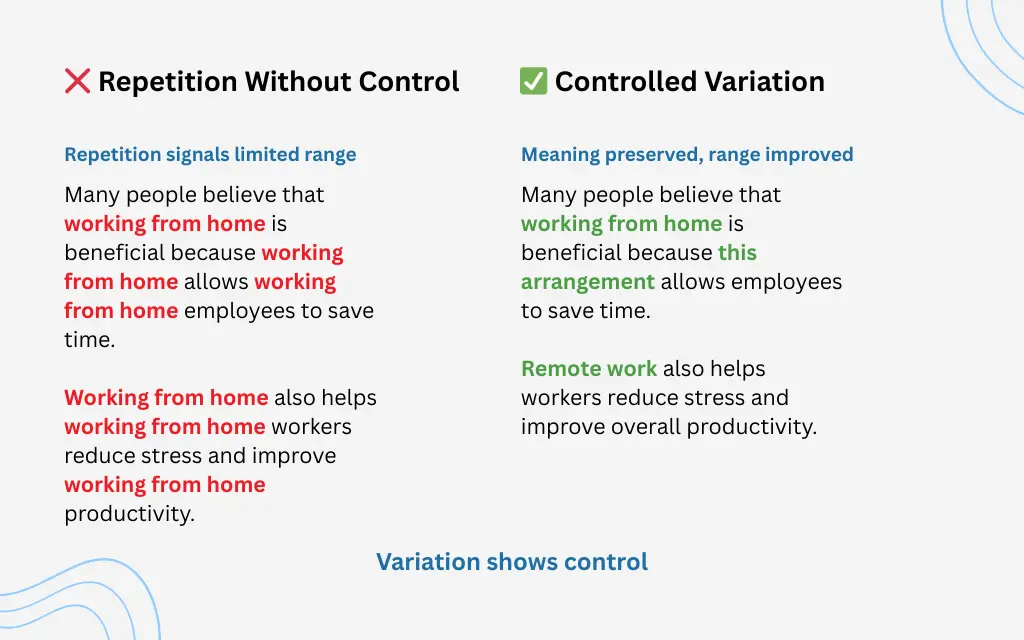
The problem appears when key words are repeated too often without variation. When this happens, it suggests limited control over vocabulary rather than clarity.
Examiners are trained to notice patterns. When the same nouns, verbs, or expressions appear again and again, it signals difficulty with paraphrasing and rephrasing. This is one of the most common reasons candidates struggle to move beyond Band 6 or 6.5.
Why repetition lowers your Lexical Resource score
Lexical Resource is not about advanced vocabulary. It is about control.
Examiners look for evidence that you can:
- express ideas clearly
- use vocabulary accurately
- vary language when it improves flow
When repetition dominates your writing, it suggests a narrow active vocabulary, even if grammar is strong.
Examiners do not count synonyms. They judge whether the language feels flexible or restricted. Excessive repetition creates the impression of restriction and limits how high the band score can go.
Where repetition most commonly appears
Repetition tends to appear in predictable places, especially under exam pressure.
Task 2 essays
In Task 2, repetition often comes from:
- repeating key words from the question in every paragraph
- restating the same idea using almost identical wording
- relying on the same general verbs such as “cause”, “make”, or “give”
This usually happens because candidates focus strongly on staying on topic, but forget to adjust how ideas are expressed.
Task 1 reports
In Task 1, repetition often appears when:
- the same trend word is used repeatedly
- descriptions rely on one verb such as “increase”
- comparisons follow the same structure throughout
Because Task 1 responses are shorter, repetition becomes noticeable very quickly.
Repetition vs clarity: finding the balance
A common concern is that avoiding repetition will reduce clarity. This concern is understandable, as clarity is essential in IELTS writing.
However, controlled variation usually improves clarity rather than harming it.
The key is to keep the idea stable while adjusting how it is expressed. This is where repetition links closely to paraphrasing. Good variation changes language, not meaning.
Natural ways to reduce repetition
Avoiding repetition does not require memorising long synonym lists. That approach often creates new problems.
Using grammatical variation
Sometimes repetition comes from repeating the same sentence pattern rather than the same words. Adjusting structure slightly can reduce repetition without changing vocabulary much.
Using reference words carefully
Pronouns and referencing expressions can reduce repetition, but only when the reference is clear. Overuse or unclear reference can damage coherence.
Examiners prefer controlled variation, not aggressive avoidance of repetition.
Why overcorrecting repetition can backfire
Some candidates become so focused on avoiding repetition that accuracy suffers.
Common issues include:
- choosing incorrect synonyms
- using words that do not fit the context
- forcing variation where repetition is acceptable
Technical or topic-specific words often need to be repeated. Examiners do not penalise repetition of essential terminology.
The goal is appropriate repetition, not zero repetition.
Repetition and band score progression
Repetition is closely linked to band score ceilings.
Band 6 writing often shows clear ideas but limited variation.
Band 7 writing shows controlled paraphrasing and flexible vocabulary.
Band 8 and above writing varies language naturally without drawing attention to it.
This is why addressing repetition is one of the most efficient ways to improve your writing score once grammar is stable.
How examiners perceive repetition
Examiners read quickly and form an overall impression.
If the writing feels repetitive, they sense limited lexical range almost immediately. This impression affects the final band score, even when individual sentences are accurate.
Reducing repetition improves not only Lexical Resource, but also the overall flow and confidence of your writing.
Practising repetition reduction effectively
The best time to address repetition is after writing, not during.
When drafting, focus on ideas and structure. When checking, look specifically for:
- repeated nouns
- repeated verbs
- repeated phrases
Ask whether each repetition is necessary or whether a small adjustment would improve flow. This mirrors how examiners read and builds long-term improvement.
Conclusion
Avoiding repetition in IELTS writing is not about sounding impressive or using difficult vocabulary. It is about showing control.
When unnecessary repetition is reduced, writing becomes more flexible, more natural, and more convincing to examiners. This directly improves Lexical Resource and helps unlock higher band scores.
Related IELTS Vocabulary Lessons
Glossary
Paraphrasing (noun) — expressing the same idea using different language without changing meaning
Lexical resource (noun) — the range, accuracy, and control of vocabulary in writing
Meaning shift (noun) — a small but important change in meaning caused by inaccurate wording
Synonym substitution (noun) — replacing words without considering natural usage
Academic tone (noun) — formal, neutral style used in IELTS writing tasks
Practice Questions
- True or False: Paraphrasing in IELTS means changing as many words as possible.
- Multiple choice: What is the main risk of poor paraphrasing?
A) Using simple vocabulary
B) Changing the original meaning
C) Writing shorter sentences - Short answer: Why is paraphrasing especially important in introductions?
- True or False: In Task 1, paraphrasing should prioritise clarity over variety.
- Short answer: Name one safe paraphrasing technique.
Answers
- False
- B
- Because it shows immediate control of language and understanding of the task
- True
- Changing sentence structure while keeping key vocabulary
Join 1,300+ English learners
Get free English lessons, IELTS tips and useful vocabulary by email.
No spam. Just practical English you can use.