
Introduction to IELTS Listening Distractors
You hear what sounds like the answer, write it down, then seconds later, the speaker changes their mind.
Suddenly, your answer is wrong.
If this has happened to you, you have encountered IELTS listening distractors.
Many candidates describe these as “trick answers” in IELTS listening. They feel unfair and frustrating. However, distractors are not tricks. They are deliberate features of natural spoken English, designed to test whether you follow meaning until it is complete.
Understanding listening traps is one of the most valuable skills in the entire Listening test, particularly for candidates aiming for Band 7 and above.
Practise English every weekday with me
Get short Mon–Fri English practice in LINE with LEW Daily, plus regular feedback to help you improve.
Explore LEW DailyNT$399/month • Cancel anytime

What Is a Distractor in IELTS Listening?
A distractor is information that sounds correct at first but is later corrected, modified, or rejected.
It mirrors how people speak in real life. In natural conversation, speakers often:
- Begin one idea
- Pause
- Clarify
- Revise their statement
IELTS reflects this reality.
For example:
“We originally planned to hold the conference in June, but due to scheduling conflicts, it will now take place in July.”
If you wrote June, you reacted too early.
The correct answer is July — the final confirmed information.
Why IELTS Listening Distractors Exist
Distractors are not designed to confuse you unfairly.
They are designed to test whether you:
- Listen beyond keywords
- Notice correction language
- Track developing meaning
- Wait for confirmation
Examiners know that weaker candidates often react quickly to familiar words. Strong candidates wait for full meaning.
Listening distractors measure depth of comprehension, not speed of reaction.
How Answers Change in Natural Speech
The “Initial Idea → Revision → Final Decision” Pattern
Many distractors follow a predictable structure:
- Initial idea
- Doubt or correction
- Final decision
For example, in Section 3:
Student A: “We could analyse last year’s survey data.”
Student B: “That might be outdated.”
Student A: “You’re right. Let’s use the updated figures instead.”
If the question asks which data they will use, the correct answer is updated figures.
The first idea is a distractor.
Recognising this pattern immediately improves control during academic discussions.
Common Types of Listening Traps
Although each test is different, IELTS listening distractors tend to follow recognisable patterns.
Numerical Correction
“The programme lasts six weeks — sorry, I mean eight weeks.”
The correction is the answer.
Contrast Language
“The venue looks expensive, but it’s actually quite affordable.”
The word but signals a shift.
Hesitation and Clarification
“We considered cancelling the event. However, we decided to postpone it instead.”
The final decision appears after the contrast.
In each case, the correct answer comes after the revision, not before it.
Why Candidates Fall for Distractors
Most candidates fall for listening traps because they:
- Write answers too quickly
- Focus only on keywords
- Stop listening after hearing familiar vocabulary
For example:
Question: What time does the lecture begin?
Recording:
“It was originally scheduled for nine o’clock, but it has been moved to ten.”
If you stop at nine, you lose the mark.
Distractors reward patience.
Listening for Confirmation
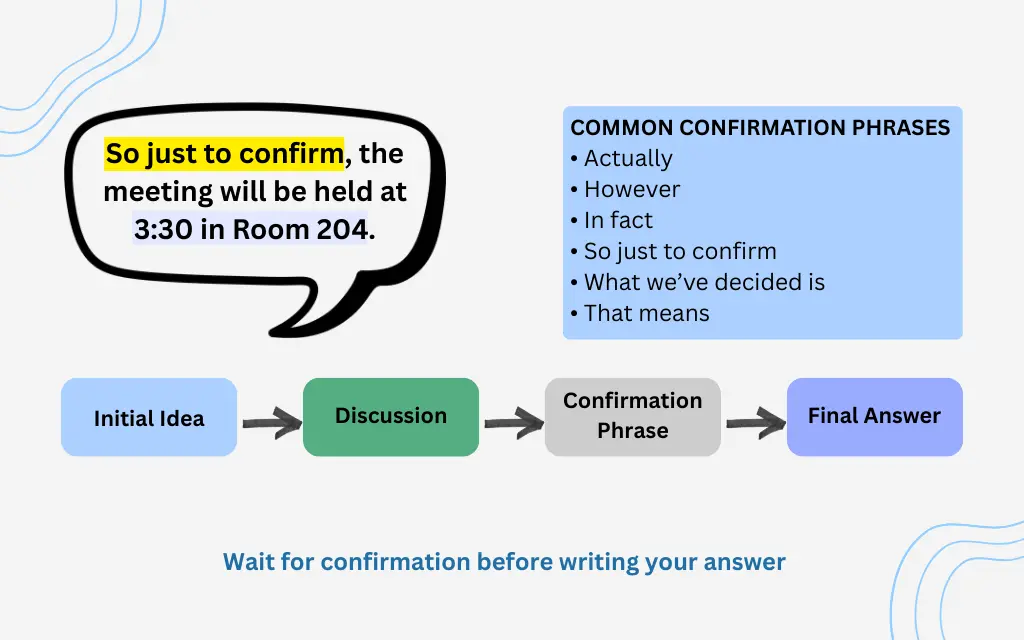
One of the most powerful strategies in IELTS Listening is waiting for confirmation.
Speakers often reinforce final decisions with phrases such as:
- “Actually…”
- “However…”
- “In fact…”
- “So just to confirm…”
- “What we’ve decided is…”
For example:
“So just to confirm, the meeting will be held at 3:30 in Room 204.”
That confirmation phrase signals certainty.
Distractors Across Different Sections
IELTS listening distractors appear in every section, but their complexity increases.
- Section 1: Often involve numbers, dates, spelling corrections
- Section 2: Common in explanations of facilities or plans
- Section 3: Frequently appear in academic discussions where ideas evolve
- Section 4: Subtle clarification of theories or conclusions
The higher the section, the more nuanced the distractors become.
However, the pattern remains consistent: early idea → revision → final meaning.
Staying Calm When It Happens
Falling for a distractor during practice is not failure. It is training.
When reviewing mistakes, ask:
- Did I stop listening too early?
- Did I ignore a contrast word?
- Did I misunderstand paraphrasing?
Over time, you begin to anticipate idea shifts instead of being surprised by them.
Strong candidates are not faster listeners.
They are more controlled listeners.
How Distractors Affect Your Band Score
Distractors are one of the main reasons candidates aiming for Band 7 remain at Band 6.5.
It is rarely vocabulary weakness.
It is often impatience.
When you train yourself to:
- Listen for the full sentence
- Notice contrast signals
- Wait for confirmation
your accuracy increases quickly.
IELTS listening distractors reward composure and analytical listening.
A Practical Method for Improvement
To build awareness:
- Complete a practice Listening test.
- Identify every question you answered incorrectly due to a change in information.
- Replay the section slowly.
- Pause at the initial idea.
- Continue listening until the final correction appears.
This deliberate practice trains your ear to recognise revision patterns.
Distractors are predictable once you understand how they function.
Conclusion
IELTS listening distractors are not unfair tricks.
They reflect natural spoken English, where speakers:
Change their minds
Clarify details
Correct themselves
Your task is to follow meaning until it is complete.
If you train yourself to:
Listen for contrast words
Wait for confirmation
Track final decisions
Avoid reacting too quickly
you will handle listening traps with confidence.
To continue strengthening your Listening performance, explore the links below. Mastering distractors is one of the most powerful upgrades you can make to your Listening band score.
Related IELTS Listening Lessons
- Distractors in IELTS Listening (Why Answers Change)
- IELTS Listening Section 3 Explained
- Common IELTS Listening Mistakes (And How to Avoid Them)
Glossary
Distractor (n.)
Information that appears correct at first but is later corrected or changed.
Correction (n.)
A revision of previously stated information.
Contrast (n.)
A shift between ideas, often signalled by words such as but or however.
Confirmation (n.)
A statement that verifies final, accurate information.
Listening Trap (n.)
A misleading detail designed to test careful listening.
Practice Section
(MCQ) A distractor is:
A. The final answer
B. A repeated word
C. Information that is later corrected
D. A spelling error
(True/False) The first number you hear is usually the correct answer.
(Short Answer) Which type of words often signal that information will change?
(MCQ) In the sentence “We planned to start in May, but we postponed it to June”, the correct answer is:
A. May
B. June
C. Both
D. Neither
(True/False) Distractors are unfair tricks designed to confuse candidates.
Answers
C
False
Contrast words such as but, however, or actually.
B
False
Join 1,300+ English learners
Get free English lessons, IELTS tips and useful vocabulary by email.
No spam. Just practical English you can use.