
Introduction to Self-Assessing IELTS Writing Accurately
Practising writing for IELTS can feel productive without leading to real improvement. Essays are completed, corrections are made, and comparisons are drawn, yet scores remain unpredictable.
The missing skill is often accurate self-assessment. Most candidates believe they are checking their writing, but they are usually rereading it with familiarity rather than judging it objectively.
This lesson explains how to self-assess IELTS writing accurately, why candidates often misjudge their own level, and how to learn to see writing from an examiner’s point of view rather than a writer’s.
Practise English every weekday with me
Get short Mon–Fri English practice in LINE with LEW Daily, plus regular feedback to help you improve.
Explore LEW DailyNT$399/month • Cancel anytime

Why self-assessment is difficult in IELTS writing
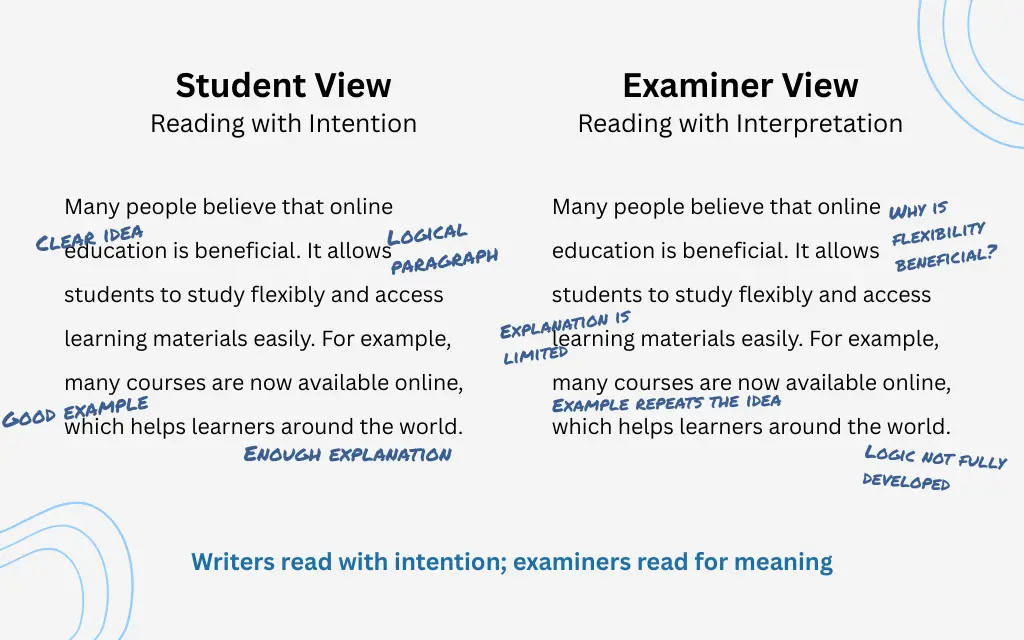
Self-assessment is challenging because writers read with intention, not interpretation.
When you read your own work, you already know what you meant. Your brain fills in gaps automatically. Weak explanations feel sufficient. Unclear links feel obvious.
Examiners do not have this advantage. They see only what is written.
This difference in perspective explains why candidates often feel confident yet repeatedly receive Band 6 or 6.5. The issue is not effort, but distance.
Checking versus self-assessing
Many learners confuse editing with assessment.
What checking usually involves
Checking focuses on surface features such as grammar, spelling, and vocabulary changes.
What self-assessment requires
Self-assessment means judging performance against marking criteria.
An examiner does not ask whether a sentence is correct. They ask whether a paragraph fulfils its purpose clearly and completely.
Until this shift is made, practice tends to repeat the same weaknesses.
Start with task completion, not language
Accurate self-assessment always begins with task response.
For Task 2, this means checking whether every part of the question is addressed, a clear position is presented, and ideas are developed rather than listed.
For Task 1, this means checking whether key features are selected, a clear overview is provided, and comparisons are made logically.
Many candidates lose marks because they polish language in an incomplete response. Examiners always prioritise completion before accuracy.
How examiners actually read your writing
Understanding examiner behaviour is essential for realistic self-assessment.
Examiners read efficiently, not sympathetically. They look for signals of control.
They notice structure before vocabulary, clarity before complexity, and development before grammatical precision.
If ideas are unclear at first reading, strong language cannot compensate.
Assess structure before details
One of the most reliable self-assessment techniques is to step back from the text.
Before correcting anything, ask:
- Is the structure immediately clear
- Does each paragraph focus on one main idea
- Is the progression of ideas logical
If these questions are difficult to answer, the examiner likely experienced the same difficulty.
This stage often reveals more than sentence-level correction ever will.
Why comparing to model answers often fails
Many candidates try to self-assess by comparing their writing to model answers found online.
This approach is usually misleading.
Model answers are written without time pressure, edited multiple times, and often exceed the required band level.
As a result, comparison shifts attention away from criteria and towards style. This makes judgement less accurate, not more.
Effective self-assessment focuses on examiner expectations, not polished examples.
Use the questions examiners implicitly ask
A practical way to self-assess is to adopt examiner-style questions.
After each paragraph, ask:
- Is the main idea clear without rereading
- Is the idea explained or merely stated
- Does this paragraph directly answer the task
If the answer is uncertain, that paragraph is likely limiting the score.
Separate assessment from improvement
Trying to fix writing while assessing it reduces accuracy.
Assessment should come first. During this stage, do not change anything. Identify missing explanation, weak logic, or repetition only.
Rewriting comes later.
This separation mirrors examiner behaviour. Examiners judge, they do not revise.
Common self-assessment blind spots
Even experienced candidates tend to miss the same issues.
These include assuming examples are obvious, overestimating paraphrasing clarity, and believing longer sentences sound more academic.
Examiners consistently penalise these areas, especially at Band 6 and 6.5.
Learning to notice these patterns in your own writing is a major step forward.
Why self-assessment accelerates improvement
Writing more essays does not automatically raise scores.
Targeted self-assessment does.
When you can identify why a piece of writing sits at Band 6 rather than Band 7, practice becomes focused. Each new essay addresses a specific weakness instead of repeating old habits.
This is why candidates who learn accurate self-assessment often improve faster than those who simply practise more.
Conclusion
Accurate IELTS writing self-assessment is a skill, not a talent.
It requires stepping away from how writing feels and judging it against examiner expectations. When done correctly, self-assessment transforms practice into progress.
If improvement has felt slow or unpredictable, learning to assess your writing honestly may be the most effective change you can make.
Related IELTS Examiner Insight Lessons
Glossary
Self-assessment (noun) — judging your own work using clear criteria
Examiner (noun) — trained professional who marks IELTS writing
Task response (noun) — how fully the question is answered
Criteria (noun) — official standards used for marking
Perspective (noun) — a particular way of seeing something
Practice Questions
- True or False: Self-assessment means correcting grammar mistakes.
- Multiple choice: What should be assessed first?
A) Vocabulary
B) Structure and task completion
C) Sentence length - Short answer: Why are model answers unreliable for self-assessment?
- True or False: Examiners read essays slowly and sympathetically.
- Short answer: What is the benefit of separating assessment from rewriting?
Answers
- False
- B
- They are edited and not exam-realistic
- False
- It improves accuracy and clarity of judgement
Join 1,300+ English learners
Get free English lessons, IELTS tips and useful vocabulary by email.
No spam. Just practical English you can use.