
Introduction to IELTS Listening Section 3
For most candidates, this is where the Listening test becomes genuinely challenging.Section 1 feels manageable. Section 2 requires focus. But IELTS Listening Section 3 often causes a noticeable drop in confidence.
The reason is simple: the format changes again.
Instead of everyday conversation or a single speaker, Section 3 introduces an academic discussion listening context. You will usually hear two students and sometimes a tutor discussing coursework, research, or assignments.
The language becomes more abstract. The ideas become less predictable. The distractors become more sophisticated. This lesson will explain what makes Section 3 different, why it feels harder, and how to approach it strategically without losing confidence.
Once you understand how section 3 listening IELTS works, it becomes structured rather than overwhelming.
Practise English every weekday with me
Get short Mon–Fri English practice in LINE with LEW Daily, plus regular feedback to help you improve.
Explore LEW DailyNT$399/month • Cancel anytime

What Is IELTS Listening Section 3?
IELTS Listening Section 3 features an academic discussion.
Typically, you will hear:
- Two students discussing a project
- A student and a tutor reviewing coursework
- A group planning research
- A discussion about an academic topic
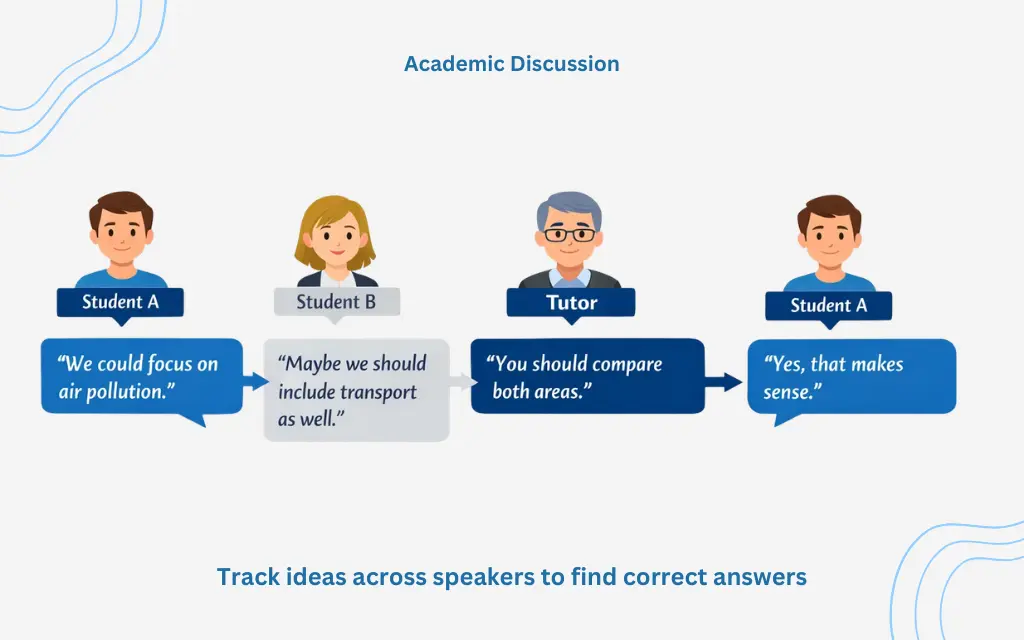
Unlike Section 2, this is not a monologue. Multiple speakers interact. They interrupt, agree, disagree, clarify, and revise their ideas. The challenge is not vocabulary alone. It is tracking ideas across different speakers.
Why IELTS Listening Section 3 Feels Harder
Students often describe Section 3 as confusing rather than difficult.
The difficulty usually comes from three factors.
First, multiple voices speak. You must identify who is talking quickly.
Second, opinions change. A speaker may begin with one idea and later modify it.
Third, distractors are more subtle than in earlier sections.
For example:
Student A: “We could focus on urban transport.”
Student B: “That might work, but the tutor suggested narrowing it down.”
Tutor: “Yes, specifically the environmental impact of electric buses.”
If the question asks about the final focus of the project, the answer is not “urban transport”. It is “the environmental impact of electric buses”.
The discussion develops gradually. Section 3 tests whether you can follow that development logically.
What Academic Discussion Listening Really Tests
In section 3 listening IELTS, you are not simply listening for numbers or basic details.
You are listening for:
- Decisions
- Reasons
- Opinions
- Agreements and disagreements
- Clarifications
The speakers may hesitate or reconsider their views. This mirrors real university discussions. If you listen only for keywords, you will fall into traps. You must follow the meaning as it evolves.
Common Question Types in IELTS Listening Section 3
Section 3 introduces more cognitively demanding tasks.
Multiple Choice Questions
These often test reasoning rather than factual detail.
You may hear several possible answers before the final decision is made.
For example:
“We first considered surveying secondary school students, but after checking the research guidelines, we realised university students would be more appropriate.”
If the question asks who they will survey, the answer is “university students”.
The first idea is not correct.
Matching Tasks
You may need to match:
- Students to their concerns
- Ideas to categories
- Research stages to descriptions
These tasks require careful tracking of who says what. If one student expresses doubt and another expresses enthusiasm, confusing them will cost you marks.
Sentence Completion
Sentence completion in Section 3 often involves academic vocabulary.
Here, word limits and spelling are critical. Even if you understand the discussion, a small grammatical mistake can lose the mark.
Understanding Distractors in Section 3
Distractors in IELTS Listening Section 3 are often logical alternatives rather than obvious corrections.
In Section 1, a distractor might be a clear correction:
“No, sorry, that’s 15 — I meant 50.”
In Section 3, it is more subtle:
“We thought about using online surveys, but after reviewing the tutor’s feedback, we decided interviews would be more effective.”
Both ideas sound reasonable. Only the final decision is correct.
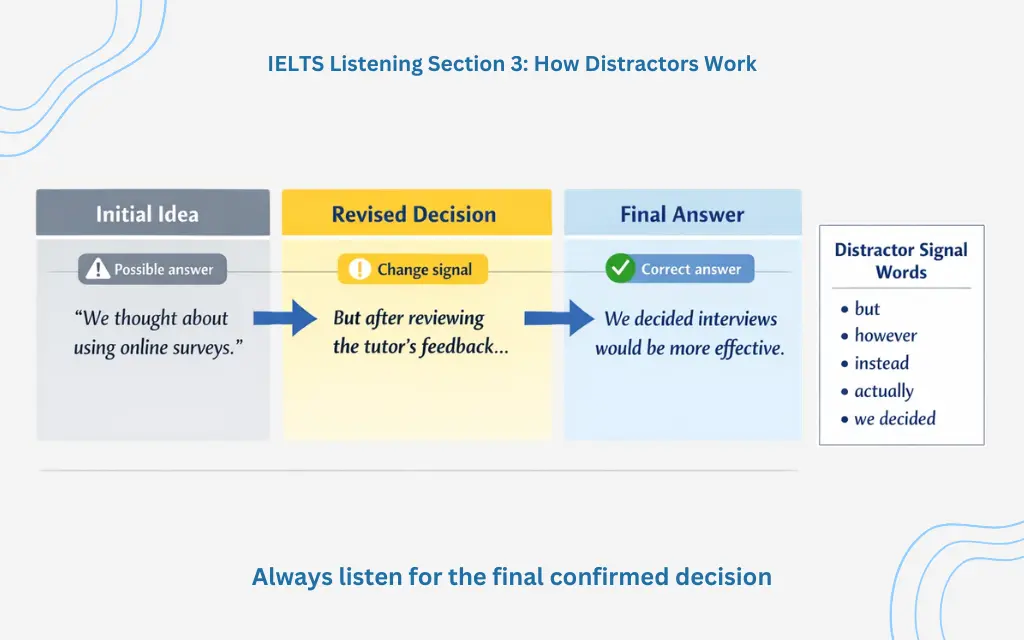
Strong candidates listen for the final confirmed position.
How to Track Multiple Speakers Effectively
One of the biggest challenges in Section 3 is identifying speakers quickly.
When the recording begins:
- Notice tone and gender
- Identify who speaks first
- Pay attention to introductions
During preparation time, underline keywords in the questions.
If a question refers to “the tutor’s advice”, focus specifically on what the tutor says. If it refers to “the students’ concerns”, listen for student dialogue. You do not need to remember every word. You need to follow the direction of the discussion.
Managing Speed and Mental Focus
Section 3 often feels fast because academic discussion includes:
- Interruptions
- Informal phrasing
- Rapid exchanges
- Overlapping ideas
To manage this:
Stay focused on the current question only.
Avoid reading too far ahead.
If you miss one answer, reset immediately. Do not mentally replay what you missed. The recording continues.
Strong listeners move forward quickly and maintain stability.
How Section 3 Influences Your IELTS Listening Band Score
Many candidates aiming for Band 7 or higher lose valuable marks in Section 3.
It is often the section where weaker listeners begin to fall behind.
However, confident candidates treat Section 3 as an opportunity.
If you can:
- Recognise final decisions
- Identify speaker roles
- Detect subtle opinion shifts
- Avoid logical distractors
your overall IELTS listening band score improves significantly.
Section 3 rewards analytical listening, not just vocabulary knowledge.
A Practical Strategy for IELTS Listening Section 3
Before the recording begins:
Read the questions carefully.
Predict what type of information is required:
Is it a reason?
A decision?
An opinion?
During the recording, listen for contrast signals such as:
- However
- Actually
- In fact
- But
- Instead
These words often introduce the correct answer.
After completing each question, mentally move forward. Do not linger.
Section 3 feels difficult because it requires deeper listening, but it becomes manageable with structured practice.
Conclusion
IELTS Listening Section 3 introduces academic discussion and multiple speakers.
It feels harder because:
- Ideas evolve
- Speakers interact
- Distractors sound logical
Success depends on:
- Tracking who is speaking
- Identifying final decisions
- Listening for reasoning rather than keywords
- Staying mentally steady
With deliberate practice, Section 3 becomes predictable rather than intimidating.
To strengthen your Listening preparation further, explore:
- Common IELTS Listening Mistakes
- IELTS Listening Section 2 Explained
- How IELTS Listening Is Marked
Listening improvement comes from understanding patterns, not memorising tricks.
Related IELTS Listening Lessons
-
- IELTS Listening – Complete Guide to Sections and Question Types
-
Multiple Choice Questions in IELTS Listening
- Distractors in IELTS Listening (Why Answers Change)
- IELTS Listening – Complete Guide to Sections and Question Types
Glossary
Academic Discussion (n.)
A conversation about coursework or research.
Distractor (n.)
Incorrect information designed to mislead candidates.
Clarification (n.)
An explanation that makes something clearer.
Opinion (n.)
A personal belief or viewpoint.
Band Score (n.)
A score from 1–9 based on the number of correct answers.
Practice Section
(MCQ) IELTS Listening Section 3 usually involves:
A. A single speaker describing a map
B. A casual phone call
C. An academic discussion between speakers
D. A news report
(True/False) In Section 3, the first idea mentioned is always correct.
(Short Answer) Why are distractors more difficult in Section 3?
(MCQ) Which signal word often introduces the correct answer?
A. Firstly
B. However
C. Also
D. Additionally
(True/False) If you miss one answer in Section 3, you should stop listening and try to remember it.
Answers
C
False
Because ideas change gradually and incorrect alternatives sound logical.
B
False
Join 1,300+ English learners
Get free English lessons, IELTS tips and useful vocabulary by email.
No spam. Just practical English you can use.