
Introduction to Prepositions in IELTS Writing
Many IELTS candidates feel confident about their writing until their score arrives. The ideas are relevant, vocabulary is wide, and sentences look advanced. Yet the band score is lower than expected, often stuck at 6 or 6.5.
One quiet reason for this is prepositions.
In IELTS writing, prepositions such as in, on, at, to, for, and with cause constant, repeated errors. These mistakes rarely block meaning completely, but they reduce grammatical accuracy. Over a full Task 1 or Task 2 response, that reduction adds up.
This lesson will focus on prepositions in IELTS writing, explaining the errors examiners notice most, why they matter, and how to reduce them in a practical, exam-safe way.
Practise English every weekday with me
Get short Mon–Fri English practice in LINE with LEW Daily, plus regular feedback to help you improve.
Explore LEW DailyNT$399/month • Cancel anytime

Why Prepositions Matter in IELTS Writing
Prepositions are small words, but they appear everywhere. Every paragraph contains them. Every sentence depends on them.
From an examiner’s perspective, this makes prepositions a powerful signal. When they are used naturally and consistently, writing feels controlled. When they are used inaccurately, writing feels unstable, even if the ideas are strong.
In the IELTS marking system, grammar is judged on accuracy across the whole response, not on isolated sentences. Preposition mistakes are rarely dramatic, but their frequency quietly lowers the overall impression of control.
This is why prepositions are closely linked to grammar accuracy in IELTS, especially at Band 6–7 boundaries.
How Examiners Actually Notice Preposition Errors
Examiners do not count preposition mistakes one by one. Instead, they read fluently and form an impression.
If prepositions are mostly correct, occasional errors are treated as slips. If prepositions are often wrong or awkward, the writing begins to feel non-native, even if it is still understandable.
This distinction matters. IELTS is not marking your grammar knowledge. It is assessing how naturally and reliably you use English to communicate ideas under exam conditions.
What Prepositions Really Do in English
Before looking at errors, it helps to understand the role prepositions play.
Prepositions show relationships: time, place, movement, cause, and connection. They link nouns, verbs, and ideas together. When the wrong preposition is used, the relationship becomes unclear or unnatural.
A helpful visual here would show one sentence with different prepositions highlighted, each subtly changing the meaning or sounding increasingly unnatural.
Why Prepositions Are So Difficult for IELTS Candidates
Prepositions are difficult because they do not follow neat, logical rules.
Many learners try to translate prepositions directly from their first language. Others memorise lists without understanding usage. Both strategies fail under exam pressure.
English prepositions are largely collocational, meaning they depend on habit rather than logic. Native speakers learn them through exposure, not rules. IELTS candidates must therefore focus on patterns, not memorisation.
Common Preposition Mistakes in IELTS Writing
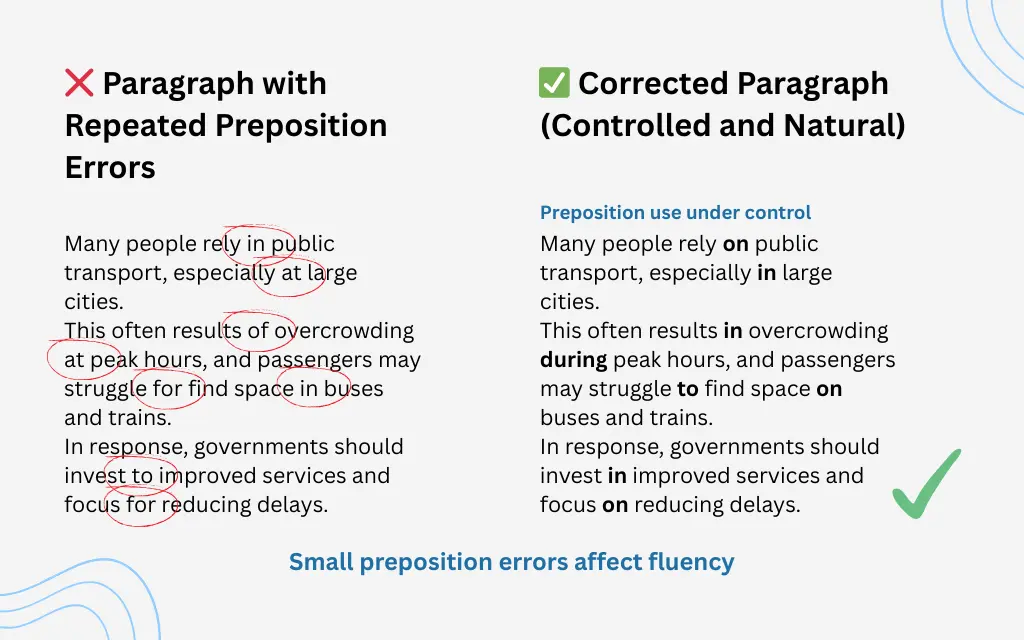
Some preposition errors appear far more often than others in IELTS scripts. These errors usually fall into predictable patterns.
One frequent issue is using the wrong preposition after common verbs or adjectives. Another is confusing prepositions of time and place. A third is adding unnecessary prepositions where none are needed.
Prepositions of Time: Where Errors Appear Most
Time expressions are everywhere in IELTS writing, particularly in Task 1. Candidates often confuse in, on, and at, especially when describing years, months, periods, or specific points.
Errors here rarely destroy meaning, but they are extremely noticeable to examiners because the correct forms are very stable in academic English.
Improving time prepositions alone can noticeably improve the naturalness of Task 1 reports.
Prepositions of Place and Data Description
In Task 1, prepositions are essential for describing charts, tables, and processes. Words like in, at, by, from, and to carry key information.
Candidates often overuse one preposition repeatedly, creating awkward phrasing. Others choose prepositions that sound logical but are not idiomatic.
Because Task 1 is short, even a small number of preposition errors can have a visible impact on grammar accuracy.
Verb + Preposition Combinations
One of the most common sources of preposition mistakes in IELTS writing is verb-preposition combinations.
Verbs such as depend, focus, result, lead, and contribute almost always require specific prepositions. When the wrong one is used, examiners immediately notice.
These errors are especially common in Task 2 essays, where abstract ideas require academic verbs. The mistake is rarely serious alone, but repetition across an essay signals weak control.
Adjective + Preposition Patterns
Adjectives also create problems. Learners often know the adjective but guess the preposition.
For example, phrases like responsible for, interested in, and aware of are extremely common in IELTS essays. When these combinations are incorrect, the sentence feels unnatural even if the grammar looks complex.
This is one reason advanced-looking vocabulary does not always produce higher scores.
When No Preposition Is Needed
Another frequent issue is adding prepositions where English does not need them.
This often happens after verbs such as discuss, consider, or request. Learners add a preposition because it exists in their first language or because the sentence feels incomplete without it.
In IELTS writing, unnecessary prepositions are just as damaging as incorrect ones because they break natural sentence flow.
Prepositions and Band Score Boundaries
At lower bands, preposition errors are frequent and often combined with other grammar issues.
At Band 6–6.5, prepositions are usually understandable but inconsistent. Errors appear regularly, especially with verbs and abstract ideas.
At Band 7 and above, preposition errors are rare and do not follow clear patterns. When they appear, they look like slips rather than habits.
Understanding this progression helps candidates focus on reducing frequency, not achieving perfection.
How to Improve Preposition Accuracy for IELTS
Improving prepositions does not mean memorising lists before the exam.
The most effective strategy is awareness. When reviewing writing, candidates should actively check prepositions, especially after verbs and adjectives. Over time, repeated correction builds stronger instinct.
This habit is far more effective than rule-based study under exam conditions.
Conclusion
Prepositions are one of the most common sources of grammar errors in IELTS writing, and one of the easiest ways to quietly lose marks.
Because they appear so often, even small mistakes reduce the examiner’s impression of grammatical control. Improving preposition accuracy does not require advanced grammar knowledge. It requires attention, pattern awareness, and consistent checking.
To strengthen this further, explore related IELTS grammar guides on Learn English Weekly that target the specific errors examiners notice most.
Related IELTS Grammar Lessons
Glossary
Preposition (noun) — A word that shows the relationship between a noun and another word
Collocation (noun) — Words that naturally occur together
Grammar accuracy (noun phrase) — Correct and consistent use of grammar structures
Examiner (noun) — The trained professional who assesses IELTS writing
Band score (noun) — The IELTS scoring scale from 0 to 9
Practice Questions
- True or False: Preposition mistakes often block meaning completely.
- Short answer: Why do examiners notice repeated preposition errors?
- Multiple choice: What matters more for IELTS grammar?
A) Knowing grammar rules
B) Using grammar consistently
C) Avoiding complex language - True or False: Preposition errors are more visible in shorter tasks.
- Short answer: What is the best way to improve prepositions for IELTS?
Answers
- False
- They signal weak grammatical control
- B
- True
- Regular checking and pattern awareness
Join 1,300+ English learners
Get free English lessons, IELTS tips and useful vocabulary by email.
No spam. Just practical English you can use.