
Introduction to IELTS Task 2 Common Mistakes
IELTS candidates leave the exam feeling confident about their Task 2 essay, only to receive a disappointing band score later. The ideas felt strong. The vocabulary looked impressive. The word count was correct. And yet, the score does not reflect the effort.
In most cases, the problem is not a lack of English ability. It is a collection of IELTS Task 2 mistakes that quietly limit the score, often without the candidate realising.
This lesson will explain the most common Task 2 writing errors, why examiners notice them immediately, and how to fix them in a practical, exam-focused way.
Practise English every weekday with me
Get short Mon–Fri English practice in LINE with LEW Daily, plus regular feedback to help you improve.
Explore LEW DailyNT$399/month • Cancel anytime

Why Small Mistakes Matter More in Task 2
Task 2 carries more weight than Task 1, and examiners read it with different expectations. They are not only assessing language. They are judging argument quality, logical development, and clarity of position.
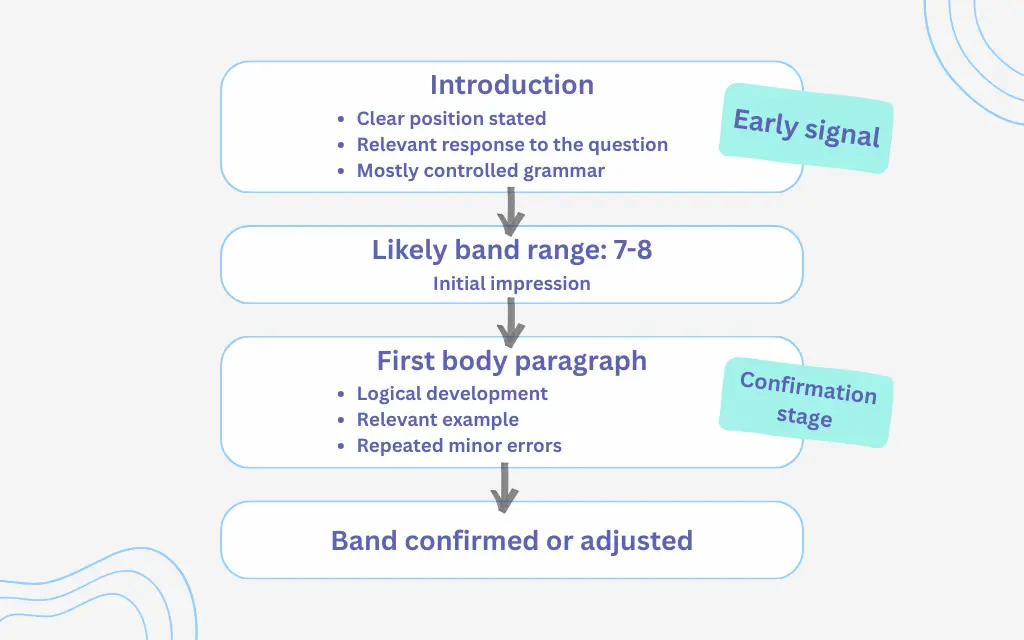
Small mistakes accumulate. One unclear sentence does not destroy a score, but repeated issues across paragraphs signal weak control. Examiners do not “average out” good and bad parts. They form an overall impression early and then look for confirmation.
Mistake 1: Not Answering the Question Fully
This is one of the most damaging Task 2 writing errors.
Candidates often write around the topic instead of responding directly to what is being asked. This usually happens when the question is misunderstood or when a memorised structure is forced onto the task.
For example, a question may ask for an opinion, but the essay discusses advantages and disadvantages without clearly stating a position. To the examiner, this looks like avoidance rather than balance.
The fix is not longer answers. It is careful question analysis before writing and a clear response that matches the task type exactly.
Mistake 2: Weak or Unclear Position
Examiners expect to know what you think.
In opinion-based questions, many candidates try to sound neutral or academic by hiding their position. This creates confusion. The essay may contain good language, but the argument feels directionless.
A clear position does not mean strong or emotional language. It means the reader can identify your viewpoint within the first paragraph and see it supported consistently.
This is especially important because Task Achievement depends heavily on clarity of stance.
Mistake 3: Overloading the Introduction
Introductions often fail not because they are short, but because they try to do too much.
Candidates may include background information, examples, personal opinions, and complex vocabulary before the essay has even started. This delays clarity and increases the risk of errors.
A strong introduction does two things well:
- It paraphrases the question accurately
- It signals your position or approach
Anything beyond that belongs in the body paragraphs.
Mistake 4: Paragraphs Without Clear Logic
Paragraph logic is a silent score-killer.
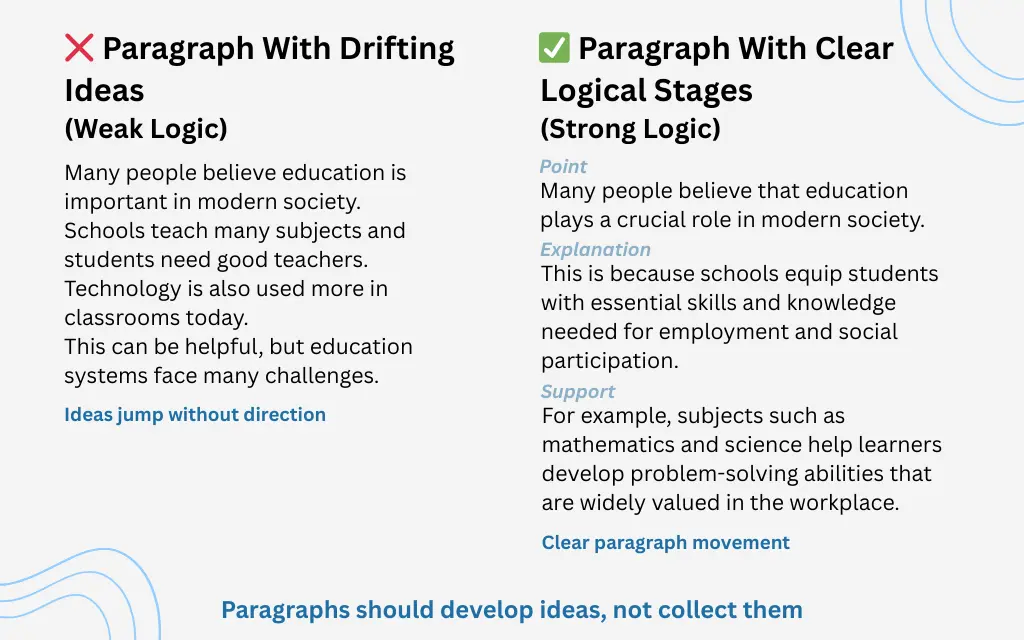
Many Task 2 essays look organised on the surface but collapse under close reading. Sentences are grammatical, yet the paragraph does not move logically from point to explanation to support.
Examiners notice this quickly. When ideas jump, repeat, or contradict each other, coherence suffers.
Mistake 5: Treating Examples as Decoration
Examples are not optional, but they must serve a purpose.
Some candidates add examples simply to increase length or sound academic. These examples are often vague, unrealistic, or unrelated to the main idea.
Examiners are not impressed by generic examples. They are looking for examples that explain or clarify a point, not just fill space.
A good example always links back clearly to the paragraph’s main idea.
Mistake 6: Using “Advanced Vocabulary” Incorrectly
This is one of the most misunderstood areas of IELTS writing.
Candidates believe that advanced vocabulary automatically increases scores. In reality, inaccurate or unnatural word choice reduces clarity and harms both Lexical Resource and Coherence.
Examiners prefer:
- Accurate words
- Natural collocations
- Controlled variety
One well-used word is better than three impressive but misused ones.
Mistake 7: Sentence Complexity Without Control
Complex sentences are important, but only when they work.
Many Task 2 writing errors come from forcing long sentences that collapse halfway through. When punctuation, clauses, or reference words fail, meaning becomes unclear.
Examiners prioritise control over ambition. A clean, accurate sentence builds confidence. A broken complex sentence creates doubt.
This is why Band 7 writing often looks simpler than Band 6 writing, but functions better.
Mistake 8: Repetition of Ideas Across Paragraphs
Repeating vocabulary is less harmful than repeating ideas.
Some essays restate the same point using different words across multiple paragraphs. This creates the illusion of development but does not actually progress the argument.
Examiners notice when body paragraphs could be merged without losing meaning. This signals weak planning rather than depth.
Each paragraph should add something new.
Mistake 9: Weak Conclusions
Conclusions are often rushed or treated as an afterthought.
Common problems include:
- Introducing new ideas
- Repeating the introduction word-for-word
- Ending without a clear final message
A strong conclusion summarises your position and main points clearly, without sounding mechanical. It should feel like a natural ending, not an obligation.
Mistake 10: Editing for Grammar Only
Many candidates check grammar but ignore logic.
They fix articles, verb tenses, and spelling, yet leave unclear arguments and weak cohesion untouched. Examiners care about how ideas connect, not just surface accuracy.
Effective checking means reading like an examiner, not like a grammar checker.
How Examiners Experience These Mistakes
Examiners do not count mistakes individually. They form impressions.
Repeated Task 2 writing errors send signals:
- Confusion suggests weak Task Achievement
- Disorganisation suggests poor Coherence
- Inaccurate language suggests limited control
Understanding this mindset helps you prioritise the right improvements.
How to Fix Task 2 Mistakes Systematically
The solution is not memorising better phrases. It is developing awareness.
Effective preparation focuses on:
- Understanding task types
- Strengthening paragraph logic
- Improving accuracy before complexity
- Practising examiner-style self-review
These skills improve both Task 1 and Task 2, but are especially critical in essays.
Conclusion
Most IELTS Task 2 mistakes are not dramatic. They are small, repeated issues that quietly limit your band score.
By understanding what examiners notice first (clarity, control, and logical development) you can fix these problems without rewriting your entire approach.
To continue improving, explore related Task 2 guides on Learn English Weekly, especially those covering essay structure, paragraph logic, and examiner marking criteria.
Related IELTS Task 2 Lessons
Glossary
Task Achievement (noun) — How well the essay answers the question
Coherence (noun) — Logical organisation and flow of ideas
Cohesion (noun) — How sentences link together
Position (noun) — The writer’s viewpoint or opinion
Argument (noun) — A structured set of ideas supporting a position
Practice Questions
- True or False: Using advanced vocabulary always increases Task 2 scores.
- Short answer: Why is paragraph logic important for coherence?
- Multiple choice: Which mistake most directly affects Task Achievement?
A) Weak conclusion
B) Not answering the question fully
C) Repeating vocabulary - True or False: Examiners count grammar mistakes individually.
- Short answer: What should a strong conclusion avoid?
Answers
- False
- It helps ideas develop clearly and logically
- B
- False
- Introducing new ideas
Join 1,300+ English learners
Get free English lessons, IELTS tips and useful vocabulary by email.
No spam. Just practical English you can use.