
How to Review IELTS Listening Practice Properly (And Actually Improve)
Most candidates complete a listening practice test, check their answers, note the score, and then move on to the next test. While this feels productive, it rarely leads to significant improvement. When you review IELTS listening practice properly, the most important learning does not happen during the test itself. It happens afterwards.
Listening self assessment in IELTS requires more than counting correct answers. It requires structured analysis. Without it, the same mistakes tend to repeat, and scores plateau.
This lesson will explain how to review IELTS listening practice effectively, how to diagnose weaknesses accurately, and how to turn each test into measurable progress.
Practise English every weekday with me
Get short Mon–Fri English practice in LINE with LEW Daily, plus regular feedback to help you improve.
Explore LEW DailyNT$399/month • Cancel anytime

Why Most Candidates Review Incorrectly
A common scenario looks like this: you complete a practice test and score 26 out of 40. You quickly check which answers were wrong, feel disappointed, and close the book.
This is not review. It is score-checking.
True review involves asking precise questions:
- Why did I lose this mark?
- Was it spelling or plural form?
- Did I fall for a distractor?
- Did I miss the answer due to timing?
- Did I misunderstand the structure of the question?
Practice reveals your current level. Review changes it.
Step 1: Categorise Every Mistake
After completing a test, resist the temptation to start another one immediately. Instead, examine each incorrect answer carefully.
Most listening errors fall into predictable categories:
- Detail errors (spelling, plural endings, numbers)
- Distractors (initial information later corrected)
- Timing issues (missing the next answer after hesitation)
- Mishearing specific words
- Grammar mismatches with the sentence structure
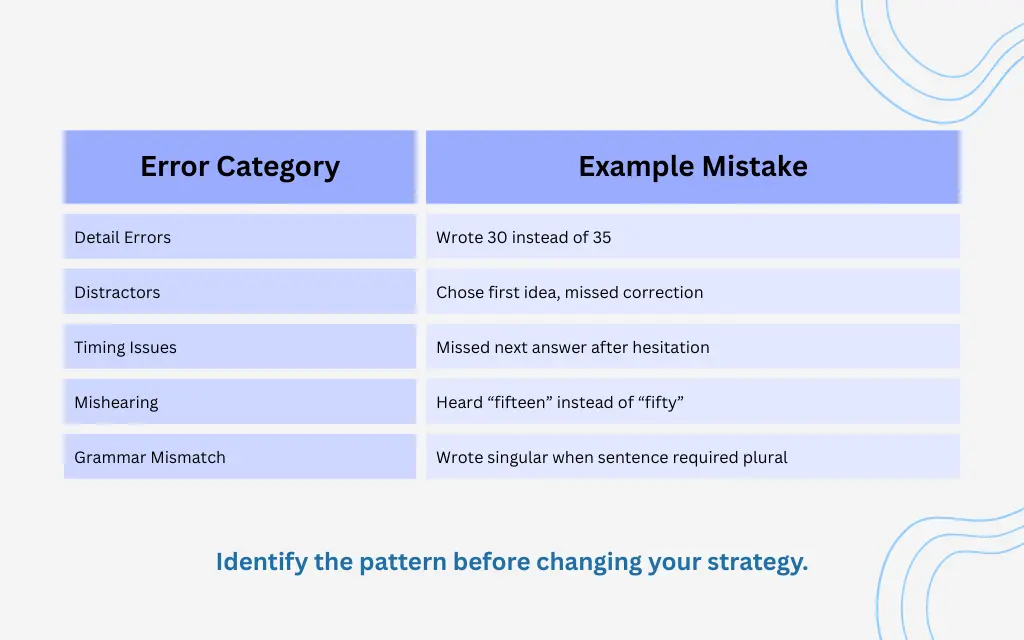
When you categorise errors systematically, patterns begin to appear. You may notice, for example, that three of your mistakes were caused by plural endings. That indicates a technical habit rather than a listening weakness.
This is genuine listening self assessment in IELTS preparation.
Step 2: Replay with Purpose
Reviewing IELTS listening practice does not mean replaying the entire recording casually. It means returning to the exact moment where the mistake occurred.
Pause at the key sentence and ask:
- Did I react too quickly?
- Did I stop listening after the first number?
- Did I ignore a contrast word such as “but” or “actually”?
For example:
“The cost was initially £45, but we reduced it to £40.”
If you wrote 45, the issue was impatience, not vocabulary.
Purposeful replay builds awareness of how listening traps work.
Step 3: Check the Question Structure
Sometimes the error lies not in listening but in reading the question carefully.
If the instruction states:
“NO MORE THAN TWO WORDS”
and you write three words, the mistake is technical.
If it states:
“Write ONE WORD ONLY”
and you write a phrase, the mark is lost.
Effective review includes checking whether you respected instructions, word limits, and grammatical fit within the sentence.
Accuracy matters as much as comprehension.
Step 4: Create a Personal Error Log
Sustained improvement requires tracking patterns over time.
After each test, record:
- Question number
- Correct answer
- Your answer
- Category of error
- Reason for mistake
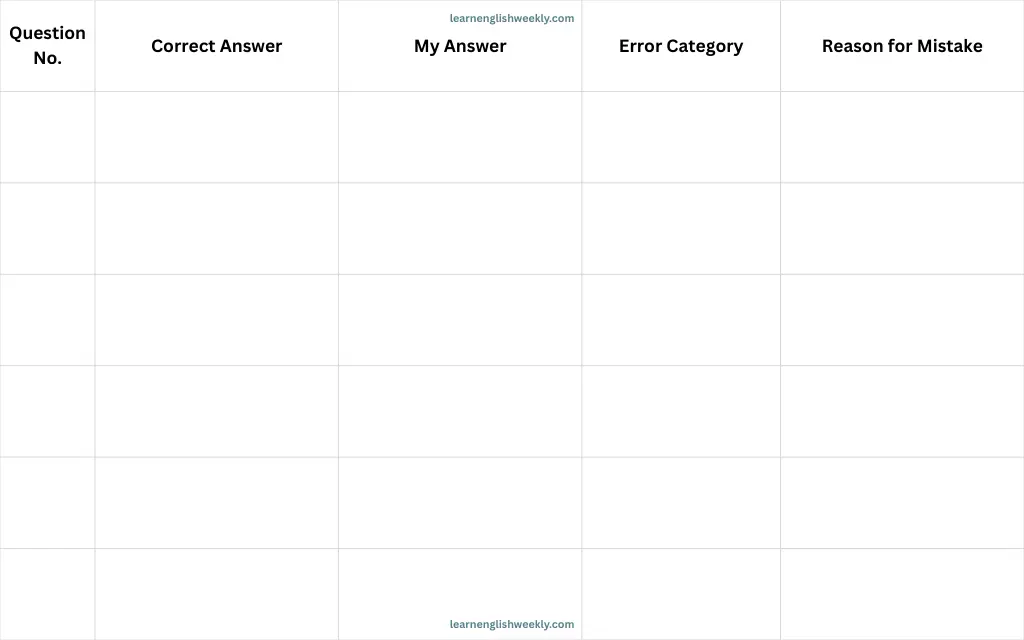
After several tests, trends become visible. You may notice consistent issues in Section 3 or frequent number confusion above twenty.
When weaknesses are visible in writing, they become easier to fix.
Step 5: Target Weakness Before the Next Test
One of the most common mistakes is completing another full test immediately.
Instead, address the weakness first.
If your errors were mostly spelling, spend focused time correcting common spelling patterns. If distractors caused problems, practise recognising contrast language. If timing was the issue, practise moving forward quickly after a missed answer.
Only then return to a full listening test.
This approach transforms repetition into strategy.
Emotional Control During Review
Review can feel uncomfortable because it exposes patterns of error. However, this discomfort is productive.
Every incorrect answer contains information.
Instead of thinking, “My listening is weak,” a more productive mindset is, “I lose marks due to plural endings. That is fixable.”
Listening self assessment in IELTS preparation requires emotional discipline as well as technical awareness.
From Score-Focused to Skill-Focused
Many candidates fixate on band scores during practice. A more effective approach is to focus on skill development.
Ask yourself:
- Can I recognise corrections quickly?
- Am I confident with numbers and dates?
- Can I maintain focus in Section 4?
- Do I check spelling systematically?
As skills strengthen, scores rise naturally.
Why Review Is Essential for Band 7
For candidates aiming for Band 7, careful review is non-negotiable.
The difference between Band 6.5 and Band 7 is often two or three marks. Those marks frequently come from:
- Plural errors
- Spelling mistakes
- Distractors
- Timing lapses
Systematic review allows you to eliminate these small but costly weaknesses. Without review, they can persist for months despite extensive practice.
Creating a Sustainable Review Routine
A simple review structure might look like this:
Day 1: Complete a full listening test.
Day 2: Analyse every incorrect answer.
Day 3: Target specific weaknesses with focused exercises.
Day 4: Complete shorter, controlled listening practice.
This rhythm prevents burnout and encourages steady, measurable growth.
Improvement becomes predictable rather than accidental.
Conclusion
To review IELTS listening practice properly, shift your focus from score to diagnosis.
When you:
- Categorise mistakes
- Replay with purpose
- Track patterns
- Target weaknesses
- Maintain emotional control
you transform practice into structured improvement.
To deepen your listening strategy further, explore the lessons linked below. Smart review builds consistent progress.
Related IELTS Listening Lessons
Glossary
Review (v.)
To examine performance carefully after completing a task.
Self Assessment (n.)
Evaluating your own performance to identify strengths and weaknesses.
Error Log (n.)
A structured record of mistakes and their causes.
Diagnosis (n.)
Identifying the underlying reason for a problem.
Pattern (n.)
A repeated behaviour or type of mistake.
Practice Section
Questions
- (True/False) Checking your score is the same as reviewing your test.
- (MCQ) The first step in effective review is to:
A. Do another test immediately
B. Categorise your mistakes
C. Ignore small errors
D. Memorise answers - (Short Answer) Why is keeping an error log useful?
- (MCQ) If you often lose marks due to plurals, your next step should be to:
A. Take a break
B. Practise spelling and plural endings
C. Change test books
D. Guess more confidently - (True/False) Emotional control during review helps improvement.
Answers
- False
- B
- Because it helps you identify patterns and target weaknesses.
- B
- True
Practise English every weekday with me
Get short Mon–Fri English practice in LINE with LEW Daily, plus regular feedback to help you improve.
Explore LEW DailyNT$399/month • Cancel anytime