
Introduction to IELTS Listening Spelling and Plurals
Many candidates understand the recording clearly, hear the correct answer, write it down confidently, and still lose the mark. In most cases, the issue is not comprehension but accuracy, specifically IELTS listening spelling or a missing plural ending.
Spelling errors and plural mistakes in IELTS Listening are among the most common reasons candidates lose marks. They seem minor and are often overlooked, yet they are entirely avoidable. For those aiming for Band 7 and above, eliminating these technical errors can immediately improve overall performance. Let's get started.
Practise English every weekday with me
Get short Mon–Fri English practice in LINE with LEW Daily, plus regular feedback to help you improve.
Explore LEW DailyNT$399/month • Cancel anytime

Why Spelling Matters in IELTS Listening
IELTS Listening is marked objectively. There is no partial credit, and your answer must match the correct form exactly.
If the correct answer is laboratories and you write laboratory, the mark is lost. If the correct answer is accommodation and you write acommodation, the answer is incorrect, regardless of whether you understood the meaning.
The test measures precision, not intention.
Why Plural Mistakes Are So Common
Plural mistakes in IELTS Listening frequently occur in sentence completion, form completion, and note completion tasks.
Consider the following example:
Question:
The hotel provides free ______ for guests.
Recording:
“The hotel provides free towels for all guests.”
If you write towel, the answer is wrong. The final “s” changes the meaning and therefore the mark.
The Grammar Clue Is Often in the Question
In many cases, the recording may not strongly emphasise the plural sound, especially in fast speech. However, the sentence itself often provides a grammatical clue.
For example:
There are several ______ available.
The word several already indicates that a plural noun is required. Strong candidates use grammar to confirm what they hear rather than relying on sound alone.
Listening carefully is important, but grammatical awareness provides an additional layer of protection against avoidable errors.
British and American Spelling in IELTS
IELTS follows British English conventions, although both British and American spellings are generally accepted if used consistently.
For example:
colour / color
centre / center
organise / organize
Consistency matters more than preference. Switching randomly between systems increases the likelihood of mistakes.
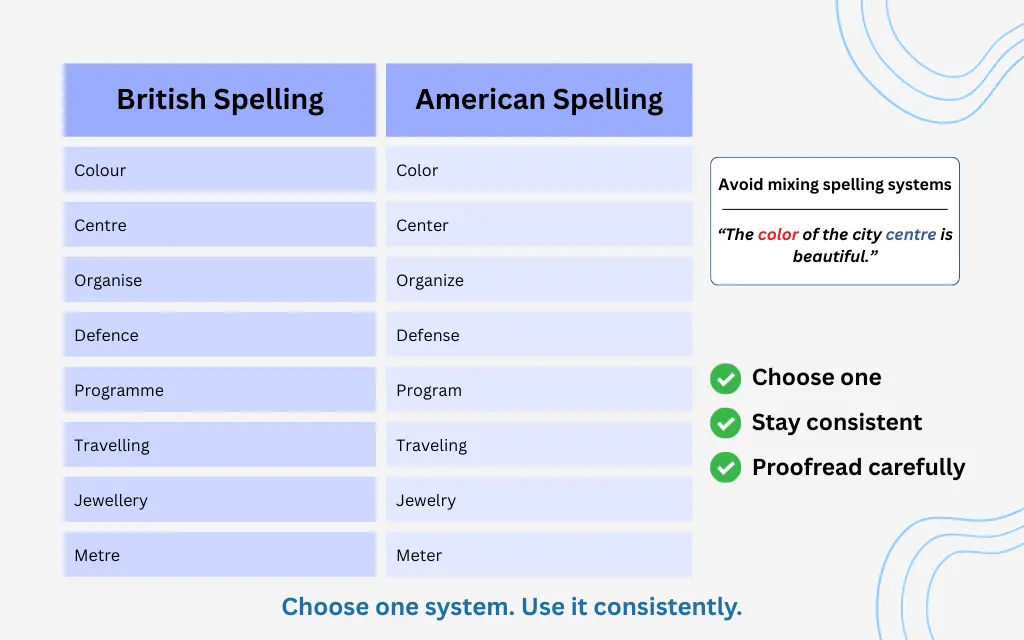
If you prepare using British spelling, it is usually safest to maintain that system in the exam.
Common Words That Cause IELTS Listening Spelling Errors
Certain high-frequency academic words regularly cause problems:
accommodation
environment
government
opportunity
separate
necessary
These are not advanced terms, yet they are frequently misspelled. A useful strategy is to build a personal “IELTS spelling list” based on errors made during practice. Patterns quickly become visible when you review carefully.
Improvement comes from awareness and correction, not from memorising long vocabulary lists.
Listening for Endings Carefully
Plural “s” is only one example of a meaningful ending. Other grammatical endings also affect accuracy, including:
- past tense (-ed)
- continuous form (-ing)
- adverbs (-ly)
For example:
“The equipment was recently upgraded.”
Writing upgrade would be grammatically incorrect.
Similarly:
“Participants must complete the form carefully.”
Writing careful changes the grammatical function and loses the mark.
IELTS listening spelling is therefore not only about correct letters, but about correct word form.
Word Limits and Technical Accuracy
Spelling and plural errors often interact with word limits.
If the instruction states:
“NO MORE THAN TWO WORDS”
and the correct answer is local residents, writing resident changes the number and meaning.
Accuracy in IELTS Listening includes:
- Correct spelling
- Correct singular or plural form
- Correct grammatical form
- Respecting the word limit
Why These Errors Are High-Impact
Spelling errors IELTS candidates make may seem minor, yet their impact can be significant. Losing four marks due to spelling or plural mistakes can reduce a Band 7 performance to Band 6.5.
That small difference can influence university admission, visa applications, or professional registration.
The key point is that these are not comprehension weaknesses. They are technical weaknesses, and technical weaknesses can be corrected quickly with focused practice.
A Practical Strategy to Improve IELTS Listening Spelling
Improvement requires targeted correction rather than general practice.
After each listening test:
- Review every incorrect answer.
- Identify whether the issue was spelling, plural form, grammar, or word limit.
- Rewrite the correct version carefully several times.
You can also practise listening specifically for final consonant sounds in short audio clips. Training your ear to hear small endings improves overall listening precision.
Progress comes from deliberate attention to detail.
Staying Calm Under Pressure
Under exam pressure, small errors become more likely. To reduce this risk:
Write clearly and legibly.
Avoid rushing.
Use final checking time actively and methodically.
Instead of rereading answers passively, scan deliberately for:
Missing plural endings
Double-letter mistakes
Common spelling traps
Word-limit errors
High-band candidates treat checking time as an essential part of performance strategy.
The Overlap with Reading Skills
There is a strong connection between spelling accuracy in Listening and copying accuracy in Reading.
In Reading, you must copy words exactly from the passage.
In Listening, you must reproduce words exactly as spoken.
Both skills depend on careful attention to detail and grammatical awareness. Improving one often strengthens the other.
Band 7+ candidates are rarely careless. They are consistent and methodical.
Conclusion
IELTS listening spelling and plural errors are small but powerful. They do not reflect weak English ability; they reflect weak checking habits.
When you train yourself to listen for final sounds, confirm singular and plural forms, respect word limits, and check spelling systematically, your score improves without the need for new vocabulary.
Precision, not complexity, often separates Band 6.5 from Band 7.
To continue strengthening your Listening skills, explore the related lessons below.
Related IELTS Listening Lessons
- Distractors in IELTS Listening (Why Answers Change)
- IELTS Listening Section 3 Explained
- Common IELTS Listening Mistakes (And How to Avoid Them)
Glossary
Plural (n.)
A word form referring to more than one person or thing.
Singular (n.)
A word form referring to one person or thing.
Spelling (n.)
The correct arrangement of letters in a word.
Accuracy (n.)
Correctness without error.
Word Limit (n.)
The maximum number of words allowed in an answer.
Join 1,300+ English learners
Get free English lessons, IELTS tips and useful vocabulary by email.
No spam. Just practical English you can use.