
IELTS Listening Time Management: How to Stay with the Audio and Stay Calm
Introduction
Many candidates do not lose marks in IELTS Listening because their English is weak. They lose marks because the recording continues while they hesitate.
The audio does not pause, repeat, or slow down. If you fall behind for even a few seconds, several answers can pass before you recover. This is why IELTS listening time management is not simply helpful, it is essential.
This lesson explains how listening timing in IELTS really works, how to follow the audio confidently, and how to manage your attention from the first section to the last without panic.
Practise English every weekday with me
Get short Mon–Fri English practice in LINE with LEW Daily, plus regular feedback to help you improve.
Explore LEW DailyNT$399/month • Cancel anytime

Understanding the Structure of IELTS Listening
Before discussing strategy, it is important to understand how timing is controlled in the test.
The Listening test lasts approximately 30 minutes and is divided into four sections, each containing ten questions. You are given short preparation time before each section begins.
However, the timing itself is controlled entirely by the recording. You cannot pause it, replay it, or slow it down.
Using Preparation Time Strategically
Before each section begins, you are given time to read the questions. This is not passive reading time; it is strategic preparation.
Start by checking the instructions and word limit. Then identify the question type and underline key words. Finally, predict the type of information required.
For example:
The seminar will take place in ______.
You expect a location.
Participants must bring their ______.
You expect a noun, probably an object.
Prediction allows you to anticipate meaning rather than react to sound. When you know what kind of answer is coming, it becomes much easier to follow the audio in IELTS Listening.
Staying with the Audio
One of the most common timing mistakes occurs after a missed answer. A candidate misses one detail, tries to recover it, stops listening, and then misses the next two answers as well.
Strong IELTS listening time management depends on recovery, not perfection.
If you miss an answer, move on immediately. The test is designed so that answers appear in order. If Question 5 has passed, Question 6 will follow shortly.
It is better to lose one mark than three.
Writing While Listening
Another common problem involves writing speed.
Some candidates attempt to write perfectly during the recording. Others pause mentally to check spelling or grammar. This interrupts concentration.
During the recording, your priority is listening. Write clearly but quickly. Avoid analysing spelling or grammar in detail at that moment. There will be time to check later.
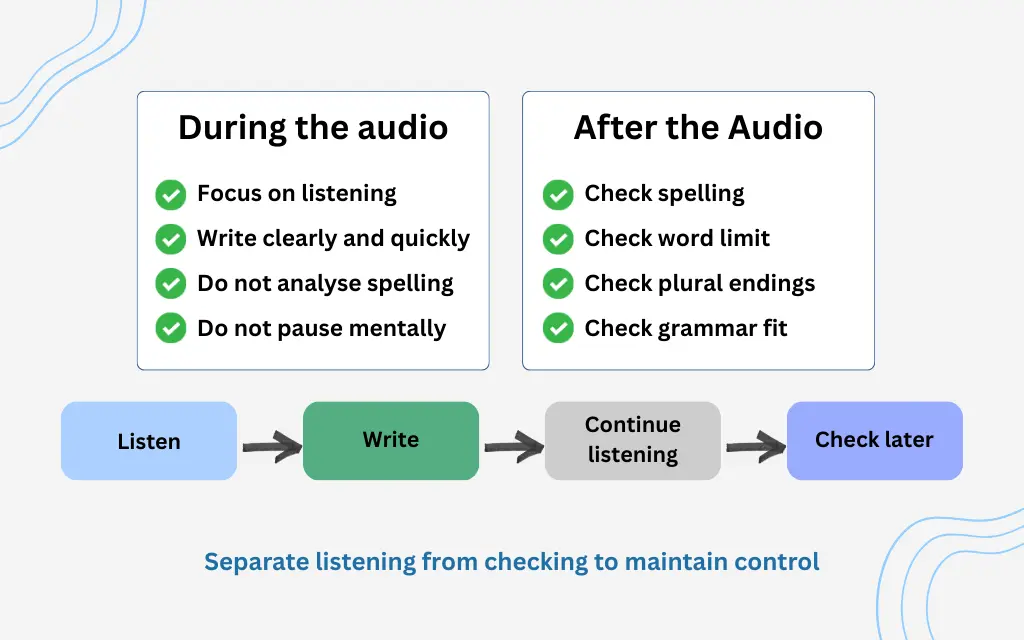
Separating listening from checking improves overall control.
Using the Pauses Between Question Groups
Most sections include short pauses between question groups, such as Questions 1–5 and Questions 6–10.
Use these moments efficiently. Quickly scan the next group of questions. Notice whether the topic or question type changes. Adjust your focus accordingly.
These brief preparation windows are extremely valuable in managing listening timing in IELTS.
Managing Sections 3 and 4
Sections 3 and 4 typically present greater timing challenges.
Section 3 includes multiple speakers discussing academic topics. Opinions may change, and answers can appear within complex exchanges.
Section 4 is usually a lecture delivered by one speaker, often with fewer pauses and faster information flow.
Section 4 Requires Sustained Focus
In Section 4, answers often appear rapidly and without repetition. If concentration drops for even ten seconds, multiple answers may be missed.
Developing listening stamina through full practice tests is therefore essential. Practising only short clips does not prepare you for the sustained focus required in the real exam.
The Role of Checking Time
In the paper-based test, you have 10 minutes at the end to transfer answers. In the computer-based test, checking time is shorter and built into the process.
Regardless of format, checking time is critical.
Use it systematically to confirm:
- Spelling
- Plural endings
- Word limits
- Numbers and dates
Common Time Management Mistakes
Time management problems are usually attention problems rather than language problems.
Typical mistakes include:
- Reading too far ahead
- Ignoring preparation time
- Trying to fix every answer immediately
- Panicking after one missed detail
- Losing focus during longer explanations
When you control attention, timing becomes manageable.
Building Listening Stamina
Listening for 30 minutes under exam pressure is mentally demanding.
To prepare effectively:
- Practise full listening tests
- Avoid pausing during practice
- Simulate exam conditions
Training under realistic timing conditions builds endurance and confidence.
Stamina reduces panic.
A Calm Exam-Day Approach
On exam day, remind yourself that you do not need to understand every word. You need to understand the information that answers the questions.
If something sounds confusing, stay calm. The next answer is coming. The test follows a predictable structure.
When you trust that structure, following the audio in IELTS becomes much easier.
How Time Management Affects Your Band Score
Many candidates aiming for Band 7 or higher already possess strong English skills. Their difficulty lies in timing rather than vocabulary.
They understand the recording but lose marks because they:
- Stop listening after a mistake
- Write too slowly
- Panic
- Lose track of question numbers
Improving IELTS listening time management often increases scores without any change in language ability.
Efficiency leads to consistency. Consistency raises band scores.
Conclusion
IELTS Listening is not only a language test. It is a test of focus under time pressure.
The audio moves forward, and your task is to move with it calmly.
If you learn to:
- Use preparation time strategically
- Recover quickly after missed answers
- Separate listening from checking
- Practise sustained focus
- Trust the structure of the test
you will approach the Listening exam with far greater control.
To continue strengthening your Listening strategy, explore the related lessons below.
Related IELTS Listening Lessons
- Distractors in IELTS Listening (Why Answers Change)
- IELTS Listening Section 3 Explained
- Common IELTS Listening Mistakes (And How to Avoid Them)
Glossary
Time Management (n.)
The ability to use available time effectively during a task.
Preparation Time (n.)
The short period before each section when you can read the questions.
Stamina (n.)
The ability to maintain focus and mental energy over time.
Recovery (n.)
The ability to move forward quickly after missing an answer.
Transfer (v.)
To copy answers onto the official answer sheet.
Join 1,300+ English learners
Get free English lessons, IELTS tips and useful vocabulary by email.
No spam. Just practical English you can use.