
Introduction to Sentence Completion Questions
Many IELTS candidates feel confident when they see sentence completion questions in the Reading test. At first glance, they look simple. You read a sentence, find the missing words, and copy them from the passage.
In reality, this question type causes frequent mistakes.
Students often choose the wrong words. They copy too many words. They change the grammar. Or they complete gaps based on meaning instead of the exact text.
As a result, marks are lost very easily.
This lesson explains how IELTS reading sentence completion questions work, why candidates struggle with them, and how you can approach these tasks calmly and accurately in the exam.
Practise English every weekday with me
Get short Mon–Fri English practice in LINE with LEW Daily, plus regular feedback to help you improve.
Explore LEW DailyNT$399/month • Cancel anytime

What Are Sentence Completion Questions?
Before learning strategies, it is important to understand what this task is designed to test.
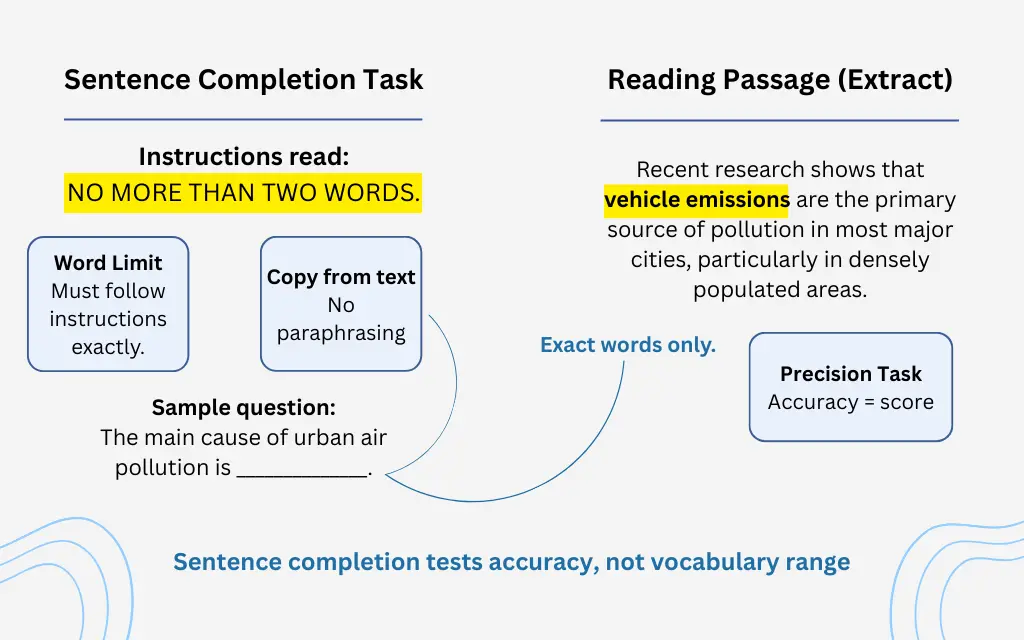
In sentence completion questions, you are given incomplete sentences that summarise information from the passage. Your job is to complete them using words taken directly from the text.
You must usually follow a word limit, such as:
- NO MORE THAN TWO WORDS
- ONE WORD ONLY
- NO MORE THAN THREE WORDS
You are not allowed to change wording.
You are not allowed to paraphrase.
You must copy exactly.
This makes sentence completion a precision task rather than a creative one.
Why Sentence Completion Is Difficult for Many Candidates
Although this task looks simple, it causes problems for clear reasons.
It Requires Exact Accuracy
In many reading tasks, close answers are acceptable. Here, they are not.
One extra word means zero marks.
A changed form means zero marks.
A missing article can mean zero marks.
This level of precision feels unfamiliar to many learners.
It Tests Grammar and Meaning Together
Sentence completion does not only test comprehension.
It also tests whether your answer fits grammatically.
You must check:
- Tense
- Number
- Word form
- Sentence structure
Many students focus on meaning and forget grammar.
It Feels Similar to Listening Gap-Fill
Because this task looks like Listening gap-fill, students often use the same habits.
They guess.
They predict.
They answer from memory.
In Reading, this is dangerous. Every answer must come directly from the passage.
Understanding the Instructions Properly
Before reading anything, always read the instructions carefully.
This sounds simple, but it is one of the biggest sources of lost marks.
Word Limit Rules
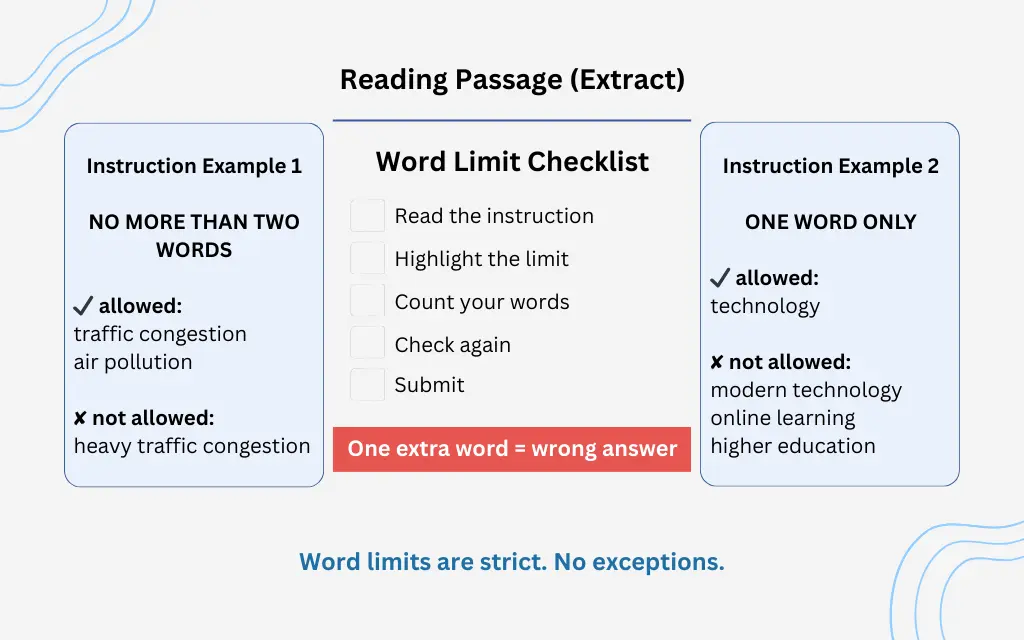
If the instruction says:
NO MORE THAN TWO WORDS
You may write:
- One word
- Two words
But never three.
If it says:
ONE WORD ONLY
You must write exactly one word.
Not one word and an article.
Not one word and a number.
One word.
Copying Exactly from the Passage
You must copy words as they appear.
Do not:
- Change tense
- Change singular/plural
- Add articles
- Remove prepositions
If the passage says:
“in recent decades”
Your answer must be:
recent decades
Not:
recent decade
the recent decades
Step-by-Step Strategy for Sentence Completion
Strong candidates follow a clear process.
Step 1: Read the Incomplete Sentence First
Start with the question.
Read it carefully.
Think about:
- The topic
- The grammar
- The type of word needed
Example:
“The study found that __________ was the main cause of pollution.”
You know you need a noun phrase.
This prepares your thinking.
Step 2: Underline Key Words
Underline important ideas in the sentence.
Look for:
- Names
- Dates
- Technical terms
- Specific concepts
These help you locate the correct paragraph.
Step 3: Scan the Passage
Scan for related language.
Look for:
- Similar wording
- Paraphrases
- Related ideas
When you find the area, slow down.
Step 4: Read Around the Information
Read two or three sentences before and after.
Sentence completion answers are often embedded in context.
Do not rely on a single line.
Step 5: Copy and Check
Copy the words exactly.
Then reread the sentence.
Ask:
Does it make sense?
Is it grammatical?
Does it fit the word limit?
Only then continue.
Recognising Paraphrasing in Sentence Completion
One reason this task is difficult is paraphrasing.
The question rarely uses the same words as the passage.
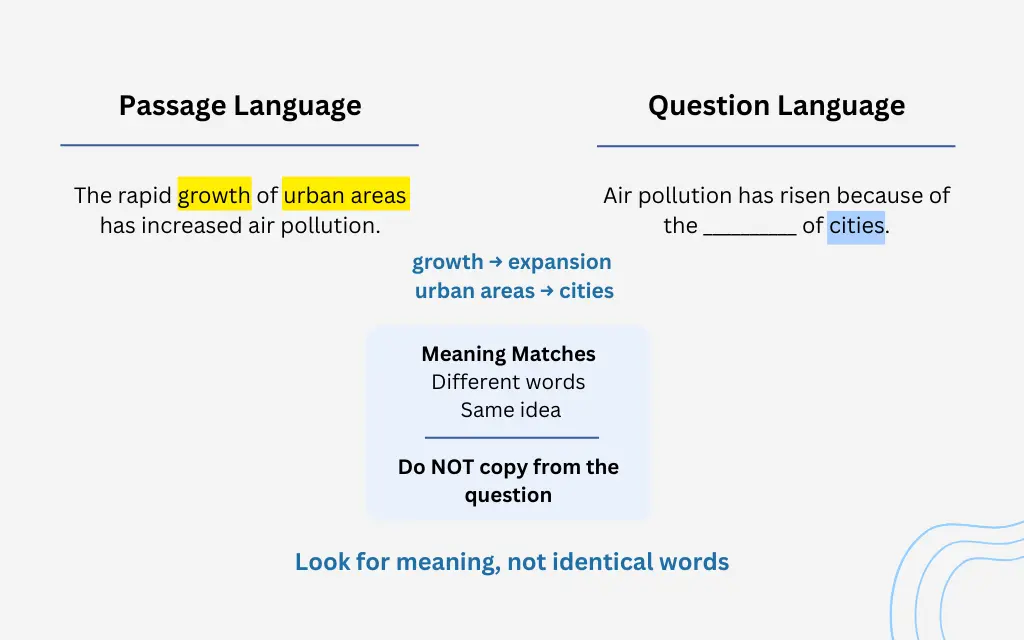
Example
Passage:
“The rapid growth of urban areas has increased air pollution.”
Question:
“Air pollution has risen because of the __________ of cities.”
Growth → expansion
Urban areas → cities
Meaning matches, words differ.
Recognising this is essential.
Common Paraphrase Patterns
You will often see:
- Verbs → nouns
- Active → passive
- Synonyms
- Reordered ideas
Practice makes these patterns automatic.
Grammar Awareness in Sentence Completion
Grammar matters more here than in most reading tasks.
Checking Word Form
Example:
“The research was conducted in __________.”
You need a place or time phrase.
If the text says:
“during the early 1990s”
Your answer is:
the early 1990s
Articles and Prepositions
If the passage says:
“on the outskirts of London”
And it fits, you must copy:
the outskirts of London
Do not remove “the”.
Singular and Plural Forms
If the passage says:
“several factors”
Your answer is:
several factors
Not:
factor
Handling Word Limits Confidently
Many strong candidates lose marks here.
Counting Words Correctly
In IELTS:
- Hyphenated words = one word
- Numbers = words
- Articles = words
Example:
“twenty-five years” = two words
“25 years” = two words
Reducing Answers When Necessary
Sometimes the passage gives more words than allowed.
You must select only what fits.
Passage:
“as a result of rapid industrial development”
Limit: NO MORE THAN TWO WORDS
Correct:
industrial development
Common Mistakes in Sentence Completion
Adding Extra Words
Students often add “the”, “a”, or “of”.
This breaks the word limit.
Never add words.
Changing Word Forms
Changing nouns to verbs or adjectives makes answers wrong.
Always copy.
Answering From Memory
Answering without checking the passage leads to inaccurate wording.
Always verify.
Ignoring Grammar
An answer may match the passage but not fit the sentence.
It still loses marks.
Grammar matters.
Time Management for Sentence Completion
These questions require care, but not excessive time.
Efficient Timing Strategy
A practical guide:
20–30 seconds: read question
40–60 seconds: find text
10 seconds: check
About one minute per question.
When to Skip and Return
If you cannot find it quickly:
Mark it
Move on
Return later
Do not get stuck.
How High-Scoring Candidates Approach This Task
Strong candidates follow discipline.
Their process:
Read → Locate → Copy → Check → Move on
No guessing.
No shortcuts.
No panic.
This mindset is trainable.
Practising Sentence Completion Effectively
Good practice focuses on mistakes.
After practice, ask:
Did I break the word limit?
Did I copy wrongly?
Did grammar fail?
Did I miss paraphrasing?
Keep a mistake log, patterns will appear.
Conclusion: Mastering Sentence Completion in IELTS Reading
Sentence completion questions reward careful, disciplined reading.
They test your ability to locate precise information, copy accurately, and respect instructions.
When you follow a clear strategy, focus on grammar, and practise with awareness, this task can become one of your strongest areas.
Related IELTS Reading Lessons
Glossary
Completion (noun)
The act of filling missing information.
Paraphrase (verb)
To express the same meaning differently.
Word limit (noun)
Maximum number of allowed words.
Context (noun)
Surrounding text that explains meaning.
Precision (noun)
Careful accuracy.
Practice Section
Questions
- (MCQ) What is mainly tested in sentence completion?
A. Speaking fluency
B. Exact reading accuracy
C. Vocabulary memorisation
D. Skimming speed - (True/False) You may change word forms if meaning stays the same.
- (Short Answer) Why is grammar important in sentence completion?
- (MCQ) What should you always check first?
A. Handwriting
B. Word limit
C. Passage title
D. Question number - (True/False) Answering from memory saves time.
Answers
- B
- False
- Because the answer must fit grammatically into the sentence.
- B
- False
Join 1,300+ English learners
Get free English lessons, IELTS tips and useful vocabulary by email.
No spam. Just practical English you can use.