
Introduction to Topic Sentences for IELTS Task 2
IELTS candidates lose marks in Task 2 even when their grammar is accurate and their ideas are relevant. When examiners explain why, the answer is often surprisingly simple: the paragraphs are hard to follow.
In most cases, the problem is not vocabulary or sentence structure. It is weak or unclear paragraph focus. This is where IELTS Task 2 topic sentences become essential.
A strong topic sentence tells the examiner exactly what the paragraph is about before they read the details. When this is done well, the essay feels controlled, logical, and easy to assess. When it is done poorly, even good ideas can feel scattered.
This lesson will explain what topic sentences really do in IELTS essays, why examiners rely on them so heavily, and how to write them naturally without sounding memorised.
Practise English every weekday with me
Get short Mon–Fri English practice in LINE with LEW Daily, plus regular feedback to help you improve.
Explore LEW DailyNT$399/month • Cancel anytime

Why Topic Sentences Matter So Much in Task 2
Examiners do not read Task 2 essays slowly or casually. They read under time pressure and must decide on a band score efficiently. Topic sentences help them do that.
A clear topic sentence acts like a signpost. It tells the examiner what role the paragraph plays in the overall argument. When every body paragraph begins with a clear focus, the essay feels organised before the examiner even reaches the supporting details.
This directly affects Coherence and Cohesion, one of the four marking criteria. Essays with weak topic sentences often receive lower coherence scores, even if the language itself is accurate.
What a Topic Sentence Actually Is (and Isn’t)
A topic sentence is the first sentence of a body paragraph that states the main idea of that paragraph. It tells the reader what will be discussed and how it connects to the question.
It is not:
- A general fact about the topic
- A background sentence
- A vague statement that could fit any essay
For example, a weak topic sentence might talk about “this issue being important in modern society”. A strong one explains which issue, why it matters, and how it supports the essay’s position.
The goal is clarity, not complexity.
How Topic Sentences Improve Coherence Scores
Coherence is about how ideas progress. Topic sentences create that progression.
When each paragraph begins with a focused idea, the examiner can follow the logic of the essay without effort. They can see how one point leads to the next, and how each paragraph contributes to the overall argument.
Without strong topic sentences, paragraphs often feel like collections of sentences rather than unified arguments. Examiners notice this immediately.
This is why improving topic sentences often raises a Task 2 score faster than learning new vocabulary.
Common Topic Sentence Mistakes in IELTS Task 2
Many candidates believe they are writing topic sentences, but examiners often disagree.
One common mistake is writing sentences that are too general. These sentences sound academic but do not actually tell the reader what the paragraph will argue.
Another frequent issue is repeating the question using different words. While paraphrasing is useful in introductions, topic sentences should advance the argument, not restart it.
A third problem is mixing multiple ideas into one topic sentence. When this happens, the paragraph loses focus, and coherence suffers.
How Examiners Use Topic Sentences When Marking
Examiners often read topic sentences first.
They do this to understand the structure of the essay quickly. If the topic sentences clearly outline an argument, the essay immediately feels organised and controlled. If they are vague or confusing, the examiner expects problems in the rest of the paragraph.
This early impression matters. IELTS marking is not mechanical; it is guided by overall judgement. Clear topic sentences help establish a higher band range early.
Writing Topic Sentences That Answer the Question
A strong topic sentence always connects directly to the task.
It does not just mention the topic. It responds to the question type. For example, in an opinion essay, the topic sentence should clearly support the writer’s position. In a discussion essay, it should clearly indicate which side is being discussed.
This alignment with the question is crucial for Task Achievement. Examiners reward paragraphs that clearly serve the purpose of the task.
Topic Sentences vs Supporting Sentences
Many learners confuse topic sentences with explanations.
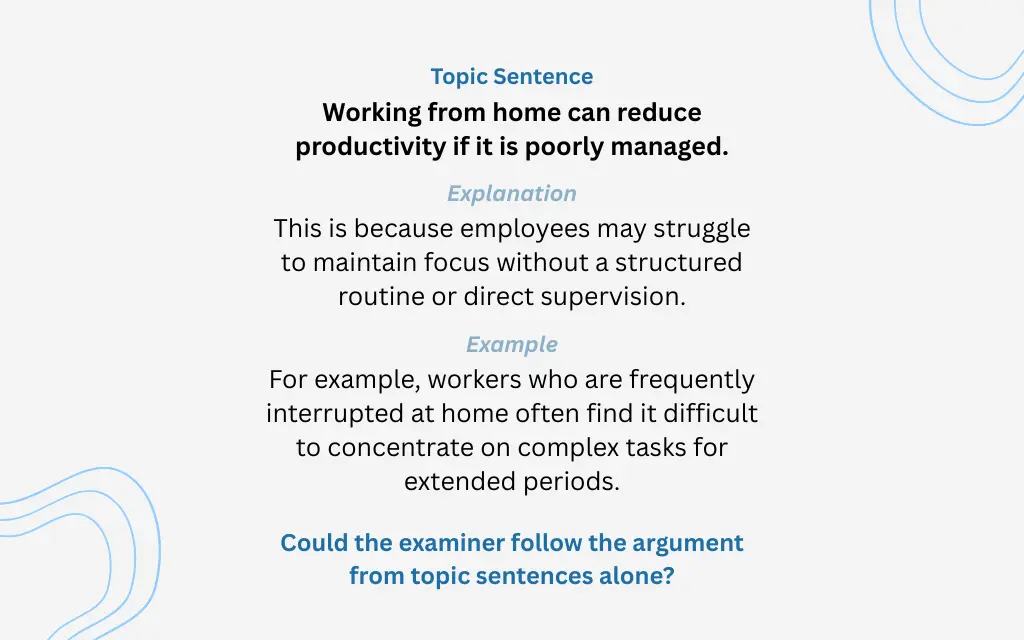
The topic sentence states the main idea. The supporting sentences explain, justify, or exemplify it. When these roles are mixed, paragraphs become unclear.
A useful mental check is this: if the examiner only reads your topic sentences, can they understand your argument? If not, the topic sentences need work.
How Long Should a Topic Sentence Be?
There is no perfect length, but clarity is the priority.
Very short topic sentences can sound vague. Very long ones often become confusing. Most effective topic sentences are one clear sentence that introduces a single, focused idea.
Complex grammar is not required. In fact, overly complex topic sentences often lead to grammatical errors and unclear meaning.
Remember: examiners value control more than ambition.
Topic Sentences Across Different Essay Types
Topic sentences adapt to essay types, but their function stays the same.
In opinion essays, they clearly support the writer’s view.
In discussion essays, they signal which perspective is being discussed.
In advantage-disadvantage essays, they clearly introduce either a benefit or a drawback.
What changes is not the structure, but the purpose of the sentence.
This flexibility is why topic sentences are such a powerful skill. Once mastered, they apply to every Task 2 essay type.
Practising Topic Sentences Without Memorisation
Memorising topic sentence templates often backfires.
Examiners quickly recognise mechanical language that does not quite fit the question. Instead, practice writing topic sentences that respond naturally to different prompts.
A good exercise is to write only the topic sentences for an essay. If they form a clear argument on their own, the structure is working.
This approach improves coherence without increasing memorisation risk.
How Topic Sentences Link Paragraphs Together
Good topic sentences also create flow between paragraphs.
They can subtly refer back to the previous point or signal contrast or progression. This helps cohesion without relying heavily on linking words.
For example, a second paragraph might naturally build on the first by introducing a different reason or a contrasting perspective.
This is one reason topic sentences are more important than connectors alone.
Conclusion
Strong IELTS Task 2 topic sentences are one of the fastest ways to improve coherence scores.
They help examiners understand your argument quickly, create clear paragraph focus, and give your essay a sense of control and purpose. Most importantly, they reduce confusion without requiring complex language.
To continue improving, explore related Task 2 guides on Learn English Weekly, especially those focusing on paragraph logic, essay planning, and examiner marking criteria.
Related IELTS Task 2 Lessons
Glossary
Topic sentence (noun) — The sentence that states the main idea of a paragraph
Coherence (noun) — Logical flow and organisation of ideas
Task Achievement (noun) — How well the essay answers the question
Paragraph focus (noun) — The central idea a paragraph develops
Supporting sentence (noun) — A sentence that explains or gives evidence
Practice Questions
- True or False: Topic sentences mainly affect grammar scores.
- Short answer: Why do examiners read topic sentences first?
- Multiple choice: Which sentence best describes a strong topic sentence?
A) A general fact about the topic
B) A sentence that restates the question
C) A sentence that clearly introduces the paragraph’s main idea - True or False: Topic sentences should always be long and complex.
- Short answer: How can topic sentences improve coherence?
Answers
- False
- To quickly understand paragraph purpose and essay structure
- C
- False
- By clearly guiding the reader through the argument
Join 1,300+ English learners
Get free English lessons, IELTS tips and useful vocabulary by email.
No spam. Just practical English you can use.