
Introduction to Coherence and Cohesion in IELTS Task 2
IELTS candidates are surprised when their writing score stays stubbornly low despite good grammar and a wide range of vocabulary. They know the topic, they answer the question, and their sentences are mostly correct, yet the band score does not improve.
Very often, the missing piece is coherence and cohesion in IELTS Task 2.
Examiners are not only assessing what you say, but how clearly your ideas connect and progress. An essay can be grammatically accurate and still feel confusing. When that happens, coherence and cohesion scores suffer, and the overall band score drops with them.
This lesson will explain what coherence and cohesion really mean in IELTS Task 2, how examiners judge them, and how you can improve them naturally, without overusing linking words or memorised structures.
Practise English every weekday with me
Get short Mon–Fri English practice in LINE with LEW Daily, plus regular feedback to help you improve.
Explore LEW DailyNT$399/month • Cancel anytime

What Coherence and Cohesion Actually Mean in IELTS
The terms coherence and cohesion are often mentioned together, but they are not the same thing.
In simple terms, coherence is about ideas, while cohesion is about language. Examiners look at whether your essay makes sense as a whole, and whether the sentences inside it connect smoothly.
A coherent essay feels logical and easy to follow. A cohesive essay uses language that guides the reader through that logic. You need both to score well.
A helpful visual here would show the difference between an essay with clear paragraph progression and one where ideas appear in random order, even though the sentences are grammatical.
Why Coherence and Cohesion Matter So Much in Task 2
Task 2 essays are marked quickly and comparatively. Examiners read dozens of scripts and must decide where each one sits on the band scale.
When an essay is coherent, the examiner can understand the argument without effort. When it is not, they have to re-read sentences or guess the writer’s intention. That extra effort works against the candidate.
This is why coherence band score IELTS issues often cap essays at Band 6 or 6.5, even when grammar and vocabulary look strong.
How Examiners Assess Coherence in Task 2
Coherence is judged at the essay and paragraph level.
Examiners ask themselves questions like:
- Does the essay have a clear overall argument?
- Does each paragraph have a clear purpose?
- Do ideas progress logically from one paragraph to the next?
If paragraphs feel repetitive, unfocused, or disconnected, coherence suffers.
Importantly, coherence is not about using “advanced” language. It is about logical organisation and clarity of thought.
How Examiners Assess Cohesion in Task 2
Cohesion is judged at the sentence and paragraph level.
Here, examiners look at how sentences link together. They notice:
- Referencing (this, these, such)
- Substitution and paraphrasing
- Natural use of linking expressions
Overuse of obvious connectors can actually reduce cohesion. When every sentence begins with “Moreover” or “On the other hand”, the writing feels mechanical.
A good cohesive essay feels smooth, not stitched together.
A Common Misunderstanding: Linking Words ≠ Coherence
One of the biggest mistakes candidates make is believing that more linking words automatically improve coherence.
In reality, linking words can hide weak logic. If the idea itself is unclear, no connector can fix it.
For example, adding “However” does not create contrast unless the ideas genuinely contrast. Examiners are trained to look past the signal word and judge the relationship between ideas.
This is why some essays sound fluent but still score poorly for coherence.
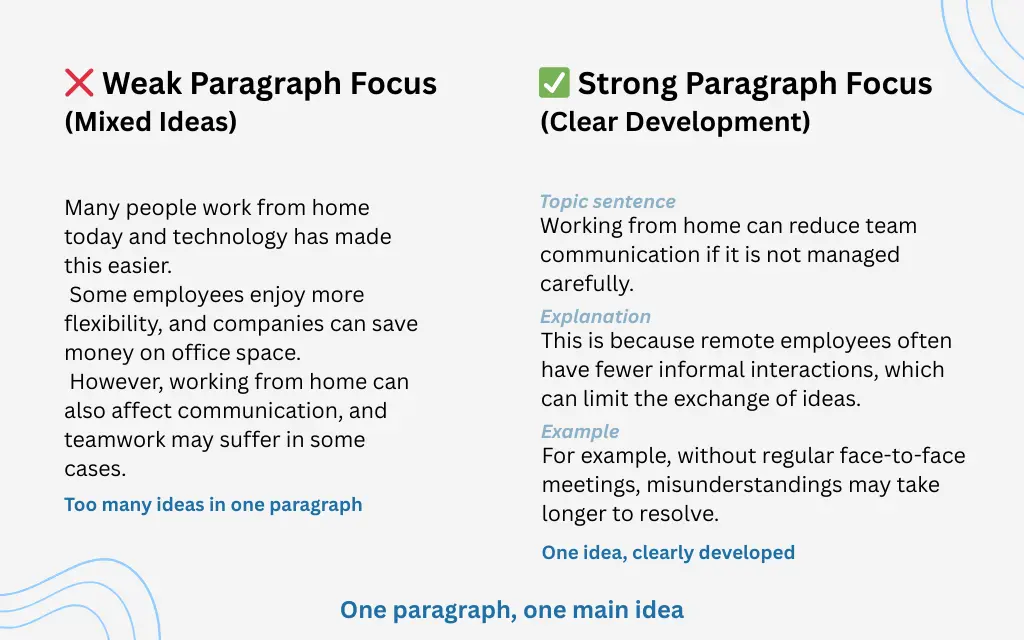
Paragraph Focus: The Core of Coherence
Clear paragraphs are the foundation of coherence.
Each body paragraph should focus on one main idea, introduced clearly and then developed. When paragraphs try to do too much, coherence breaks down.
Strong paragraph focus allows the examiner to follow the argument even if they skim. Weak focus forces them to stop and interpret.
Progression of Ideas Across the Essay
Coherence is not only about individual paragraphs; it is about how those paragraphs work together.
Examiners look for progression:
- One point builds on another
- Ideas are not simply repeated
- Each paragraph adds something new
When an essay circles the same idea using different words, it feels static. This often limits the score to Band 6.5.
Clear progression signals higher-level control and planning.
Cohesion Without Over-Linking
Effective cohesion often uses subtle language choices, not obvious connectors.
Pronouns, synonyms, and logical referencing help sentences connect naturally. For example, referring back to “this trend” or “such measures” shows control without forcing structure.
This kind of cohesion is harder to memorise but much more natural, and examiners value it.
Sentence Control and Cohesion
Broken sentences damage cohesion.
When a long sentence collapses grammatically, the link between ideas disappears. Even if the intention is clear, the execution weakens the flow.
This is why examiners prefer controlled sentence variety over ambitious but unstable structures. Cohesion depends on clarity more than complexity.
How Coherence and Cohesion Affect Band Scores
At lower bands, writing may be understandable but disorganised. At higher bands, writing feels guided and deliberate.
A typical difference between Band 6 and Band 7 essays is not vocabulary level, but how easily the examiner can follow the argument.
Improving coherence and cohesion often produces faster score improvements than focusing on grammar alone.
Improving Coherence and Cohesion in Practice
The most effective way to improve is to read your writing like an examiner.
Instead of asking, “Is my grammar correct?”, ask:
- Can I summarise each paragraph in one sentence?
- Does each paragraph clearly support my position?
- Do sentences connect naturally, or only through linking words?
These questions target coherence and cohesion directly.
Conclusion
Strong coherence and cohesion in IELTS Task 2 writing are not about memorising connectors or complex structures. They are about clear thinking, logical organisation, and controlled language.
When ideas progress smoothly and sentences link naturally, examiners can assess your work confidently, and higher band scores become much more achievable.
Related IELTS Task 2 Lessons
Glossary
Coherence (noun) — Logical organisation and progression of ideas
Cohesion (noun) — Linguistic connections between sentences and ideas
Paragraph focus (noun) — The single main idea a paragraph develops
Progression (noun) — Movement of ideas from one point to the next
Referencing (noun) — Using pronouns or phrases to link ideas
Practice Questions
- True or False: Using more linking words always improves coherence.
- Short answer: What is the main difference between coherence and cohesion?
- Multiple choice: Which area most affects coherence?
A) Spelling accuracy
B) Paragraph focus
C) Idiomatic vocabulary - True or False: Cohesion is assessed only at paragraph level.
- Short answer: Why do examiners value natural cohesion?
Answers
- False
- Coherence is about ideas; cohesion is about language links
- B
- False
- Because it improves clarity without sounding mechanical
Join 1,300+ English learners
Get free English lessons, IELTS tips and useful vocabulary by email.
No spam. Just practical English you can use.