
Practice vs Strategy in IELTS Listening: Why Doing More Tests Isn’t Enough
Introduction
Candidates complete numerous IELTS Listening practice tests yet see little or no improvement in their scores. A typical pattern is familiar: ten tests completed, score remains 6.5. Another test is taken, and the score remains unchanged.
This is not unusual. It reflects a misunderstanding of how improvement works.
Effective IELTS listening practice strategy is not about the quantity of tests completed. It is about how those tests are used. Listening improvement in IELTS rarely happens through repetition alone. Without analysis and adjustment, practice can simply reinforce existing weaknesses.
This lesson explains why practice sometimes fails IELTS learners, what strategy actually means in this context, and how combining the two leads to measurable score improvement.
Practise English every weekday with me
Get short Mon–Fri English practice in LINE with LEW Daily, plus regular feedback to help you improve.
Explore LEW DailyNT$399/month • Cancel anytime

Why Practice Alone Often Fails
Consider two students.
Student A completes three full listening tests every week.
Student B completes one test per week and spends significant time analysing it.
After four weeks, Student A has completed twelve tests. Student B has completed four.
In many cases, Student B improves more.
The reason is simple: practice measures your current level, but it does not automatically raise it. If you repeat the same habits, you reproduce the same mistakes.
What Practice Actually Does
Practice has clear benefits. It helps you:
- Become familiar with question types
- Understand the structure of the test
- Build listening stamina
- Reduce anxiety about timing
However, practice alone does not automatically eliminate:
- Spelling errors
- Plural mistakes
- Confusion caused by distractors
- Time management weaknesses
If you complete a test, check the answers, and immediately move on, your IELTS listening improvement may be limited. Practice identifies weaknesses. Strategy addresses them.
What Strategy Actually Means
Strategy is not a trick or shortcut. It is a structured plan based on evidence from your own performance.
In IELTS Listening, strategy means understanding:
- Where you lose marks
- Why you lose them
- How to prevent those errors
For example, if you consistently lose marks in Section 3 due to distractors, completing additional full tests may not help. A more effective strategy would be to:
- Practise recognising contrast words such as “however” or “actually”
- Train yourself to wait for final confirmation
- Slow your reaction to the first possible answer
Strategy is targeted and specific. Practice without strategy is general and repetitive.
Passive Practice vs Active Practice
There is an important distinction between passive and active practice.
Passive practice involves completing a test, checking the score, and moving on. The focus remains on results rather than process.
Active practice involves completing a test, analysing every incorrect answer, identifying patterns of error, and designing follow-up exercises to address those weaknesses.
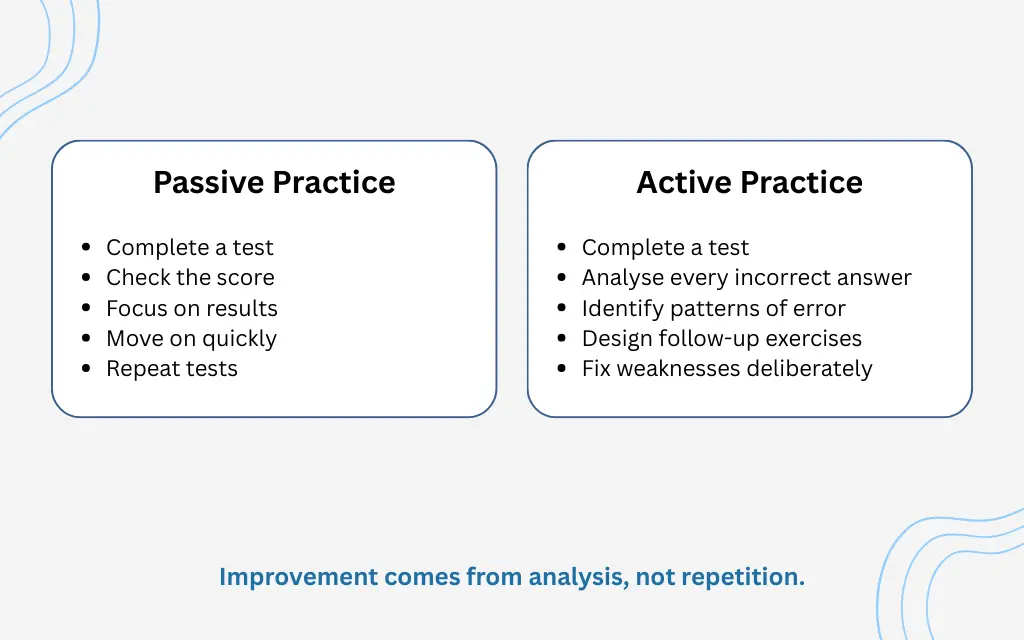
Active practice takes longer. However, it produces deeper and more reliable improvement.
For instance, if you repeatedly misspell “accommodation”, the solution is not another full listening test. The solution is targeted spelling correction. If you confuse “fifteen” and “fifty”, focused number listening practice is more effective than broad repetition.
Why Scores Plateau
A plateau at Band 6 or 6.5 is common. At this level, candidates usually understand most of the recording. The remaining errors are often technical rather than linguistic.
Common plateau causes include:
- Careless detail mistakes
- Failure to recognise distractors
- Weak checking habits
- Poor recovery after missing an answer
Doing more complete tests rarely resolves these issues. Improvement requires refinement rather than repetition.
If you want to improve your IELTS listening score, you must move from general practice to targeted correction.
A Simple Listening Improvement Framework
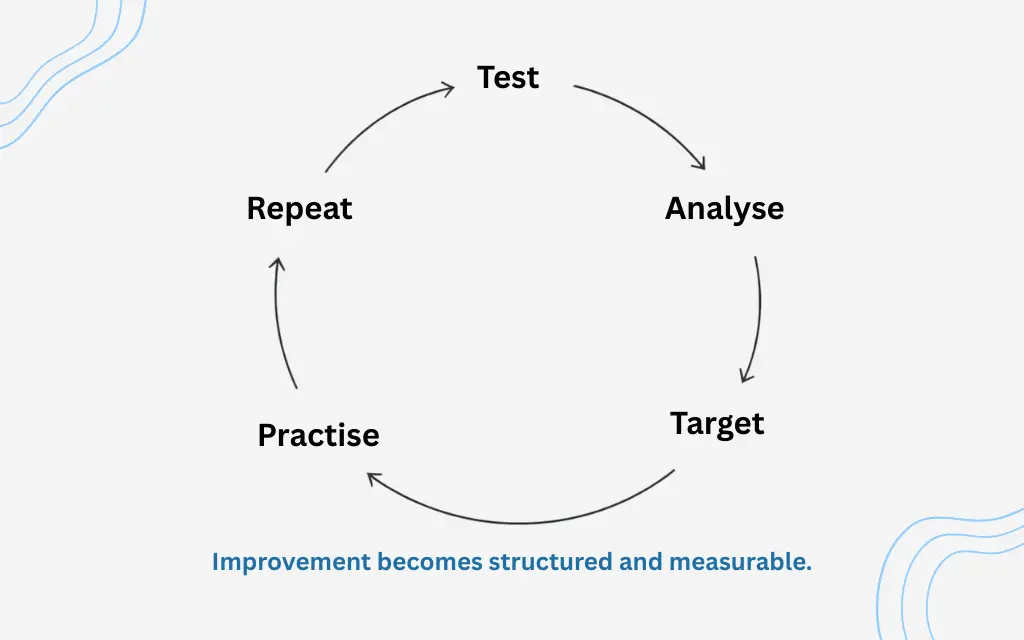
Instead of asking, “How many tests should I complete?”, ask, “What type of mistakes am I making?”
After each test, categorise your errors. For example:
- Three marks lost due to plural mistakes
- Two marks lost due to distractors
- One mark lost due to spelling
This immediately clarifies your strategy.
You might dedicate one week to eliminating plural errors and another to improving distractor recognition.
The Psychological Impact of Strategy
There is also a psychological dimension to this issue.
When candidates complete many tests without seeing improvement, confidence decreases. They begin to believe their listening ability is insufficient.
In reality, their ability may be improving gradually, but their score remains stable because the same small weaknesses persist.
Strategic practice restores confidence by giving you control. Instead of hoping for a higher score, you work systematically toward it.
How High Scorers Approach Practice
Candidates who achieve Band 7 or above often practise differently.
They complete fewer full tests.
They spend more time reviewing mistakes.
They look for patterns rather than isolated errors.
They simulate exam conditions periodically, not constantly.
High scores are rarely the result of endless repetition. They are usually the result of intelligent repetition guided by strategy.
Balancing Practice and Strategy
This discussion does not suggest abandoning practice tests. Practice remains essential.
A balanced approach might include:
- One full listening test per week
- Several short targeted sessions focusing on weaknesses
- Regular timed simulations under realistic conditions
Strategy guides practice. Practice confirms progress.
Moving from Band 6.5 to Band 7
For candidates currently scoring around 6.5, improvement often comes from reducing avoidable errors rather than increasing vocabulary knowledge.
If you eliminate:
- Two plural mistakes
- One spelling error
- One distractor
your score may increase immediately.
Listening improvement in IELTS at this stage is often technical rather than linguistic. Small refinements can produce significant results.
Conclusion
Practice alone measures your level. Strategy raises it.
An effective IELTS listening practice strategy combines full tests with careful analysis, targeted correction, and structured repetition.
If you want to improve your IELTS listening score:
- Complete tests deliberately
- Analyse mistakes carefully
- Identify patterns
- Target specific weaknesses
- Simulate exam conditions periodically
Repeat with intention rather than repetition alone. Progress in IELTS Listening is rarely about doing more. It is about doing better.
Related IELTS Listening Lessons
- Distractors in IELTS Listening (Why Answers Change)
- IELTS Listening Section 3 Explained
- Common IELTS Listening Mistakes (And How to Avoid Them)
Glossary
Strategy (n.)
A planned and structured method for achieving a goal.
Plateau (n.)
A period in which progress slows down or stops.
Passive Practice (n.)
Completing tasks without analysing mistakes in depth.
Active Practice (n.)
Completing tasks and systematically analysing weaknesses to improve performance.
Refinement (n.)
The process of making targeted improvements to increase quality and precision.
Practice Section
Questions
- (True/False) Doing more tests automatically guarantees a higher IELTS Listening score.
- (MCQ) Strategy helps you:
A. Memorise the recording
B. Identify and fix specific weaknesses
C. Avoid practising
D. Guess answers - (Short Answer) What is the difference between passive and active practice?
- (MCQ) A score plateau usually means:
A. Your English is perfect
B. The test is unfair
C. You need targeted improvement
D. You should stop practising - (True/False) High scorers usually focus on analysing mistakes carefully.
Answers
- False
- B
- Passive practice means completing tests without analysis, while active practice involves reviewing and correcting mistakes.
- C
- True
Practise English every weekday with me
Get short Mon–Fri English practice in LINE with LEW Daily, plus regular feedback to help you improve.
Explore LEW DailyNT$399/month • Cancel anytime