
Introduction to IELTS Listening Section 1
The conversation sounds simple. The vocabulary feels familiar. It often resembles real-life English. That is exactly why IELTS Listening Section 1 can be deceptive.
Although it is considered the easiest part of the test, many students still lose marks here through small, preventable mistakes. Because Section 1 focuses on everyday conversation IELTS contexts, it tests precision more than complexity.
This lesson will explain what Section 1 really involves, the question types you will meet, the traps that reduce scores, and how to approach it calmly and confidently on test day.
If you treat Section 1 seriously, it becomes a reliable source of early marks, and those early marks build confidence for the rest of the paper.
Practise English every weekday with me
Get short Mon–Fri English practice in LINE with LEW Daily, plus regular feedback to help you improve.
Explore LEW DailyNT$399/month • Cancel anytime

What Is IELTS Listening Section 1?
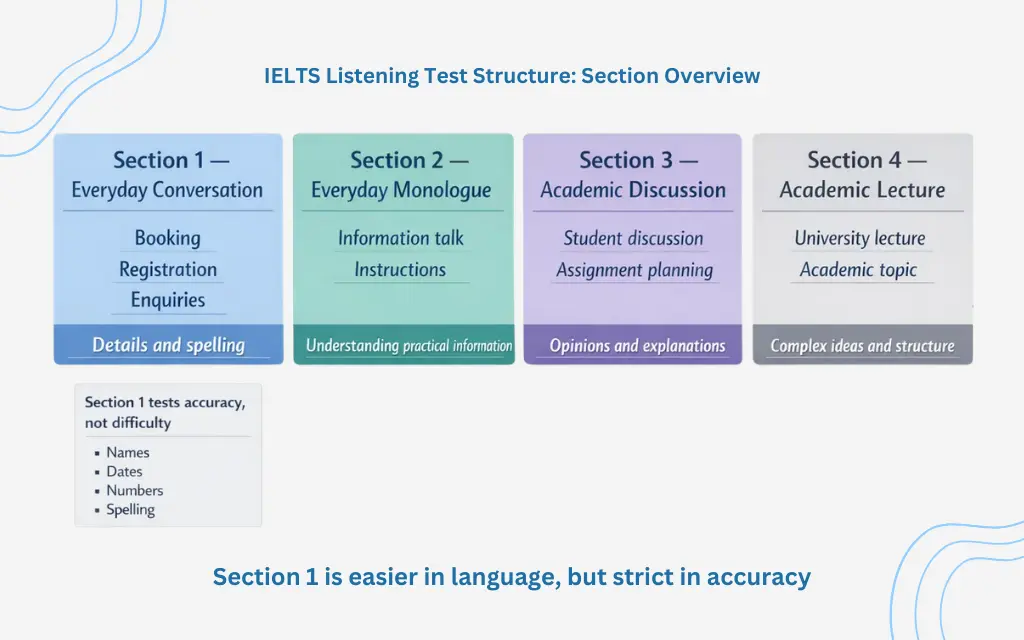
IELTS Listening Section 1 is always a conversation between two people in an everyday situation. It usually involves booking, registering, enquiring, or organising something practical.
Common scenarios include:
- Booking a hotel room
- Registering for a course
- Asking about gym membership
- Arranging accommodation
- Making an appointment
Unlike later sections, the language is practical rather than academic. You will hear names, addresses, dates, phone numbers, prices, and short explanations.
However, simplicity does not mean safety.
Section 1 is designed to test:
- Careful listening
- Spelling accuracy
- Attention to detail
- Ability to follow corrections in conversation
How IELTS Listening Section 1 Is Structured
Before the recording begins, you are given time to read the questions. Most commonly, Section 1 consists of a form completion task.
For example:
Name: ______
Date of birth: ______
Address: ______
Reason for enquiry: ______
The answers appear in order. This is important. The questions follow the natural flow of the conversation, so you do not need to search randomly.
Most answers are:
- One or two words
- A number
- A name
- A date
- A short phrase
The vocabulary may be simple, but the challenge lies in accuracy.
The Most Common Task: Form Completion
Form completion dominates Section 1 listening IELTS tasks. At first glance, it looks straightforward. You hear information and fill in the gaps.
However, this task is where many marks are lost.
Why Form Completion Is Tricky
Speakers often:
- Spell names letter by letter
- Correct themselves
- Change details mid-sentence
- Mention numbers quickly
For example:
“That’s H-A-R-P-E-R… actually sorry, it’s H-A-R-P-U-R.”
If you stop listening after the first spelling, you miss the correction.
Or:
“The appointment is on the 15th… no, sorry, that’s the birthday party — it’s the 5th of May.”
This is a classic distractor.
Section 1 rewards candidates who listen until the full idea is complete.
What Skills IELTS Listening Section 1 Really Tests
Many students assume Section 1 tests only vocabulary. In reality, it tests discipline.
Listening for Detail
You must catch precise information, not general meaning.
If the speaker says:
“It’s £35 per month, but there’s a £10 registration fee.”
And the question asks for the monthly cost, the answer is £35 — not £45.
You are listening for exactly what the question requires.
Spelling Accuracy
Names and addresses must be spelled correctly.
If the correct answer is:
Catherine
and you write:
Katherine
it is incorrect.
Spelling errors are one of the most common IELTS listening mistakes, especially at Band 6 level.
Number Awareness
Under pressure, numbers can sound similar:
- 15 and 50
- 13 and 30
- 14 and 40
Strong candidates anticipate this and concentrate carefully when numbers are spoken.
Common Traps in IELTS Listening Section 1
Even though this is entry-level listening content, candidates still lose reliable marks here.
Distractors
The speaker may mention incorrect information before giving the final answer. Always wait until the speaker finishes the full statement.
Listen for signals such as:
- “Actually…”
- “Sorry…”
- “That was incorrect…”
- “Let me correct that…”
These phrases often introduce the real answer.
Fast Spelling
Names may be spelled quickly and without repetition. If you panic and miss one letter, the mark is lost.
Word Limits
If the instruction says:
NO MORE THAN TWO WORDS
and you write three words, the answer is wrong.
Band 7 candidates rarely lose marks through instruction errors. Band 6 candidates often do.
How to Prepare for IELTS Listening Section 1
Preparation for Section 1 is different from preparation for Section 4.
Because this section focuses on everyday conversation IELTS contexts, practice should include:
- Telephone enquiries
- Booking conversations
- Registration dialogues
- Customer service interactions
However, improvement does not come from repetition alone. It comes from reflection.
After each practice test, ask:
- Did I lose marks through spelling?
- Did I miss corrections?
- Did I exceed the word limit?
- Did I panic after one missed answer?
Patterns will appear. When patterns appear, solutions become clearer.
A Step-by-Step Approach on Test Day
Before the recording starts:
- Read the instructions carefully.
- Identify the word limit.
- Predict the type of answer required in each gap.
For example:
Contact number: ______
→ Expect a number.
Reason for visit: ______
→ Expect a noun phrase.
Prediction helps your brain respond more quickly when the answer appears.
During listening:
- Stay calm.
- Move on immediately if you miss something.
- Continue listening for corrections.
At the end, use your checking time carefully. Check:
- Spelling
- Singular or plural forms
- Word limit
- Clear handwriting
Small details separate Band 6 from Band 7.
Why Section 1 Matters for Your Overall Band Score
Some students focus heavily on Sections 3 and 4 because they are more difficult.
But Section 1 is where you secure dependable marks.
If you aim for Band 7 in Listening, you cannot afford to lose easy points here. High-scoring candidates often score full or near-full marks in Sections 1 and 2. That early accuracy reduces stress and improves concentration in later sections.
Section 1 is not “just the easy part”. It is your foundation.
Conclusion
IELTS Listening Section 1 may sound simple, but it demands careful attention.
It tests:
- Listening for detail
- Spelling accuracy
- Number recognition
- Concentration under pressure
When you understand how Section 1 works and treat it as guaranteed marks rather than casual practice, your overall listening band score becomes more stable.
To continue improving, explore our guides on:
- How IELTS Listening is marked
- Common IELTS Listening mistakes
- Section-by-section Listening strategies
Build accuracy early, and the rest of the test becomes more manageable.
Related IELTS Listening Lessons
-
- IELTS Listening – Complete Guide to Sections and Question Types
-
Common IELTS Listening Mistakes (And How to Avoid Them)
- Form Completion in IELTS Listening
- IELTS Listening – Complete Guide to Sections and Question Types
Glossary
Distractor (n.)
Incorrect information given before the correct answer.
Form Completion (n.)
A task where you fill missing details in a form.
Word Limit (n.)
The maximum number of words allowed in an answer.
Everyday Conversation (n.)
Natural spoken interaction about daily situations.
Band Score (n.)
The final score from 1–9 based on performance.
Practice Section
(MCQ) IELTS Listening Section 1 usually involves:
A. Academic lecture
B. Group discussion
C. Everyday conversation
D. Debate
(True/False) Answers in Section 1 appear in random order.
(Short Answer) Why is spelling especially important in Section 1?
(MCQ) Which of the following is a common trap?
A. Complex academic theory
B. Speaker correcting information
C. Long essay
D. Visual data
(True/False) Section 1 is unimportant for achieving Band 7.
Answers
C
False
Because incorrect spelling results in losing the mark.
B
False
Join 1,300+ English learners
Get free English lessons, IELTS tips and useful vocabulary by email.
No spam. Just practical English you can use.