
Introduction to Band 7 vs Band 9 in IELTS Speaking
Many IELTS candidates believe the difference between Band 7 and Band 9 in speaking is about using more advanced vocabulary, speaking for longer, or sounding more British or American.
This belief creates frustration. Candidates who are already fluent, understandable, and confident often feel stuck. They practise more, learn harder words, and extend their answers, yet their score does not move beyond Band 7.
This lesson breaks down what examiners actually hear at Band 7, what changes at Band 9, and why the jump is less about adding language and more about control, consistency, and trust.
Practise English every weekday with me
Get short Mon–Fri English practice in LINE with LEW Daily, plus regular feedback to help you improve.
Explore LEW DailyNT$399/month • Cancel anytime

Why Band 7 is already a strong speaking score
Before comparing the two bands, it is important to understand what Band 7 represents from an examiner’s perspective.
A Band 7 speaker communicates clearly, speaks fluently with only occasional hesitation, and uses a wide range of vocabulary with generally good grammatical control. They are fully understandable throughout the test.
This is not an average performance. Band 7 reflects confident, effective spoken English. The difference at Band 9 is not a new level of fluency, but a higher level of polish and reliability.
How examiners compare Band 7 and Band 9
Examiners are not asking whether a candidate sounds impressive.
Instead, they are listening for consistency across the entire test. They ask themselves whether the speaker remains controlled under pressure, whether misunderstandings could ever occur, and whether language adapts easily as topics change.
Band 7 answers often sound strong but slightly uneven. Band 9 answers sound effortless and dependable from start to finish.
Fluency: smooth versus effortless
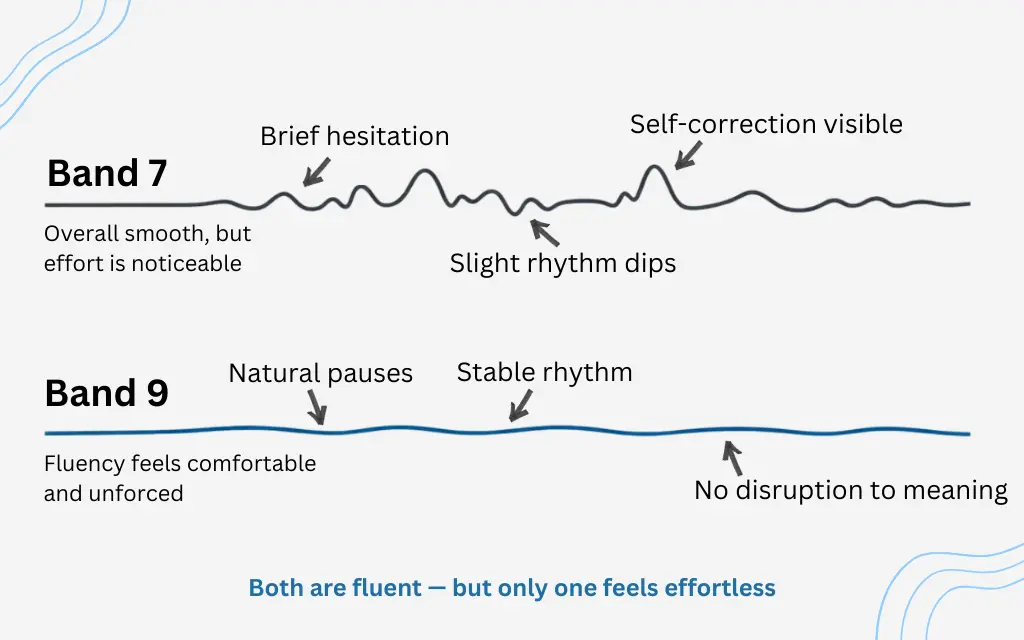
Both Band 7 and Band 9 speakers are fluent, but the quality of fluency differs.
Band 7 speakers may hesitate briefly when ideas become abstract, slow down while searching for words, or self-correct in a way that slightly interrupts rhythm. None of this is serious, but it is noticeable.
Band 9 speakers also hesitate at times, but those pauses feel natural. They do not interrupt meaning or disrupt the overall flow. Fluency feels comfortable rather than managed.
Vocabulary: range versus precision
Vocabulary is one of the most misunderstood differences between Band 7 and Band 9.
A Band 7 speaker uses a wide range of vocabulary and paraphrases effectively. However, word choice may occasionally be slightly imprecise, or familiar phrasing may be reused when ideas become complex.
A Band 9 speaker does not use harder vocabulary. They use vocabulary more precisely. Words fit the exact meaning, adapt smoothly to topic changes, and never sound forced or rehearsed.
The difference is accuracy of choice, not difficulty.
Grammar: flexibility versus control
At Band 7, grammar is generally accurate, with occasional slips that do not affect understanding. These may appear more often in longer answers or when ideas become complex.
At Band 9, grammar remains controlled even when the speaker is thinking aloud. Structures feel flexible rather than constructed, and grammar supports meaning without drawing attention to itself.
This consistency is what builds examiner trust.
Pronunciation: clarity versus comfort
Pronunciation is not about accent at either band.
Band 7 speakers are clearly understandable, but may sound careful, place stress inconsistently, or use flatter intonation when discussing abstract ideas.
Band 9 speakers sound comfortable in English. Stress and intonation highlight meaning naturally, and tone shifts easily to show contrast, opinion, or uncertainty. Comfort, not correctness, is the key distinction.
Part-by-part differences examiners notice
Part 1: everyday topics
Band 7 answers are clear and relevant, but may feel cautious or slightly short.
Band 9 answers feel conversational, with natural extension and no sense of “test mode”.
Part 2: the long turn
Band 7 responses are organised, but sometimes sound planned or rehearsed.
Band 9 responses are structured but invisible, with examples flowing naturally and timing controlled without effort.
Part 3: abstract discussion
Band 7 speakers give clear opinions, but may stay concrete or return to familiar ideas.
Band 9 speakers develop ideas flexibly, handle abstraction comfortably, and adapt instantly to follow-up questions.
Examiner trust: the hidden difference
One of the biggest differences between Band 7 and Band 9 is examiner confidence.
By the end of the test, examiners ask whether the speaker could ever be misunderstood, whether they can handle unfamiliar topics, and whether their language adapts naturally.
Band 7 speakers sometimes feel slightly dependent on preparation. Band 9 speakers feel fully independent.
Why memorised strategies limit Band 9 performance
Many Band 7 candidates rely on memorised openings, fixed opinion phrases, or prepared structures. These strategies help reach Band 7, but they often cap performance.
Examiners hear repetition across answers and sense control being applied rather than owned. Band 9 speaking sounds unplanned but controlled.
Why longer answers do not raise your band
Speaking for longer does not increase your score.
Longer answers increase the chance of errors, expose limits in control, and can reduce clarity if ideas are not focused. Band 9 speakers often answer efficiently rather than extensively.
Quality of expression matters more than quantity.
How Band 9 speakers handle mistakes
Mistakes happen at every band.
Band 7 speakers often stop, hesitate, or lose rhythm after an error. Band 9 speakers correct naturally within the flow, rephrase smoothly, and maintain confidence.
Recovery matters more than accuracy.
Moving from Band 7 to Band 9 realistically
Not everyone needs Band 9, but for those aiming higher, improvement comes from refining control rather than learning new language.
The focus should be on staying accurate under pressure, practising spontaneous speaking instead of scripts, and building comfort rather than complexity.
The jump is about refinement, not transformation.
Conclusion
The difference between Band 7 vs Band 9 IELTS speaking is not dramatic, but it is consistent.
Band 7 reflects strong, effective English.
Band 9 reflects complete control, natural flexibility, and examiner trust.
Instead of trying to sound more advanced, aim to sound more comfortable, precise, and reliable across all speaking situations.
Related IELTS Speaking Lessons
Glossary
Band descriptor (noun) — official criteria used to assess IELTS performance
Fluency (noun) — ability to speak smoothly without unnatural pauses
Lexical resource (noun) — range and accuracy of vocabulary use
Examiner trust (noun phrase) — confidence that a speaker can handle any topic
Precision (noun) — accuracy and exactness of word choice
Comprehension & Practice Questions
True or False: Band 7 is considered an average speaking score.
Multiple choice: What most distinguishes Band 9 speakers?
A) Accent
B) Long answers
C) Control and consistency
Short answer: Why do memorised phrases limit higher bands?
True or False: Mistakes automatically prevent a Band 9 score.
Short answer: What does examiner trust mean?
Answers
False
C
They sound rehearsed and limit flexibility
False
Confidence that the speaker can communicate clearly in all situations
Join 1,300+ English learners
Get free English lessons, IELTS tips and useful vocabulary by email.
No spam. Just practical English you can use.