
Introduction to Articles (a, an, the) in IELTS Writing
IELTS candidates lose marks without ever realising why. Their ideas are clear, their vocabulary is strong, and their sentence structure looks fine. Yet the score refuses to rise.
Very often, the reason is something small but constant: articles.
In IELTS writing, mistakes with a, an, and the are among the most frequent grammar errors examiners see. They rarely block understanding completely, but they quietly reduce accuracy, and accuracy matters.
This lesson will focus on articles in IELTS writing, not as abstract grammar rules, but as exam-relevant choices that affect band scores. You will learn how examiners interpret article errors, where candidates lose marks most often, and how to improve article use without overthinking.
Practise English every weekday with me
Get short Mon–Fri English practice in LINE with LEW Daily, plus regular feedback to help you improve.
Explore LEW DailyNT$399/month • Cancel anytime

Why Articles Matter So Much in IELTS Writing
Articles may feel minor, but in IELTS they carry a lot of weight.
Examiners assess grammar under “Grammatical Range and Accuracy”. Article use sits right at the centre of that assessment because it shows whether a writer controls basic English structures consistently.
An occasional article mistake is usually tolerated. Repeated article errors are not.
When examiners see missing or incorrect articles throughout an answer, they interpret it as a systemic weakness, not a slip. This is why article errors often cap candidates at Band 6 or 6.5, even when ideas are strong.
How Examiners Notice Article Errors
Examiners do not circle every “a” or “the” mistake. Instead, they form an impression as they read.
If articles are mostly correct, small errors fade into the background. If articles are often missing, added randomly, or used inconsistently, the writing feels unnatural and less controlled.
This impression matters more than rule knowledge. IELTS is not a grammar test, it is a communication test. Article errors signal weak control over meaning and specificity.
What Articles Actually Do in English
Before looking at mistakes, it helps to clarify what articles do.
Articles tell the reader whether a noun is:
- general or specific
- new or already known
- one of many or a particular one
This is why articles are closely linked to meaning, not just grammar.
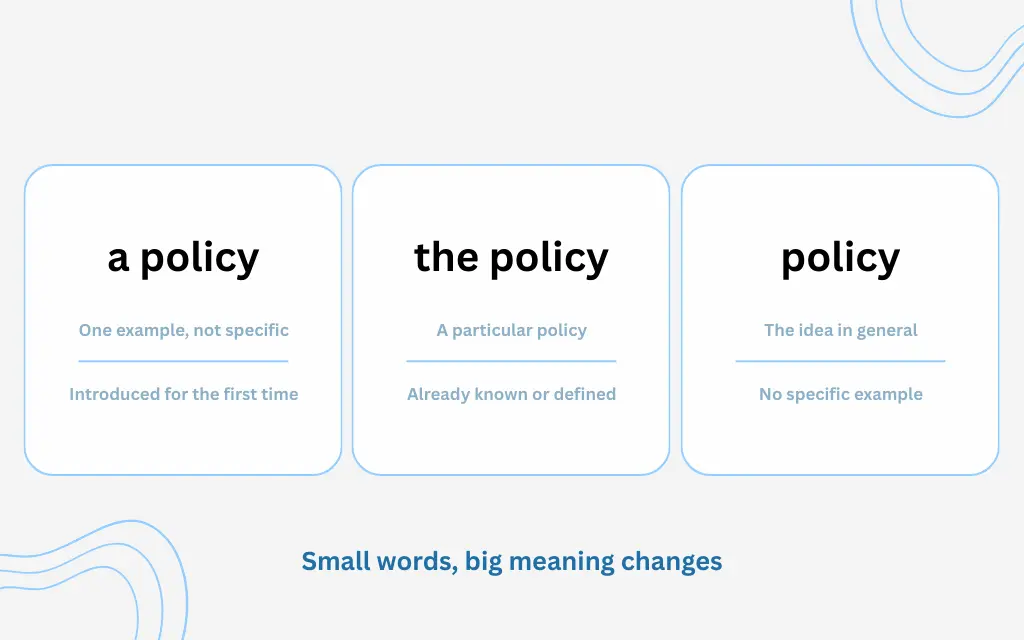
“A” and “An”: Introducing Something New
In IELTS writing, a and an are most often used when a noun is mentioned for the first time or when speaking generally.
Candidates usually understand this idea, but problems appear when they apply it mechanically.
For example, learners sometimes add a before abstract nouns, or forget it before countable singular nouns. These mistakes accumulate quickly across an essay.
In Task 2, incorrect use of a and an often appears in introductions and topic sentences, where accuracy matters most.
“The”: Specific, Known, or Defined
“The” causes more trouble than “a” or “an”.
Many learners overuse the, adding it whenever a noun feels important. Others avoid it completely, afraid of making mistakes. Both strategies cause problems.
In IELTS writing, the is used when the reader can clearly identify which thing is being discussed. This may be because it was mentioned earlier, defined by context, or understood as unique.
Misusing the often makes writing sound unnatural rather than incorrect, which is why examiners notice it quickly.
Zero Article: When No Article Is Correct
One of the hardest concepts for IELTS candidates is knowing when no article is needed.
This appears frequently with plural nouns, uncountable nouns, and abstract ideas when speaking generally.
Many article errors in IELTS writing are not about choosing the wrong article, but about using an article when none is needed.
Examiners see this especially often in Task 2 essays discussing education, technology, crime, or society in general terms.
Article Errors That Cost IELTS Marks
Certain article mistakes appear again and again in examiner reports and real scripts.
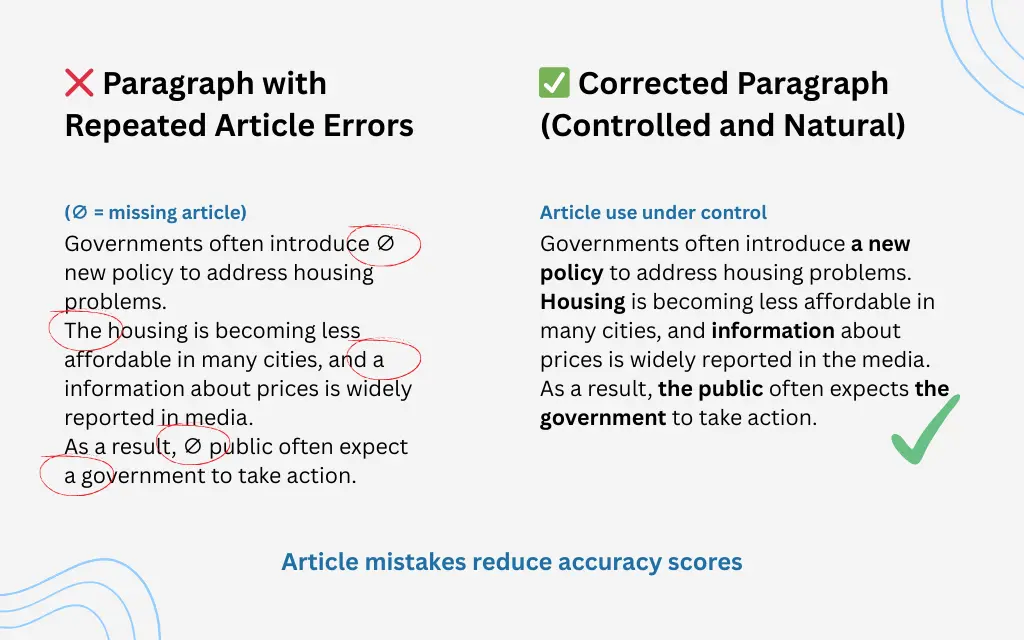
Common patterns include missing articles before singular countable nouns, overusing the with general concepts, and adding a before uncountable nouns.
These errors are rarely dramatic, but their frequency lowers grammatical accuracy and creates a pattern examiners cannot ignore.
Articles in IELTS Task 1 vs Task 2
Article use behaves differently in Task 1 and Task 2.
In Task 1, articles are closely tied to data descriptions. Specific charts, tables, or groups often require the, while general trends do not.
In Task 2, articles are more abstract and linked to ideas rather than visuals. This makes them harder (and more important) to control.
Candidates who improve article accuracy often see score gains in both tasks simultaneously.
Accuracy Matters More Than Complexity
One important point many learners miss is that IELTS does not reward “advanced” article use.
Simple, accurate article usage across an essay is far more valuable than complex noun phrases filled with errors.
Examiners would rather see basic structures used correctly than ambitious language that collapses under pressure.
This is why article control is a foundation skill, not an advanced one.
How to Improve Article Accuracy Practically
Improving article use does not mean memorising hundreds of rules.
Instead, it involves slowing down slightly when writing, noticing noun phrases, and asking one simple question:
“Does the reader know exactly which thing I mean?”
Over time, this habit improves accuracy more effectively than rule drilling.
How Examiners Interpret Article Errors at Different Bands
At lower bands, article errors are frequent and often affect understanding.
At mid bands, errors remain but meaning is usually clear.
At higher bands, article mistakes are rare and inconsistent, appearing as slips rather than patterns.
Understanding this progression helps learners focus on improvement rather than perfection.
Conclusion
Articles may be small words, but in IELTS writing they have a big impact.
Consistent mistakes with a, an, and the signal weak grammatical control and quietly limit band scores. Improving article accuracy does not require advanced grammar. It requires awareness, consistency, and practice in exam-style writing.
To strengthen this area further, explore related IELTS grammar guides on Learn English Weekly that focus on the specific errors examiners notice most.
Related IELTS Grammar Lessons
Glossary
Article (noun) — A word used before a noun to show meaning or reference
Definite article (noun) — “The”; used for specific or known nouns
Indefinite article (noun) — “A” or “an”; used for general or new nouns
Zero article (noun) — No article used before a noun
Countable noun (noun) — A noun that can be counted
Practice Questions
- True or False: Frequent article errors usually cap IELTS writing scores.
- Short answer: Why does overusing “the” cause problems in IELTS writing?
- Multiple choice: Which matters more to examiners?
A) Complex article use
B) Accurate article use
C) Avoiding articles - True or False: Article errors are more noticeable in Task 2 than Task 1.
- Short answer: What question helps decide article use?
Answers
- True
- It makes writing sound unnatural or unclear
- B
- True
- “Does the reader know exactly which thing I mean?”
Join 1,300+ English learners
Get free English lessons, IELTS tips and useful vocabulary by email.
No spam. Just practical English you can use.