
Introduction to IELTS Speaking Part 1
For many candidates, IELTS Speaking Part 1 feels deceptively easy.
The questions are personal. The topics are familiar. You talk about your home, your work, your studies, or your free time. It feels like a warm-up, not a test.
And yet, IELTS Speaking Part 1 quietly sets the tone for your entire speaking score.
This is where examiners form their first impression of your fluency, pronunciation, and overall control. Small habits in Part 1 often explain why candidates later struggle to reach Band 7, even when Parts 2 and 3 feel stronger.
This lesson explains what IELTS Speaking Part 1 really tests, the types of questions you can expect, how to answer them naturally, and how to avoid the most common mistakes candidates make at this stage.
Practise English every weekday with me
Get short Mon–Fri English practice in LINE with LEW Daily, plus regular feedback to help you improve.
Explore LEW DailyNT$399/month • Cancel anytime

What is IELTS Speaking Part 1?
IELTS Speaking Part 1 is the introduction and interview section of the speaking test.
It lasts around four to five minutes and takes place at the very beginning of the exam. The examiner asks questions about familiar topics, usually based on your background and everyday life.
Although it is designed to help you relax, it is fully assessed. Your performance in Part 1 contributes directly to your final speaking band score.

What examiners are really listening for in Part 1
Despite the simplicity of the questions, examiners are not evaluating your lifestyle or personal experiences.
They are listening for how you speak.
In IELTS Speaking Part 1, examiners focus particularly on:
- basic fluency and comfort
- clear, intelligible pronunciation
- simple but accurate grammar
- natural vocabulary use
You are not expected to sound advanced at this stage. You are expected to sound clear, relaxed, and in control.
This is why very short or tense answers can quietly limit your score, even when the English is technically correct.
Typical IELTS Speaking Part 1 question topics
Part 1 questions come from a predictable range of everyday themes. The specific questions change, but the topic areas remain stable.
Common IELTS Speaking Part 1 topics include:
- home and accommodation
- work or studies
- daily routines
- hobbies and free time
- food
- transport
- weather
- technology

How IELTS Speaking Part 1 questions are structured
Most Part 1 questions follow a simple and repeatable structure.
They often begin with phrases such as:
- “Do you…”
- “Is there…”
- “How often…”
- “What kind of…”
The examiner may then ask a short follow-up question on the same topic.
For example:
- “Do you work or study?”
- “What do you like most about it?”
This structure allows examiners to observe your natural speaking ability without preparation.
How long should your Part 1 answers be?
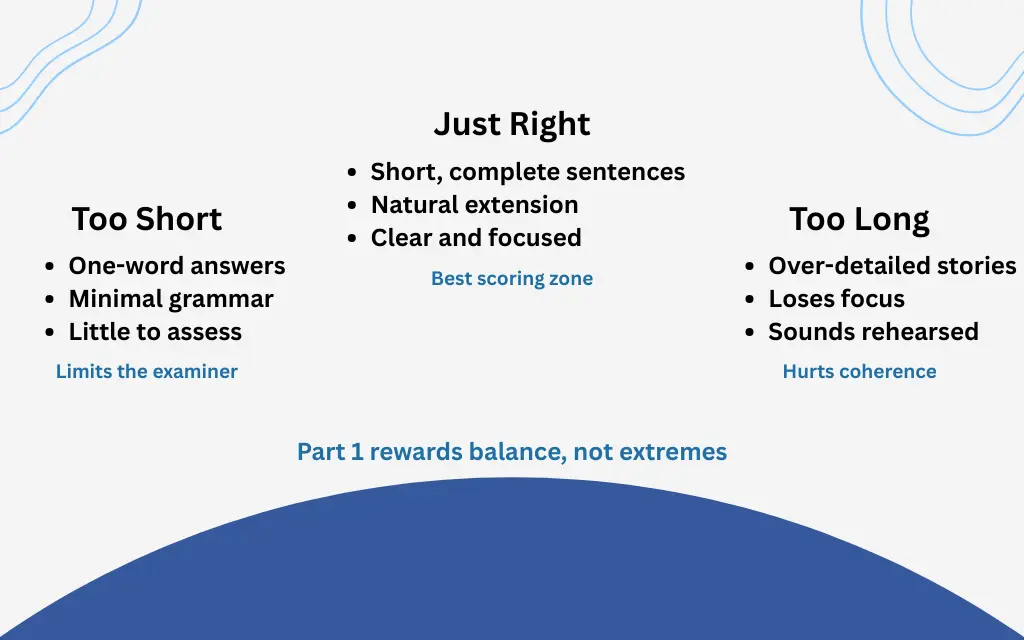
One of the most common mistakes in IELTS Speaking Part 1 is giving answers that are too short.
A strong Part 1 answer is usually one or two sentences.
For example, instead of:
“Yes, I do.”
A better answer would be:
“Yes, I do. I usually read in the evening because it helps me relax after work.”
This length provides enough language for the examiner to assess fluency, grammar, and vocabulary without sounding rehearsed or unfocused.
Example IELTS Speaking Part 1 questions and natural answers
Example 1: Home
Question:
“Do you live in a house or an apartment?”
Weak answer:
“An apartment.”
Stronger answer:
“I live in an apartment near the city centre. It’s quite small, but it’s convenient for work.”
The stronger answer shows basic description, fluency, and control.
Example 2: Free time
Question:
“What do you usually do in your free time?”
Natural answer:
“I don’t have much free time during the week, but at weekends I usually meet friends or watch films at home.”
The response sounds conversational rather than prepared.
Common IELTS Speaking Part 1 mistakes to avoid
Speaking in single words
Single-word answers severely limit what examiners can assess. Even beginners should aim for short, complete sentences.
Sounding memorised
Some candidates prepare answers in advance. In Part 1, this often sounds unnatural because the questions are simple and personal.
Examiners can easily hear when answers are over-prepared.
Over-explaining
Part 1 is not the place for long stories. Speaking for too long can reduce coherence and make answers feel unfocused.
Grammar expectations in IELTS Speaking Part 1
IELTS Speaking Part 1 mainly tests basic grammar, not complexity.
You are expected to control:
- present simple
- present continuous
- past simple (occasionally)
- basic connectors such as because and and
Accuracy matters more than range at this stage. A short, accurate sentence is always safer than a long sentence full of errors.
Vocabulary expectations in IELTS Speaking Part 1
Advanced vocabulary is not required in Part 1.
Examiners listen for:
- appropriate word choice
- natural collocations
- light variation rather than repetition
For example, instead of repeating good, you might naturally say nice, enjoyable, or relaxing. This shows control without forcing complexity.
Pronunciation and tone in Part 1
Pronunciation in Part 1 is about clarity, not accent.
Speaking calmly, using natural pauses, and applying basic sentence stress helps the examiner follow your ideas easily.
A relaxed tone often sounds more fluent than rushed or tense speech.
How Part 1 affects your overall speaking score
Some candidates treat Part 1 as a warm-up. This is a mistake.
The examiner begins assessing you from the first question.
If Part 1 shows:
- clear control
- relaxed delivery
- intelligible pronunciation
the examiner expects that level to continue.
If Part 1 sounds hesitant or weak, it becomes difficult to raise the band score later.
How to practise IELTS Speaking Part 1 effectively
Effective practice does not involve memorising answers.
Instead, focus on:
- answering naturally
- extending responses slightly
- recording yourself and listening for hesitation or repetition
Speaking aloud is essential. Silent practice does not develop fluency.
Conclusion
IELTS Speaking Part 1 may seem simple, but it plays a crucial role in your final band score.
By understanding the question style, answering naturally, and avoiding common early-stage mistakes, you can start the test confidently and set yourself up for success in Parts 2 and 3.
Strong speaking scores begin with the very first answer.
Related IELTS Speaking Lessons
Glossary
Fluency (noun) — ability to speak smoothly without unnatural pauses
Examiner (noun) — trained official who assesses IELTS Speaking
Pronunciation (noun) — clarity of sounds, stress, and intonation
Follow-up question (noun) — an additional question on the same topic
Band score (noun) — IELTS score from 0 to 9
Comprehension & Practice Questions
- True or False: IELTS Speaking Part 1 is not assessed.
- Multiple choice: How long should a typical Part 1 answer be?
A) One word
B) One or two sentences
C) A full paragraph - Short answer: What is the main grammar focus in Part 1?
- True or False: Advanced vocabulary is required in Part 1.
- Short answer: Why is Part 1 important for the overall speaking score?
Answers
- False
- B
- Simple, accurate grammar
- False
- It sets examiner expectations and contributes fully to the final score
Join 1,300+ English learners
Get free English lessons, IELTS tips and useful vocabulary by email.
No spam. Just practical English you can use.