Introduction to True / False / Not Given in IELTS Reading
Few parts of the IELTS Reading test create more frustration than True / False / Not Given questions.
Many candidates leave the exam feeling confused. They understood most of the passage, recognised much of the vocabulary, and still lost several marks in this section. This can feel especially discouraging because the questions look simple on the surface.
In reality, the problem is rarely English ability. It is almost always a misunderstanding of how this task works.
This lesson explains how true false not given IELTS questions are designed, how examiners expect you to judge statements, and how you can avoid the most common traps that lower scores.
When you understand the logic behind this task, it becomes far more predictable.
Practise English every weekday with me
Get short Mon–Fri English practice in LINE with LEW Daily, plus regular feedback to help you improve.
Explore LEW DailyNT$399/month • Cancel anytime

Why True / False / Not Given Feels So Difficult
Before learning techniques, it helps to understand why this question type causes so many problems.
In most reading tasks, you look for information. You find it and choose an answer.
In True / False / Not Given, you must compare two ideas and judge their relationship. You are not only reading. You are evaluating meaning.
You are constantly asking yourself whether the passage and the statement match, contradict each other, or remain unrelated. This requires precision. Even a small change in wording can change the answer completely.
This is why many strong readers still lose marks in this section.
What “True”, “False”, and “Not Given” Really Mean
Many candidates lose marks because they do not fully understand these three labels. Let’s clarify them carefully.
What “True” Means
“True” means the statement agrees exactly with the passage. The idea is clearly supported.
Example:
Passage:
“The museum opened in 1995 and has attracted over two million visitors.”
Statement:
“The museum began operating in 1995.”
The meaning matches. This is True.
What “False” Means
“False” means the passage clearly contradicts the statement. The opposite idea appears in the text.
Example:
Passage:
“The company reduced its workforce by 10%.”
Statement:
“The company increased its workforce.”
This directly contradicts the passage. This is False.
What “Not Given” Means
“Not Given” means the passage does not mention this information at all.
Example:
Passage:
“The hotel was renovated in 2018.”
Statement:
“The hotel has a swimming pool.”
The passage says nothing about a pool. This is Not Given.
Not Given does not mean “unlikely” or “probably wrong”. It means there is no evidence either way.
Why “Not Given” Causes the Most Errors
Among the three options, Not Given creates the most confusion.
Many candidates think, “I didn’t see this, so it must be false.” This is incorrect.
False requires contradiction. Not Given requires absence.
If the passage is silent about an idea, the answer is Not Given, even if the statement sounds logical.
Examiners often include statements that feel reasonable in real life but are unsupported in the text. Learning to ignore logic and trust evidence is essential.
How True / False / Not Given Questions Are Written
Understanding how examiners create these questions helps you think more clearly during the test.
First, they select a sentence or idea from the passage. Then they modify it in different ways. They may paraphrase it, remove part of the information, change a detail, or reverse the meaning.
Each type of change produces a different answer.
When you recognise this process, you stop reacting emotionally and start analysing calmly.
A Reliable Step-by-Step Method for TFNG
A clear method reduces panic and improves accuracy.
Step 1: Read the Statement Slowly
Do not rush this stage. Pay attention to names, dates, numbers, and strong words such as “all”, “never”, or “only”. These often signal traps.
Make sure you understand exactly what the statement claims before looking at the passage.
Step 2: Locate the Relevant Section
Scan the passage for keywords or paraphrases. Do not reread the entire text.
Find the area where the idea appears, then slow down.
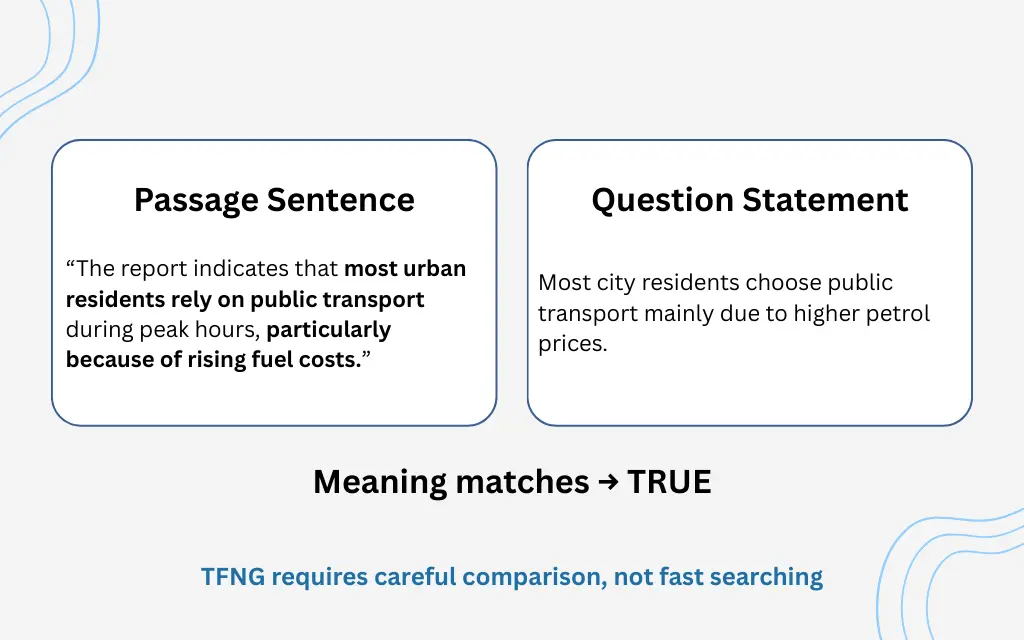
Step 3: Compare Meaning, Not Words
Focus on meaning rather than vocabulary.
For example:
Statement: “Many people opposed the plan.”
Passage: “The proposal faced considerable resistance.”
Different words, same meaning. This supports True.
Step 4: Decide Using Evidence Only
Ask yourself one question: does the passage clearly support, contradict, or ignore this statement?
Your answer must come from evidence, not feeling or logic.
The Role of Paraphrasing in TFNG
Paraphrasing is central to this task.
The same idea almost never appears in the same words.
For example:
Passage: “significant growth”
Statement: “major expansion”
These match in meaning.
Weak candidates look for identical words. Strong candidates look for equivalent ideas.
Training this skill improves accuracy more than memorising techniques.
Common Traps in True / False / Not Given Questions
Examiners use predictable traps. Understanding them prevents repeated mistakes.
One common trap involves partial information. The passage mentions part of an idea, but not all of it.
For example, “Some students received scholarships” does not support “All students received scholarships”. This is False.
Another trap involves extreme language. Words such as “always”, “never”, or “completely” often make statements too strong. These frequently lead to False answers.
Logical guessing is another major trap. A statement may sound sensible, but logic does not matter. Only the text matters. Reasonable but unsupported equals Not Given.
Time references also cause problems. Changes in tense or time period can completely alter meaning.
Why Skimming Alone Does Not Work
Some candidates skim too quickly and rely on memory.
This approach fails in TFNG.
You must read the relevant sentence carefully and compare ideas precisely. Speed comes from having a method, not from rushing.
When you slow down in the right place, you save time overall.
Managing Time in TFNG Questions
True / False / Not Given questions can drain time if you are not careful.
Strong candidates answer clear questions first, skip uncertain ones, and return later. They avoid spending several minutes on a single statement.
Progress matters more than perfection during the first pass.
Example Analysis
Let’s look at a typical example.
Passage:
“Researchers found that children who read daily performed better in vocabulary tests.”
Statement:
“Daily reading improves children’s vocabulary skills.”
Meaning matches. This is True.
Statement:
“All children who read daily became top students.”
Extra claim. This is False.
Statement:
“Teachers encourage daily reading at home.”
Not mentioned. This is Not Given.
With practice, this type of analysis becomes automatic.
How Practice Should Be Structured
Random practice produces slow improvement.
A better approach is focused training. Spend time mastering each answer type and identifying your personal weak points.
For example, you may practise distinguishing False from Not Given for several days before moving to mixed exercises.
This targeted approach builds confidence faster.
Psychological Control in TFNG
Many mistakes happen because of stress.
Under pressure, candidates guess, rush, or doubt clear answers. Training yourself to pause and check evidence prevents these errors.
Three seconds of calm thinking can save a full mark.
How Examiners Mark TFNG Answers
Markers follow strict rules.
They do not reward “almost correct” answers. Only exact logical matches receive marks.
This is why careful comparison is more important than general understanding.
Building Long-Term Confidence
Confidence grows when patterns become familiar.
After enough focused practice, you will recognise traps quickly and trust your method.
At that stage, TFNG becomes one of the most predictable parts of the Reading test.
Conclusion
True / False / Not Given questions are challenging because they require careful comparison rather than fast reading.
When you understand their logic, they stop being confusing.
Focus on evidence. Ignore assumptions. Trust the text. With consistent practice, this section becomes a strength rather than a weakness.
Related IELTS Reading Lessons
Glossary
Paraphrase (verb) — express the same meaning using different words
Contradict (verb) — say the opposite of something
Evidence (noun) — information that supports an answer
Scan (verb) — search quickly for specific words
Precision (noun) — careful accuracy
Comprehension & Practice Questions
True or False: “Not Given” means the statement is probably wrong.
Multiple choice: What is most important in TFNG?
A) Speed
B) Guessing
C) Evidence
Short answer: What does “False” mean?
True or False: Logical guessing is reliable in TFNG.
Short answer: Why is paraphrasing important?
Answers
False
C
The passage contradicts the statement
False
Because ideas are rewritten using different words
Join 1,300+ English learners
Get free English lessons, IELTS tips and useful vocabulary by email.
No spam. Just practical English you can use.