
Introduction to IELTS Reading Vocabulary
One of the most common worries IELTS candidates have about the Reading test is vocabulary.
Many students say things like:
“I don’t understand many words.”
“There are too many difficult terms.”
“I panic when I see unknown vocabulary.”
Because of this, many learners believe that improving their IELTS reading score means memorising thousands of new words. They spend hours studying word lists, academic dictionaries, and advanced vocabulary books, hoping this will protect them on exam day.
Yet in real IELTS exams, many candidates with strong vocabulary still score poorly, while others with limited vocabulary achieve Band 7 or above.
This shows something important.
Success in IELTS reading is not about knowing every word. It is about knowing how to work with vocabulary intelligently.
This lesson explains what IELTS reading vocabulary really means, how examiners expect you to handle unknown words, and what actually helps you improve your reading band score.
Practise English every weekday with me
Get short Mon–Fri English practice in LINE with LEW Daily, plus regular feedback to help you improve.
Explore LEW DailyNT$399/month • Cancel anytime

Why Vocabulary Causes Anxiety in IELTS Reading
Reading anxiety often begins the moment candidates open the test booklet.
They see long academic passages filled with unfamiliar terms, technical language, and complex sentences. Confidence drops immediately.
Many learners assume:
“If I don’t understand every word, I will fail.”
This belief is understandable, especially for students who learned English through translation-based methods. In many traditional classrooms, understanding every word is treated as success.
IELTS reading works differently.
The exam is designed so that no candidate understands everything. Even native speakers meet unfamiliar vocabulary. This is intentional. IELTS measures reading skill, not dictionary knowledge.
Once you accept this, your mindset changes. You stop fighting unknown words and start working around them.
That is when progress begins.
What Examiners Expect You to Do With Unknown Words
IELTS examiners do not expect perfect comprehension. They expect strategic reading.
When you meet an unfamiliar word, one of three things usually applies.
Sometimes the word is unimportant.
Sometimes the word can be guessed from context.
Sometimes the word is essential.
Strong readers quickly recognise which situation they are in.
Example:
The newly introduced legislation was met with widespread opposition.
Even if “legislation” is unfamiliar, the sentence clearly refers to a new rule or law that people dislike. Full definition is unnecessary.
Compare this with:
The experiment relied on photosynthesis to generate energy.
Here, understanding “photosynthesis” may matter more. However, surrounding context still provides clues.
IELTS rewards readers who focus on meaning rather than perfection.
Passive and Active Vocabulary in Reading
Not all vocabulary knowledge is equal.
In IELTS reading, two types matter.
Passive vocabulary refers to words you recognise when reading.
Active vocabulary refers to words you can use in speaking and writing.
For reading, passive vocabulary is far more important.
You do not need to produce advanced language. You only need to recognise it and understand its function.
For example, you may never use “infrastructure” or “sustainability” in daily conversation. But recognising them in texts is enough.
This is why reading improvement comes mainly from exposure, not memorisation.
Using Context to Understand Unknown Vocabulary
Context is your most powerful reading tool.
When you meet an unfamiliar word, look at:
- sentence structure
- examples
- cause-and-effect signals
- contrast words (however, although)
- explanations that follow
Example:
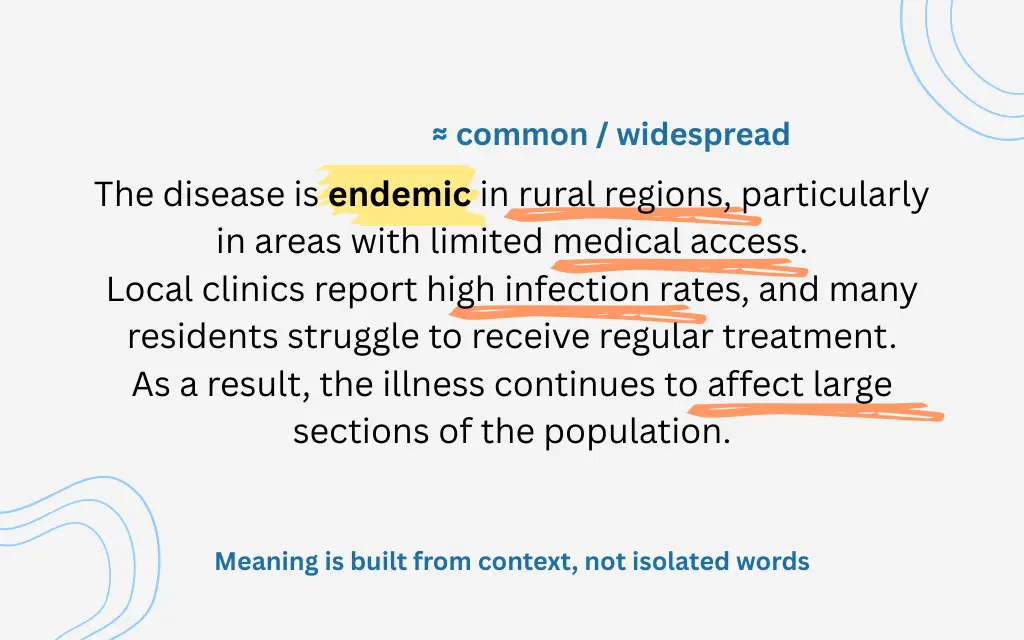
The disease is endemic in rural regions, particularly in areas with limited medical access.
Even if “endemic” is new, the surrounding clues suggest it means “common” or “widespread”.
Skilled readers build meaning from relationships between ideas.
Why Memorising Word Lists Rarely Raises Scores
Many candidates rely heavily on vocabulary apps and word lists. These tools can help, but they often create false confidence.
Memorisation causes three main problems.
Words are learned without context.
Meanings are oversimplified.
Usage is unclear.
For example, learning that “issue” means “problem” is incomplete. In real texts, it may also mean “topic”, “edition”, or “publication”.
Without context, memorised words become unreliable.
Real improvement comes from repeated exposure in authentic reading.
Vocabulary and Paraphrasing in IELTS Reading
Paraphrasing is central to IELTS Reading.
Examiners rarely repeat vocabulary from passages. Instead, they reformulate ideas.
Example:
Text:
The company reduced its workforce significantly.
Question:
The firm dismissed many employees.
If you only search for “workforce”, you will miss the answer.
You must recognise relationships between expressions.
This is why vocabulary knowledge must be flexible, not fixed.
Vocabulary That Matters Most for Reading
Not all vocabulary deserves equal attention.
Certain word groups appear repeatedly in IELTS texts.
These include:
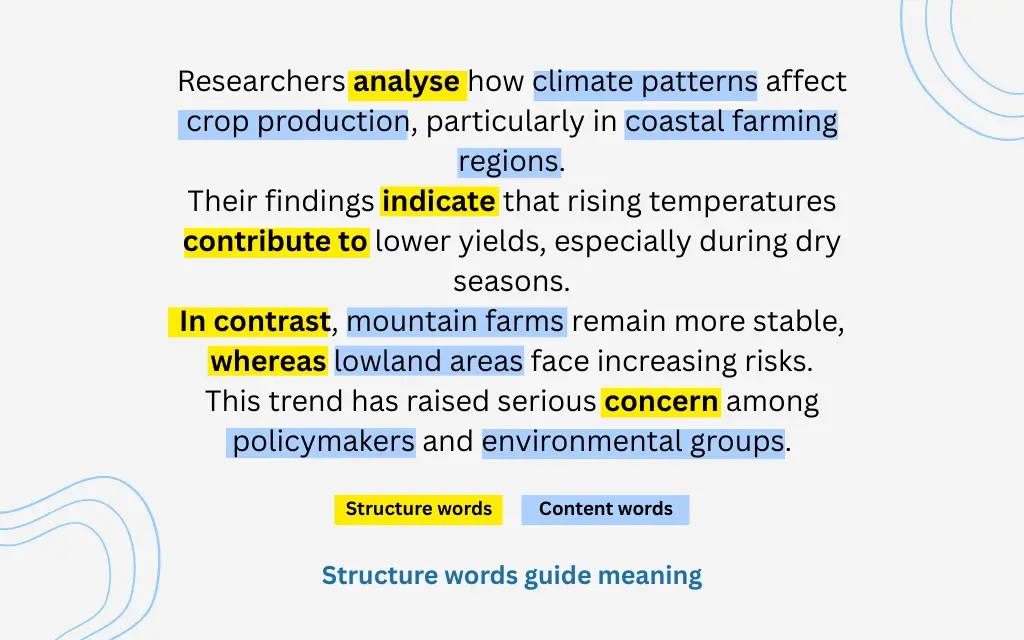
- academic process words (analyse, indicate, evaluate)
- cause-and-effect language (lead to, result in, contribute to)
- comparison language (whereas, in contrast, similarly)
- attitude words (concern, criticism, support)
These words shape meaning and structure arguments.
Understanding them helps you follow ideas even when technical terms are difficult.
How Strong Readers Handle Difficult Passages
Good readers do not fight texts. They manage them.
When sections are difficult, they slow down slightly. When passages are easy, they move faster.
They avoid rereading everything.
Instead, they ask:
What is the main idea here?
How does this link to the question?
Which sentence carries the key meaning?
This approach reduces overload and protects time.
A Practical Vocabulary Strategy for the Exam
An effective exam strategy follows a clear pattern.
First, skim for topic and structure.
Second, use keywords to locate sections.
Third, read carefully for meaning.
Fourth, evaluate unknown words calmly.
When you meet new vocabulary, ask:
Does this affect my answer?
If no, ignore it.
If yes, infer from context.
Only rarely should you guess blindly.
This keeps thinking organised and efficient.
How Vocabulary Confidence Raises Band Scores
When candidates stop fearing unknown words, three things happen.
They read faster.
They think more clearly.
They make fewer careless mistakes.
This improves time management and accuracy.
Vocabulary confidence is therefore psychological as well as linguistic.
Conclusion
IELTS reading is not a vocabulary test. It is a meaning test.
You do not need to understand every word. You need to understand relationships, arguments, and ideas.
When you learn to use context, recognise paraphrasing, and focus on key language patterns, unknown words lose their power.
Instead of causing panic, they become background noise.
Explore related guides on paraphrasing and reading traps to strengthen your overall exam strategy.
Related IELTS Reading Lessons
Glossary
Context (noun) — surrounding information that explains meaning
Passive vocabulary (noun) — words you recognise when reading
Paraphrase (noun/verb) — expressing the same idea in different words
Inference (noun) — conclusion based on clues
Academic vocabulary (noun) — words used in formal texts
Practice Questions
- Why does IELTS include unknown vocabulary?
- True or False: You must understand every word to score well.
- What is passive vocabulary?
- Why is context important?
- How does vocabulary confidence affect performance?
Answers
- To test reading skills, not memorisation.
- False.
- Words you recognise when reading.
- It helps you infer meaning.
- It improves speed and accuracy.
Join 1,300+ English learners
Get free English lessons, IELTS tips and useful vocabulary by email.
No spam. Just practical English you can use.