Introduction to Comparison Language for IELTS Task 1
Many IELTS Task 1 responses fail not because the data is misunderstood, but because it is not compared clearly. Candidates often describe figures one by one, hoping the examiner will see the relationship between them. Examiners do not do that work for you.
What they want to see is comparison.
Using IELTS Task 1 comparison language effectively shows that you understand the data, can prioritise key features, and can communicate relationships clearly. This skill sits at the intersection of Task Achievement, Coherence, and Grammar, which is why it has such a strong impact on scores.
This lesson will explain how comparison language works in Task 1, what examiners expect to see, and how to compare data naturally without sounding mechanical or memorised.
Practise English every weekday with me
Get short Mon–Fri English practice in LINE with LEW Daily, plus regular feedback to help you improve.
Explore LEW DailyNT$399/month • Cancel anytime

Why Comparison Is Central to Task 1
Task 1 is not a description task. It is a data interpretation task.
Examiners assess whether you can:
- Identify relationships between figures
- Highlight contrasts and similarities
- Show trends in relation to other trends
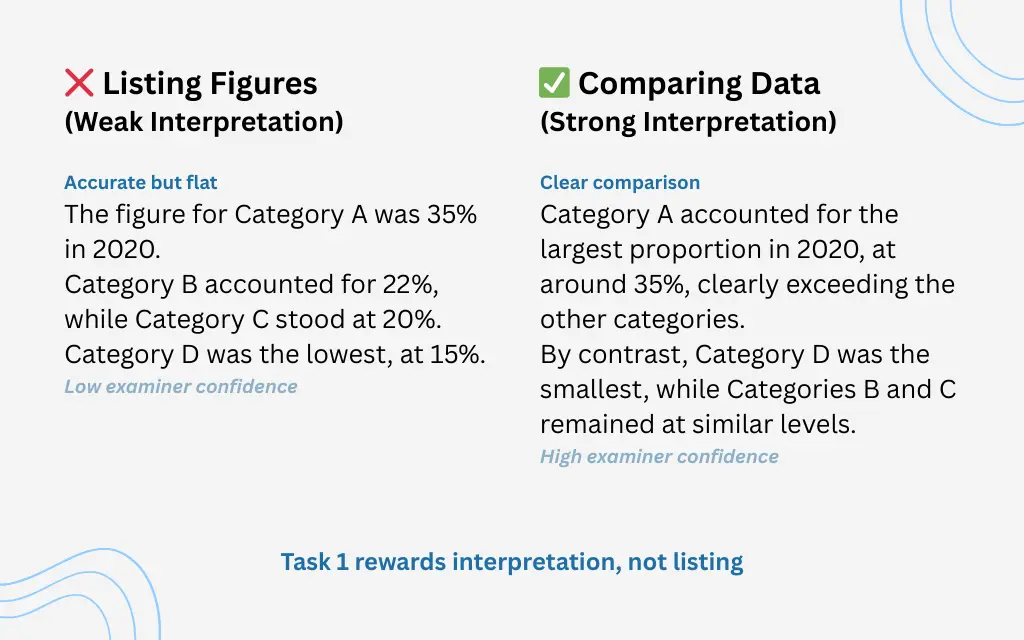
If a response simply lists information, even accurately, it often feels flat. When comparison language is used well, the writing feels purposeful and analytical.
What Examiners Mean by “Comparing Data”
Comparing does not mean using more than or less than repeatedly.
It means showing how values relate in meaningful ways. This can include:
- One category being higher or lower than another
- One trend increasing while another declines
- One group remaining stable compared to change elsewhere
The goal is to guide the reader’s attention to the most important contrasts.
Comparison vs Description: The Key Difference
Many candidates confuse description with comparison.
Description reports facts. Comparison interprets them.
For example, describing that two figures exist is different from showing how they differ. Examiners reward interpretation because it demonstrates understanding, not just observation.
This distinction often separates Band 6 from Band 7 responses.
Where Comparison Language Fits in a Task 1 Response
Comparison language is most effective when it appears:
- In the overview, at a high level
- In body paragraphs, when grouping data
- At transition points between ideas
It should not appear randomly. It should support structure.
When comparison language aligns with paragraph logic, coherence improves automatically.
Comparing Categories in Static Data
When data does not change over time, comparison focuses on relative size or rank.
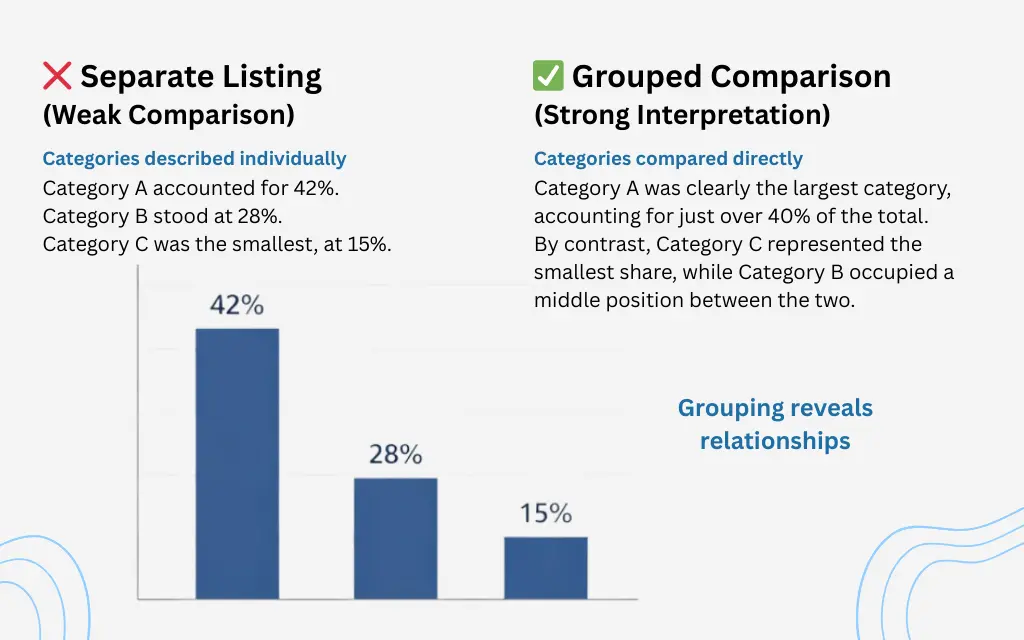
Rather than listing each category, strong responses compare groups directly. This helps reduce repetition and makes relationships clearer.
For example, instead of describing three categories separately, a stronger approach contrasts the largest and smallest while positioning the middle category between them. See how proportions and categories are compared in a complete report with our IELTS pie-chart sample answer.
Comparing Trends Over Time
In time-based visuals, comparison often focuses on direction and scale.
Examiners look for whether you:
- Compare rising and falling trends
- Show differences in speed or magnitude
- Identify stability versus change
The key is to avoid narrating year by year. Comparison language allows you to summarise movement more efficiently.
Language That Signals Comparison Naturally
Comparison language should sound natural, not formulaic.
Examiners notice when phrases are overused or forced. They prefer simple, flexible structures that fit the data.
This is where grammar control matters. Accurate comparative structures signal confidence and range, even when vocabulary is simple.
Avoiding Mechanical Comparison
A common mistake is repeating the same comparison structure in every sentence.
This often sounds robotic and lowers coherence. Variety matters, but only when it remains controlled.
Strong responses mix:
- Direct comparisons
- Implied contrasts
- Grouping phrases
This variation keeps the writing natural and readable.
Implicit Comparison: Letting Data Speak
Not all comparison needs to be explicit.
Sometimes, placing two figures side by side in a sentence creates a clear contrast without using obvious comparative words. Examiners recognise this as sophisticated control.
For example, showing one value alongside another can imply difference more smoothly than stating it directly.
Comparison Language and Task Achievement
Comparison language directly affects Task Achievement.
Examiners assess whether you have:
- Selected key features
- Shown relationships between them
- Avoided unnecessary detail
When comparison is weak, Task Achievement suffers even if grammar and vocabulary are accurate.
This is why comparison language is not just a grammar issue. It is a scoring issue.
Comparison language is especially useful for map tasks, where you often need to describe how an area has changed; this guide to IELTS map language gives you the location and development vocabulary you need.
How Comparison Improves Coherence
Comparison helps organise information.
When you group similar data and contrast it with different data, the structure becomes clearer. Paragraphs feel purposeful rather than repetitive.
Examiners experience this as coherence, even before they analyse linking words.
Grammar Control in Comparison Language
Because comparison relies on grammar, it overlaps strongly with grammar assessment.
Examiners look for:
- Accurate comparative forms
- Consistent sentence control
- Natural use without strain
Errors in comparison structures tend to repeat, which makes them more noticeable. Stabilising a few reliable patterns is more effective than attempting many complex ones.
Common Comparison Problems in Task 1
Weak comparison language often shows up as:
- One sentence per category, with no links
- Overuse of “more than” and “less than”
- Comparisons that focus on minor differences
These patterns suggest description rather than analysis.
Selecting What to Compare
Not all data should be compared.
Strong responses compare:
- The most different values
- The most significant trends
- The clearest contrasts
Comparing everything equally often weakens focus. Examiners want to see judgement.
Comparison Language Across Different Visuals
Although visuals vary, the principle remains consistent.
Whether you are comparing bars, lines, or segments, the examiner expectation is the same: highlight relationships that matter.
This consistency allows you to apply the same thinking across all Task 1 types.
Practising Comparison Language Effectively
To practise, take a Task 1 visual and:
- Write only the overview using comparison
- Remove all numbers
- Focus on relationships
If the overview still makes sense, your comparison language is working.
Why Examiners Value This Skill So Highly
Comparison is a core academic skill.
IELTS Task 1 reflects real academic writing, where data is interpreted, not copied. This is why examiners value comparison language so highly and why it appears implicitly across multiple band descriptors.
Conclusion
Mastering IELTS Task 1 comparison language transforms how your writing is assessed. When you compare data clearly and naturally, you show understanding, judgement, and control, all qualities examiners reward.
Instead of listing figures, focus on relationships. Instead of repeating structures, aim for clarity. This shift alone can raise your Task 1 score significantly.
To build on this skill, explore the related Learn English Weekly Task 1 and grammar guides linked below, especially those focused on comparatives and examiner marking.
Related IELTS Task 1 Lessons
Glossary
Comparison (noun) — Showing how two or more things relate
Contrast (noun) — Highlighting differences
Category (noun) — A group within data
Trend (noun) — A general direction of change
Comparative (adjective) — A grammatical form used to compare
Comprehension / Practice Questions
- True or False: Listing data counts as comparison.
- What do examiners value more?
A) Number of figures
B) Clarity of relationships - Why does comparison improve coherence?
- Short answer: Name one way to compare data implicitly.
- True or False: Comparison language affects Task Achievement.
Answers
- False
- B
- It organises information logically
- Placing values side by side
- True
Join 1,300+ English learners
Get free English lessons, IELTS tips and useful vocabulary by email.
No spam. Just practical English you can use.