
Introduction to Complex Sentences for IELTS Writing
IELTS candidates believe that higher scores come from writing longer, more complicated sentences. As a result, they force complex grammar into every paragraph, hoping this will impress the examiner.
The outcome is often the opposite.
Instead of demonstrating strong grammar range, the writing becomes hard to follow, error-prone, and unstable. Ideas get lost inside sentences that are trying to do too much at once.
This lesson will explain how to use complex sentences in IELTS writing effectively, without overusing them or damaging clarity. You will learn when complexity helps your score, when it hurts, and how examiners actually interpret sentence complexity in relation to grammar range.
Practise English every weekday with me
Get short Mon–Fri English practice in LINE with LEW Daily, plus regular feedback to help you improve.
Explore LEW DailyNT$399/month • Cancel anytime

What “Complex Sentences” Really Mean in IELTS
Before looking at examples, it is important to clarify what examiners mean by complex sentences.
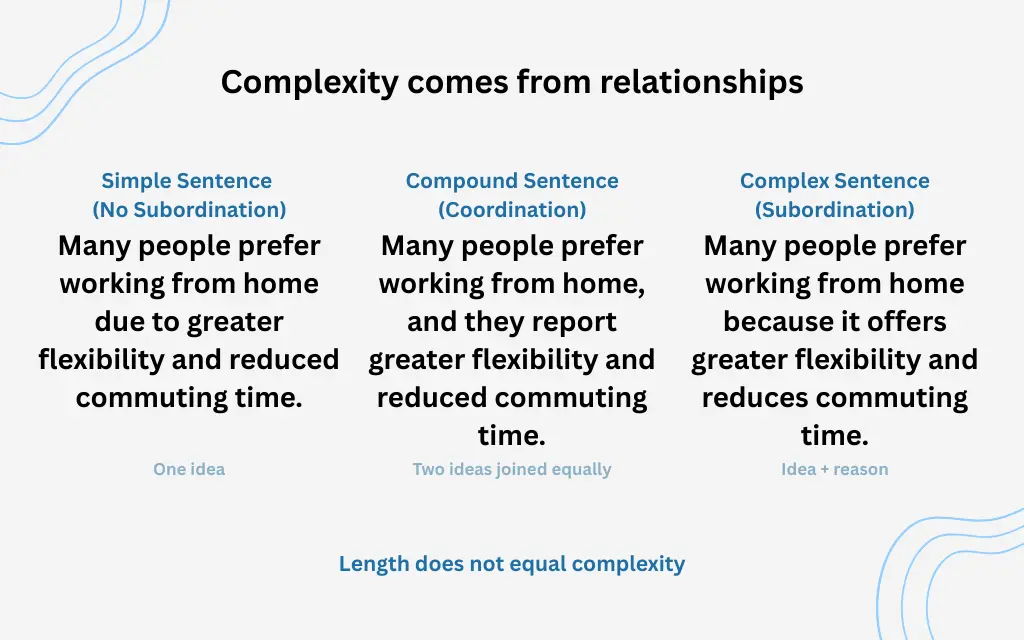
In IELTS, a complex sentence is not a long sentence. It is a sentence that combines ideas using subordination, such as clauses beginning with because, although, which, that, while, or if. These structures allow you to show relationships between ideas rather than listing them separately.
A simple sentence can be long, and a complex sentence can be short. Examiners focus on control, not length.
Why Sentence Complexity Matters for IELTS Scores
Sentence complexity contributes directly to grammar range IELTS scores. Examiners expect candidates to use a mix of sentence types, especially at Band 7 and above.
However, complexity is only rewarded when it is accurate and purposeful. A complex sentence that collapses grammatically or obscures meaning reduces your score rather than increasing it.
This is why many candidates remain stuck at Band 6–6.5. They attempt complexity but lack consistent control.
How Examiners Actually Judge Sentence Complexity
Examiners do not count how many complex sentences you write. They assess how naturally you use them.
If complex sentences appear occasionally, fit the idea being expressed, and remain accurate, they signal strong grammatical control. If every sentence is complex, or if complex structures repeatedly break down, they signal over-ambition.
In practice, examiners look for balance: a natural mix of simple, compound, and complex sentences across the response.
When Complex Sentences Are Most Useful
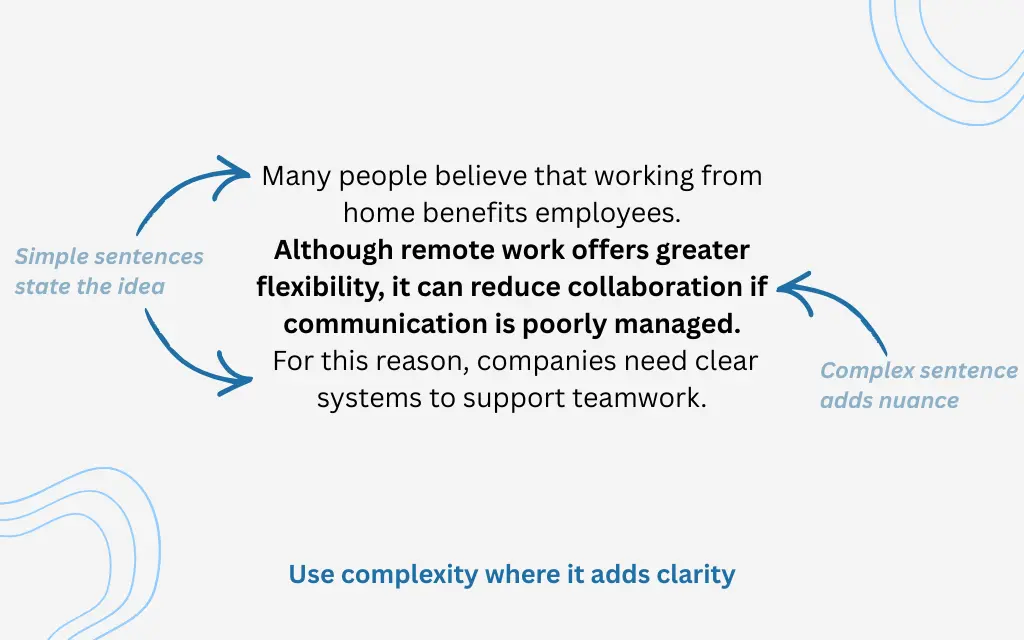
Complex sentences are most effective when you need to show contrast, cause and effect, limitation, or explanation.
For example, when qualifying an argument, a complex sentence allows you to show nuance. When explaining why something happens, subordination clarifies the relationship between cause and result.
In these situations, complexity improves clarity rather than reducing it.
When Complex Sentences Hurt Your IELTS Writing
Problems arise when candidates use complex sentences simply because they believe they must.
Overuse often leads to run-on sentences, unclear references, or incorrect clause connections. This is especially common in Task 2 introductions and body paragraphs where candidates attempt to “sound academic”.
In these cases, the examiner notices strain rather than skill.
Complexity should serve meaning. When it exists only to demonstrate grammar range, it becomes a liability.
Complex Sentences and Band Score Boundaries
At lower bands, writing relies heavily on simple sentences, often joined with and or but. This limits grammar range.
At Band 6, candidates usually attempt complex sentences but do so inconsistently. Errors appear frequently, particularly with clause endings or verb forms.
At Band 7, complex sentences are used selectively and mostly accurately. At Band 8 and above, they are fully controlled and varied, but never excessive.
Understanding this progression helps you aim for appropriate complexity, not maximum complexity.
Common Types of Complex Sentences Used Well in IELTS
Certain complex sentence patterns appear frequently in high-scoring IELTS responses because they are reliable and flexible.
Relative clauses are one example. They allow you to add information smoothly without starting a new sentence. Conditional clauses are another, particularly when discussing consequences or hypothetical situations.
The key is familiarity. Using a small number of well-controlled patterns is far safer than experimenting with unfamiliar structures in an exam.
Avoiding the “One-Sentence Paragraph” Problem
A common mistake among candidates trying to sound advanced is writing very long paragraphs made up of one or two extremely complex sentences.
This damages coherence. IELTS writing is assessed partly on how easily ideas can be followed. Long, overloaded sentences force the reader to work harder than necessary.
Breaking ideas into clear units, even when using complex grammar, improves readability and overall score.
Complex Sentences in Task 1 vs Task 2
Complex sentences appear differently across tasks.
In Task 1, complexity is often structural rather than argumentative. Subordinate clauses describe trends, comparisons, or stages in a process. Overly complex sentences here often lead to factual confusion.
In Task 2, complex sentences support reasoning. They help explain why, under what conditions, or to what extent an argument applies.
Using the same sentence style in both tasks is a common error. Task awareness matters.
How to Practise Complex Sentences Safely
The safest way to improve complex sentence use is not to write more of them, but to refine a few reliable patterns.
When practising, identify one sentence per paragraph where complexity genuinely improves clarity. Focus on making that sentence accurate and natural, while keeping surrounding sentences simple.
Over time, this builds confidence and control without risking overuse.
How to Check Your Own Sentence Complexity
When reviewing writing, ask two simple questions:
Does this sentence express more than one idea?
Would splitting it make the meaning clearer?
If the answer to the second question is yes, the sentence may be too complex for its purpose.
This self-checking habit mirrors how examiners respond instinctively while reading.
Conclusion
Complex sentences are essential for higher IELTS writing scores, but only when used with restraint and purpose.
Examiners reward controlled complexity, not constant complexity. A small number of accurate, well-placed complex sentences is far more effective than filling every paragraph with them.
To strengthen this skill further, explore related grammar guides on Learn English Weekly that focus on sentence control, grammar range, and examiner expectations.
Related IELTS Grammar Lessons
Glossary
Complex sentence (noun) — A sentence containing a main clause and at least one subordinate clause
Grammar range (noun phrase) — The variety of grammatical structures used
Subordinate clause (noun) — A clause that depends on a main clause
Relative clause (noun) — A clause that adds information about a noun
Coherence (noun) — How clearly ideas are organised and connected
Practice Questions
- True or False: Longer sentences always score higher in IELTS writing.
- Short answer: Why can overusing complex sentences lower a band score?
- Multiple choice: What do examiners value most?
A) Sentence length
B) Sentence variety and control
C) Advanced vocabulary - True or False: Task 1 and Task 2 require the same type of complexity.
- Short answer: What is a safe way to practise complex sentences?
Answers
- False
- They reduce clarity and increase errors
- B
- False
- Refining a few reliable patterns
Join 1,300+ English learners
Get free English lessons, IELTS tips and useful vocabulary by email.
No spam. Just practical English you can use.