
Introduction to Accuracy vs Vocabulary Range
Many IELTS candidates feel torn between two competing goals. On the one hand, they want to use impressive vocabulary and advanced grammar to show range. On the other, they worry about making mistakes and losing marks. This tension leads to a familiar question: what matters more in IELTS writing — accuracy or range?
Understanding accuracy vs range IELTS performance is one of the most important mindset shifts a candidate can make. Examiners are not asking you to choose one over the other. They are judging how well you balance them.
This lesson will explain how accuracy and range are assessed in IELTS writing, why candidates often misunderstand their relationship, and how prioritising control can actually increase your score, even when your vocabulary stays relatively simple.
Practise English every weekday with me
Get short Mon–Fri English practice in LINE with LEW Daily, plus regular feedback to help you improve.
Explore LEW DailyNT$399/month • Cancel anytime

How Examiners Think About Accuracy and Range
Accuracy and range are not separate checklists. They are two sides of the same judgement.
Examiners look at how much language you attempt, and how well you control it. They do not reward ambition that collapses under pressure, and they do not penalise simplicity when it is used effectively.
This is why two essays with very different vocabulary levels can receive the same band score. What matters is whether the language works reliably.
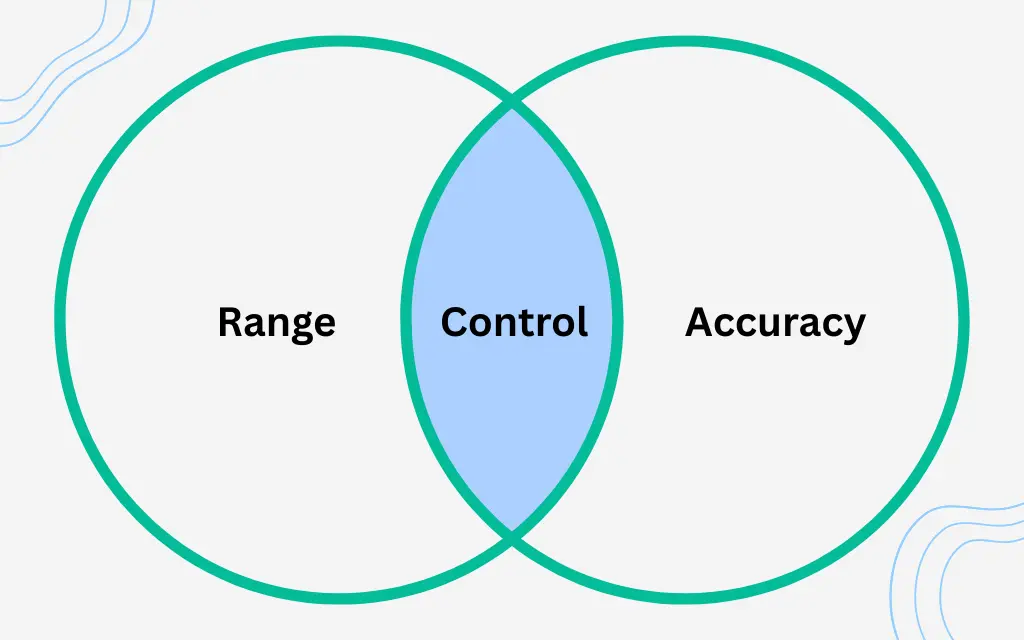
What Accuracy Really Means in IELTS Writing
Accuracy refers to how consistently grammar and vocabulary are used correctly.
This includes:
- Correct sentence structure
- Appropriate word choice
- Stable tense use
- Minimal spelling and agreement errors
Importantly, accuracy does not mean perfection. Even high-band writing contains small errors. What examiners look for is whether those errors are rare and non-distracting.
When errors become frequent, or appear every time a complex structure is attempted, examiner confidence drops quickly.
What Examiners Mean by “Range”
Range refers to the variety of language you use.
In vocabulary, this means using more than the most basic words. In grammar, it means showing flexibility in sentence structures. However, range does not require constant complexity.
Examiners are satisfied when they see that you can use a range of language. They do not need you to demonstrate it in every sentence.
This is where many candidates misunderstand grammar range IELTS expectations.
Why Vocabulary Range Is Often Overvalued by Candidates
Many learners believe that higher scores require “advanced” vocabulary. As a result, they force words that feel impressive but slightly unnatural.
This approach often leads to:
- Incorrect collocations
- Awkward phrasing
- Loss of clarity
Examiners do not reward rare words used inaccurately. They reward appropriate vocabulary used accurately.
A simpler word used precisely usually scores higher than an advanced word used incorrectly.
Accuracy Builds Examiner Trust
One of the most important (and least discussed) aspects of IELTS writing is trust.
When examiners read an essay with few errors, they relax. They assume the writer is in control. This positive impression carries through the rest of the assessment.
When errors appear frequently, even if ideas are strong, examiners become cautious. They start noticing problems more quickly.
Accuracy builds confidence. Confidence supports higher bands.
Range Without Accuracy: Where Scores Stall
Many candidates reach Band 6.5 or 7 by expanding vocabulary and grammar range, then get stuck.
At this stage, writing often shows ambition but inconsistent control. Complex sentences appear, but they break down. Vocabulary becomes broader, but precision drops.
This is why focusing on IELTS vocabulary accuracy often unlocks progress when further expansion does not.
Refining what you already use is often more effective than adding new language.
Accuracy Without Range: Another Common Limitation
The opposite problem also exists. Some candidates write very accurately but use limited structures and vocabulary.
This writing is clear and easy to read, but feels repetitive. Examiners may see strong control but limited flexibility.
At higher bands, examiners expect evidence that you can handle some complexity. This does not require constant variety, just occasional, successful expansion.
Balance is key.
How High-Band Writing Balances Accuracy and Range
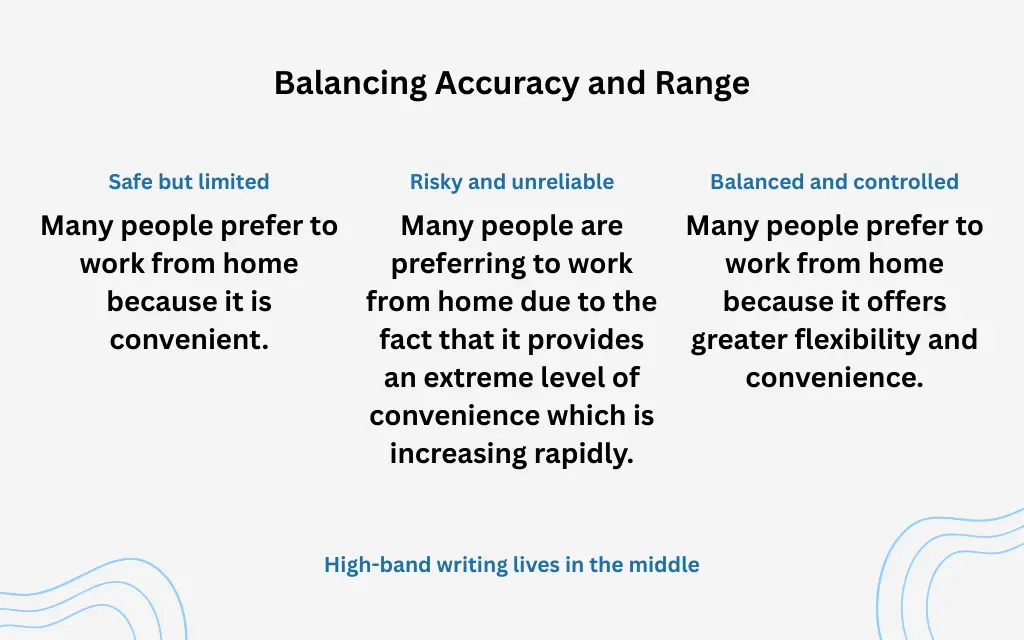
Higher-band writing does not sit at either extreme. It lives in the middle.
Strong essays:
- Use mostly accurate, familiar language
- Introduce complexity selectively
- Avoid unnecessary risk
Range appears naturally when ideas demand it. Accuracy is protected by avoiding overload.
Grammar Range vs Grammar Control
A crucial distinction in IELTS writing is between range and control.
Grammar range is about what you attempt. Grammar control is about how reliably it works.
Examiners value control more than range. A smaller set of structures used confidently often scores higher than a wide set used unpredictably.
This is why practising control, not invention, leads to more stable results.
Vocabulary Choice and Meaning
Vocabulary accuracy is not only about correctness. It is about fit.
Words must suit the context, tone, and task. Even technically correct words can lower scores if they feel unnatural or exaggerated.
High-band writing often uses common words in precise ways. This clarity helps ideas stand out more than decorative vocabulary.
Accuracy and Range Across Task 1 and Task 2
The balance between accuracy and range applies to both tasks, but in slightly different ways.
In Task 1, accuracy with tense, comparison, and data description is especially important. Vocabulary range is useful, but clarity matters more.
In Task 2, range becomes more visible through sentence variety and argument development. However, accuracy still anchors the score.
In both tasks, control outweighs ambition.
Why Chasing Range Can Lower Scores
When candidates chase range, they often:
- Write longer sentences than they can manage
- Use words they cannot fully control
- Increase error frequency
This pushes writing away from examiner expectations rather than towards them.
Ironically, many candidates improve their scores by simplifying — not by expanding.
A Better Strategy for IELTS Writing Improvement
Instead of asking How can I use more advanced language?, ask:
- How can I reduce repeated errors?
- Which structures do I use well already?
- Where does my accuracy drop?
This mindset leads to gradual, reliable improvement.
Range should grow after accuracy stabilises, not before.
Conclusion
Understanding accuracy vs range IELTS performance is essential for consistent writing improvement. IELTS does not reward language that looks impressive but fails under pressure. It rewards language that works.
Accuracy builds examiner trust. Range demonstrates flexibility. The highest scores come from balancing both, with control at the centre.
To explore this further, continue with the related Learn English Weekly grammar and writing guides linked below, where accuracy and range are shown in real IELTS contexts.
Related IELTS Grammar Lessons
Glossary
Cohesion (noun) — How ideas are connected on the surface level of writing
Cohesion device (noun) — A word or structure used to link ideas
Reference (noun) — Using words to point back to earlier ideas
Connector (noun) — A word that links clauses or sentences
Flow (noun) — How smoothly writing is read
Practice Questions
- True or False: More linking words always improve cohesion.
- Which is part of cohesion?
A) Vocabulary difficulty
B) Reference words - Why can overusing connectors lower a score?
- Short answer: Name one cohesion device.
- True or False: Cohesion affects both Task 1 and Task 2.
Answers
- False
- B
- It makes writing feel mechanical
- Reference / linking word / repetition
- True
Join 1,300+ English learners
Get free English lessons, IELTS tips and useful vocabulary by email.
No spam. Just practical English you can use.