
Introduction to Word Choice Mistakes in IELTS Writing
In IELTS writing, it is possible to feel confident about grammar and still receive a disappointing score. When this happens, the issue is often not sentence structure, but word choice.
Word choice mistakes are one of the most common reasons writing scores stall at Band 6 or 6.5. A sentence may be grammatically correct and even understandable, yet still sound slightly wrong. Examiners notice this immediately.
This lesson explains what word choice really means in IELTS writing, why mistakes happen so frequently, how examiners interpret them, and how to improve accuracy without losing confidence or avoiding new vocabulary.
Practise English every weekday with me
Get short Mon–Fri English practice in LINE with LEW Daily, plus regular feedback to help you improve.
Explore LEW DailyNT$399/month • Cancel anytime

What “word choice” really means in IELTS writing
Word choice is not about selecting advanced or impressive vocabulary. It is about selecting the most accurate word for the meaning, context, and tone.
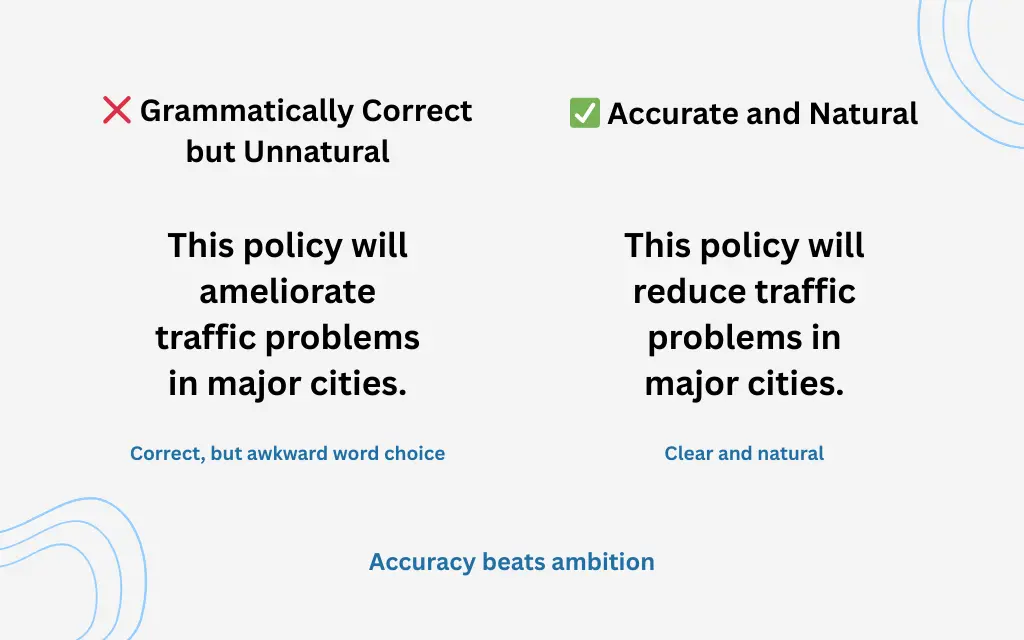
In IELTS writing, a simple word used accurately is always safer than an advanced word used incorrectly. Examiners are not impressed by ambition if it reduces clarity.
A practical way to think about word choice is reader reaction. If a native speaker would hesitate or feel unsure when reading a sentence, there is likely a word choice problem, even if grammar is correct.
Why word choice mistakes happen so often
Word choice errors are common because IELTS candidates are managing several pressures at once.
Direct translation from the first language
Many learners translate ideas directly from their first language. The English word may exist, but its usage or meaning may not match. This creates sentences that are understandable but unnatural.
Learning words without usage
Vocabulary lists often focus on meaning, not behaviour. Learners know what a word means, but not how it is typically used in real sentences, including collocation and tone.
Risk-taking under exam pressure
Under time pressure, candidates often choose a more complex word instead of a simple one, believing this will improve their score. In reality, this increases the risk of inaccuracy.
How examiners react to word choice mistakes
Examiners do not mark writing word by word. They read continuously and look for patterns.
Occasional word choice mistakes may be tolerated. Repeated mistakes signal weak control of vocabulary and directly affect the Lexical Resource score.
Examiners consistently value accuracy over ambition. A clear, simple word that fits the context always scores better than an advanced word that feels slightly wrong.
This is why word choice mistakes often prevent candidates from moving beyond Band 6.5.
Common types of word choice mistakes
Most word choice problems fall into predictable categories.
Similar words that are not interchangeable
Many English words share a general meaning but differ in formality, usage, or collocation. Choosing the wrong one creates awkward sentences, especially in academic writing.
Correct word, wrong structure
Sometimes the word itself is correct, but it is used in the wrong grammatical pattern. This often happens with verbs that require specific prepositions or objects.
Overuse of vague vocabulary
Words such as thing, stuff, or overly general terms reduce precision. While not incorrect, repeated use weakens clarity and argument strength.
Word choice in Task 1 vs Task 2 writing
Word choice affects both tasks, but in different ways.
Task 1 reports
In Task 1, word choice mistakes often involve inaccurate trend verbs, unclear comparisons, or misuse of time expressions. Because Task 1 language is repetitive by nature, even small errors stand out clearly.
Task 2 essays
In Task 2, word choice problems usually appear in abstract ideas, opinion statements, and cause-and-effect relationships. Inaccurate word choice here weakens both clarity and argument quality.
Why advanced vocabulary often causes problems
Many candidates believe higher-level vocabulary automatically leads to higher scores. This belief creates unnecessary risk.
Advanced words often have narrower meanings, specific contexts, and fixed collocations. When these conditions are not met, the sentence feels unnatural and examiner confidence drops.
Controlled, accurate vocabulary consistently scores higher than ambitious but unreliable word choice.
Improving word choice without losing confidence
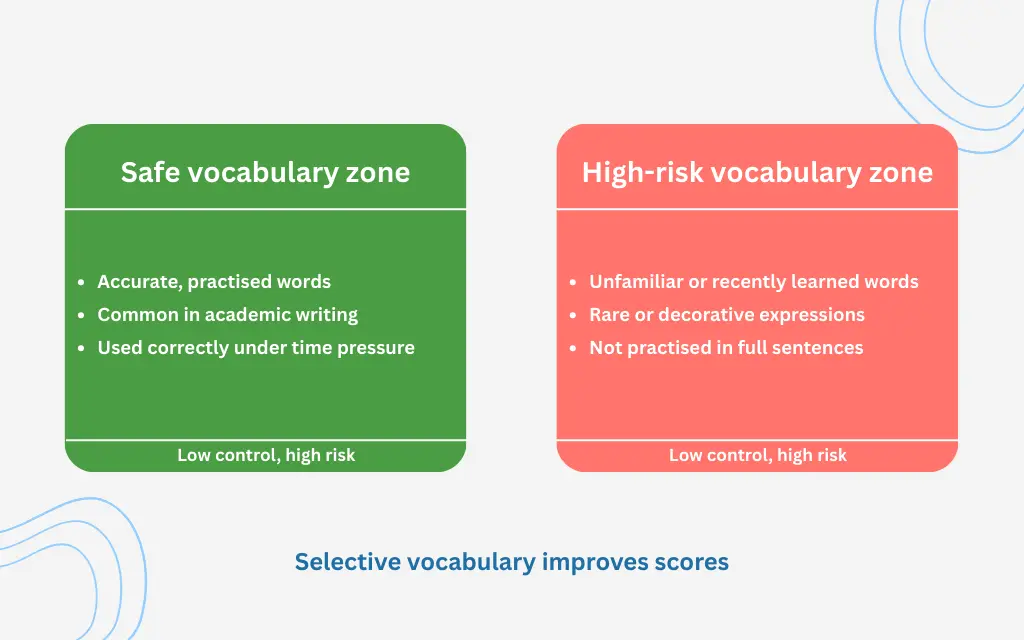
The goal is not to avoid new vocabulary, but to use it selectively.
Strong IELTS writers prioritise:
- words seen repeatedly in academic contexts
- vocabulary they have practised in full sentences
- expressions they can control under time pressure
How to check word choice like an examiner
When reviewing your writing, check word choice before grammar.
Focus on words that feel uncertain and ask:
- Is this word commonly used in this context?
- Would this phrase appear in academic writing?
- Am I choosing this word for accuracy or to sound advanced?
This habit builds awareness and reduces repeated mistakes over time.
The link between word choice and band score improvement
Improving word choice is one of the most efficient ways to move from Band 6.5 to Band 7.
At lower bands, examiners see frequent but understandable mistakes. At higher bands, they see controlled, accurate vocabulary with only occasional slips.
This is why improving word choice has such a strong impact on overall writing performance.
Conclusion
Word choice mistakes in IELTS writing are not a sign of low ability. They usually result from pressure, over-ambition, or incomplete learning.
By focusing on accuracy, context, and examiner expectations, you can reduce these mistakes without limiting expression. Clear, accurate word choice builds trust with the examiner, and that trust leads to higher scores.
Related IELTS Vocabulary Lessons
Glossary
Word choice (noun) — selecting the most accurate word for meaning and context
Lexical Resource (noun) — IELTS criterion measuring vocabulary range and accuracy
Collocation (noun) — words that naturally appear together
Accuracy (noun) — correctness of language use
Context (noun) — the situation in which a word is used
Practice Questions
- True or False: Using advanced vocabulary always improves your IELTS score.
- Multiple choice: Which IELTS criterion is most affected by word choice mistakes?
A) Task Response
B) Lexical Resource
C) Coherence and Cohesion - Short answer: Why do examiners prefer simple but accurate words?
- True or False: Word choice mistakes are more serious when they appear repeatedly.
- Short answer: When should you check word choice in your writing?
Answers
- False
- B
- Because they show control and clarity
- True
- After writing, during revision
Join 1,300+ English learners
Get free English lessons, IELTS tips and useful vocabulary by email.
No spam. Just practical English you can use.