Introduction to IELTS Reading Traps
Many IELTS candidates leave the Reading test feeling confused.
They finish the paper.
They understood most of the passages.
They felt confident.
And yet, the score is lower than expected.
In most cases, this happens because of IELTS reading traps.
These are not accidents. They are carefully designed features of the test that catch unprepared candidates.
This lesson will explain how IELTS reading traps work, why they fool intelligent students, and how you can avoid them calmly and consistently.
Practise English every weekday with me
Get short Mon–Fri English practice in LINE with LEW Daily, plus regular feedback to help you improve.
Explore LEW DailyNT$399/month • Cancel anytime

Why IELTS Uses Traps in Reading
The IELTS Reading test does not only measure your English.
It measures how well you read under pressure.
Examiners want to know whether you can follow meaning rather than isolated words, notice small changes in ideas, and resist distraction when time is limited.
Traps help separate average candidates from high-band candidates. They reward careful thinking, not speed alone.
How Traps Are Built into Reading Questions
Traps usually appear in three places: in the question, in the answer options, and in the passage itself.
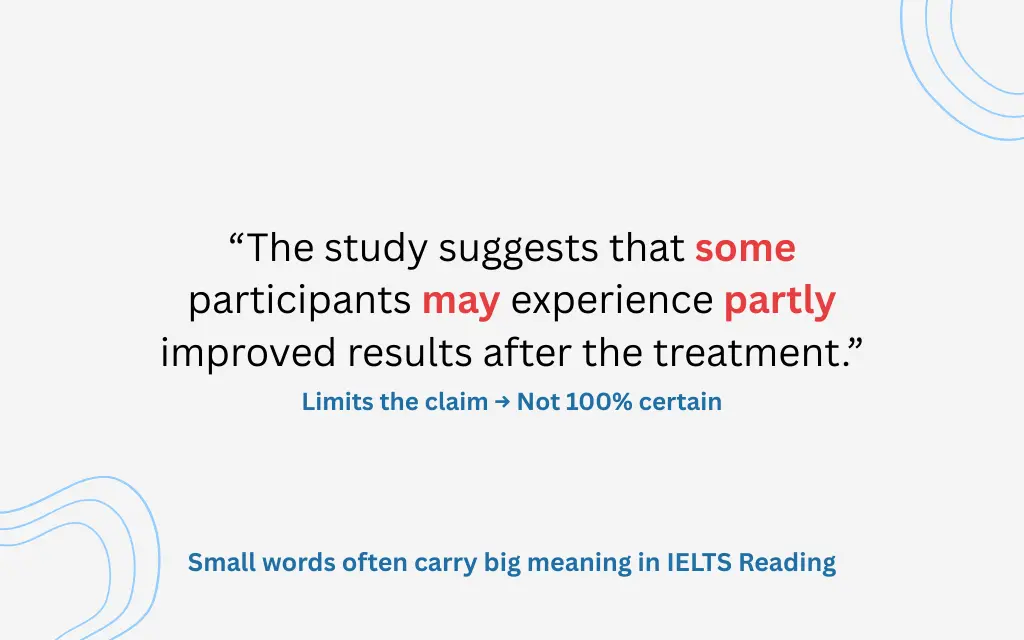
They are created through small language changes that alter meaning.
Sometimes a single word is enough to change the answer completely.
For example, “some researchers agree” and “most researchers agree” look similar, but they do not mean the same thing. Only one may match the text.
Many candidates miss these differences because they read too quickly.
Trap 1: Matching Words Instead of Meaning
This is the most common mistake in IELTS Reading.
Many students scan for familiar words and choose an answer immediately.
However, IELTS rarely repeats meaning directly.
For example, a question may say that sleep “improves” memory, while the passage says it “may support” recall. These are not the same.
“May support” is weaker than “improves”.
Strong candidates always check whether the meaning truly matches, not just the vocabulary.
Trap 2: Extreme Language
IELTS often uses very strong words to mislead candidates.
Words such as “always”, “never”, “completely”, “only”, and “all” are common warning signs.
Academic texts usually avoid absolute statements. They prefer careful, balanced language.
When you see extreme wording, slow down and check carefully. In many cases, the answer is wrong.
Trap 3: Partial Truth
Some answers are half correct and half wrong.
These are especially dangerous because part of the information matches the passage.
For example, the text may say a museum opened in 1980 and expanded in 1995. An option may say it opened in 1995. The year appears in the passage, but the meaning is wrong.
Partial truth is still wrong in IELTS.
Trap 4: Opinion and Fact Confusion
IELTS clearly separates opinion from evidence.
Many candidates mix these up.
If the passage says “some critics believe” something is harmful, this is opinion. It is not proof.
An option that states the idea as fact is therefore incorrect.
Always ask yourself who is saying something and whether evidence is given.
Trap 5: Synonym Mismatch
IELTS uses many synonyms, but not all similar words mean the same thing.
For example, “rapid” and “immediate” are related, but not identical. “Rapid” means fast. “Immediate” means without delay.
Choosing answers based on “close” meaning often leads to mistakes.
Precise meaning matters more than general similarity.
Trap 6: Reference Word Confusion
Pronouns and reference words cause many reading errors.
Words such as “it”, “they”, “this”, and “these” always refer to something earlier in the text.
If you do not track what they refer to, you may misunderstand the sentence.
Careful readers always check what a reference word points to before answering.
Trap 7: Logical Reversal
Sometimes IELTS reverses cause and effect.
For example, the text may say that poor diet causes fatigue, while an option says fatigue causes poor diet.
The same words appear, but the relationship is reversed.
This trap is easy to miss when reading quickly.
Trap 8: Distractors in Multiple Choice Questions
Multiple-choice questions always include distractors.
These are options that look correct but contain small errors.
Some may include true information from the passage but answer the wrong question. Others may mix two ideas incorrectly.
Never choose an option just because it “sounds right”. Every word must match the text.
How Traps Differ by Question Type
Different reading tasks use traps in different ways.
In True / False / Not Given, traps often involve degree, certainty, and missing evidence.
In Matching Headings, traps usually focus on examples rather than main ideas.
In Summary Completion, grammar, logic, and collocation are common problem areas.
In Multiple Choice, small changes in meaning create most errors.
Understanding these patterns makes traps easier to recognise.
Example: Trap Analysis in Practice
Consider this passage:
“Many students prefer online courses because they are flexible, although some miss face-to-face interaction.”
Question:
“Online courses are better than classroom learning.”
Some students see the word “prefer” and choose “True”.
However, the passage gives a mixed view. It does not say “better”.
The correct answer is “Not Given”.
This type of trap appears frequently in IELTS.
Why Strong Students Still Fall for Traps
Traps work because of psychology.
Some candidates become overconfident and stop checking carefully. Others rush because of time pressure. Some try to guess patterns instead of reading meaning.
These behaviours increase mistakes even among fluent readers.
High scores require emotional control as well as language skill.
How to Read Like an Examiner
Examiners read in a very analytical way.
They constantly ask themselves:
What exactly is claimed?
How strong is the claim?
Who is saying it?
Is evidence provided?
Training yourself to read in this way reduces careless errors.
A Simple Trap-Avoidance Method
Before choosing an answer, pause briefly and ask yourself four questions:
Does this match meaning, not just words?
Is the language too strong?
Is the information complete?
Is it clearly supported by the text?
This takes only a few seconds but saves many marks.
Training Yourself to Spot Traps
The best way to improve is through focused practice.
After each practice test, analyse your wrong answers. Identify which trap type caused the mistake. Keep a record of recurring patterns.
Over time, you will start recognising traps automatically.
Long-Term Benefits of Trap Awareness
When you learn to recognise traps, accuracy improves, confidence grows, and panic decreases.
You stop guessing and start making evidence-based decisions.
This leads to more stable and predictable reading scores.
Conclusion
IELTS reading traps are not tricks. They are part of the assessment design.
They test whether you can read carefully, think critically, and stay calm under pressure.
By understanding how traps work and reading like an examiner, you can avoid unnecessary mistakes and protect your score.
Related IELTS Reading Lessons
Glossary
Trap (noun) — a question designed to mislead
Distractor (noun) — wrong option that looks correct
Synonym (noun) — word with similar meaning
Reference (noun) — word that points to something else
Reversal (noun) — change to opposite meaning
Comprehension & Practice Questions
True or False: IELTS traps are accidental.
Multiple choice: Which word often signals a trap?
A) Some
B) Always
C) Many
Short answer: Why are partial truths dangerous?
True or False: Matching words guarantees correctness.
Short answer: What should you check before choosing an answer?
Answers
False
B
They mix correct and incorrect information
False
Meaning, strength, and evidence
Join 1,300+ English learners
Get free English lessons, IELTS tips and useful vocabulary by email.
No spam. Just practical English you can use.