
Introduction to Task 1 Trend Vocabulary
If there is one small section of IELTS Writing Task 1 that causes the most damage to scores, it is the overview. Many candidates lose marks here without realising it. They understand the chart, they write accurate sentences, and they meet the word count... yet their band score remains stubbornly low.
The reason is simple. They do not fully understand what an IELTS Task 1 overview is supposed to do.
The overview is not an introduction. It is not a summary of numbers. It is not a place to show vocabulary. It is a short, focused paragraph that tells the examiner, very clearly, that you understand the big picture of the data.
This lesson will explain how to write IELTS Task 1 overviews properly, why examiners care so much about them, and how small changes in this one paragraph can significantly improve your Task 1 score.
Practise English every weekday with me
Get short Mon–Fri English practice in LINE with LEW Daily, plus regular feedback to help you improve.
Explore LEW DailyNT$399/month • Cancel anytime

Why the Overview Is So Important in Task 1
In Task 1, examiners assess your writing using official marking criteria. One of the most important parts of those criteria is Task Achievement. The overview plays a central role in this.
Examiners expect every Task 1 response to include a clear overview. When it is missing, unclear, or inaccurate, the score for Task Achievement is limited, no matter how good the rest of the writing is.
Many students are surprised by this. They believe that accurate detail should compensate for a weak overview. Unfortunately, this is not how IELTS marking works. The overview shows whether you can step back from the data and identify what really matters.
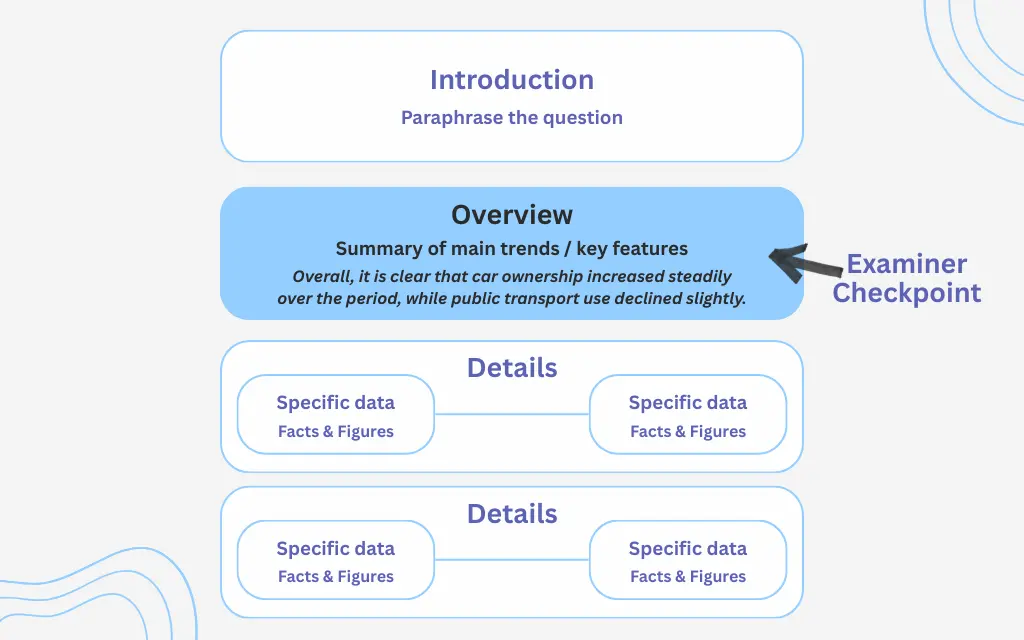
What an IELTS Task 1 Overview Actually Is
An overview paragraph in IELTS is a brief explanation of the main features or trends shown in the visual. It focuses on patterns, contrasts, or overall changes, not on specific numbers.
Think of the overview as answering this question:
If the examiner reads only this paragraph, do they understand what is happening in the data overall?
A strong overview usually mentions:
- The general direction of change
- Major differences or contrasts
- Overall patterns across categories or time
It deliberately avoids detailed figures, years, or minor fluctuations.
What an Overview Is Not
Many Task 1 summaries fail because candidates misunderstand the purpose of the overview.
An overview is not a rewritten introduction. Simply repeating the task question in different words does not show understanding. It is also not a list of data points. Mentioning specific figures often weakens the overview rather than strengthening it.
Another common problem is writing an overview that is technically correct but meaningless. For example, saying that “there were changes over time” does not tell the examiner anything useful.
A stronger overview interprets the data. It explains how things changed, not just that they did.
Where the Overview Should Appear
The overview can appear either:
- As a separate short paragraph after the introduction, or
- As a clearly marked sentence within the introduction
Both positions are acceptable, as long as the overview is easy to identify. What matters most is clarity, not location.
However, many teachers recommend placing the overview in its own short paragraph. This makes it easier for the examiner to find and reduces the risk of it being missed or unclear.
Language Style for a Strong Overview
The language used in an overview should be calm, neutral, and precise. This is not the place for dramatic vocabulary or complex sentence structures.
Examiners respond positively to clear verbs such as increase, decrease, remain stable, or overtake, as long as they accurately reflect the data. Simple sentence structures are often more effective than complex ones here.
A weaker overview might try to sound impressive but feel vague. A stronger overview sounds straightforward and confident.
For example, instead of forcing several ideas into one long sentence, a candidate might write two short, clear sentences that describe the main patterns separately.
Identifying the Main Features Before You Write
One reason many candidates struggle with Task 1 overview examples is that they start writing too quickly. They focus on details before understanding the overall shape of the data.
Before writing the overview, it helps to pause and ask:
- What increased overall?
- What decreased or remained stable?
- Which category was highest or lowest?
- Were there any clear contrasts or reversals?
You do not need to mention all of these points in the overview. The goal is to identify which ones define the data most clearly.
Common Overview Mistakes That Lower Scores
Many candidates make the same overview mistakes again and again.
One common issue is being too specific. Including years or numbers often turns the overview into a body paragraph. Another problem is writing an overview that contradicts the data, even slightly. Examiners are very sensitive to accuracy at this stage.
Another frequent mistake is omitting the overview entirely. This alone can prevent a score above Band 6, regardless of how good the rest of the report is.
Finally, some candidates write an overview that simply repeats obvious information, such as stating that multiple categories are shown. This does not demonstrate analysis.
Writing Overviews for Different Task 1 Visuals
Although the principle of the overview remains the same, the focus can change slightly depending on the type of visual.
For charts showing change over time, overviews usually focus on overall increases, decreases, or stability. For visuals comparing categories, the overview often highlights the highest and lowest values or major contrasts.
For diagrams or maps, the overview typically describes the overall process or main transformation.
What matters is not the visual type itself, but whether the overview captures the main message of the data.
Checking Your Overview Before Moving On
Before continuing with the rest of your Task 1 answer, it is worth checking your overview carefully.
A useful self-check is to read the overview on its own and ask whether it clearly summarises the data without support from other paragraphs. If it sounds vague, overly detailed, or confusing, it probably needs revision.
Another useful check is length. Overviews are usually short. If yours feels long or complex, it may be trying to do too much.
How Overviews Affect Your Overall Task 1 Score
The overview does not exist in isolation. It influences how examiners interpret the rest of your writing.
A clear overview prepares the examiner for what they are about to read. It frames the data logically and makes your body paragraphs easier to follow. A weak overview has the opposite effect, making the report feel disorganised even if the details are accurate.
This is why improving the overview often leads to immediate score improvements, sometimes without changing anything else in the answer.
Conclusion
Learning how to write IELTS Task 1 overviews properly is one of the most effective ways to improve your Task 1 score. The overview shows the examiner that you understand the data at a high level and can identify what matters most.
By focusing on main patterns, avoiding unnecessary detail, and using clear, neutral language, you can turn a common weakness into a strength.
To apply this skill further, explore related Learn English Weekly guides on Task 1 common mistakes, sentence structures, and examiner marking, where strong overviews are placed in full context.
Related IELTS Task 1 Lessons
Glossary
Overview (noun) – A short paragraph describing the main features or trends
Task Achievement (noun) – How well the task requirements are fulfilled
Trend (noun) – A general direction of change
Data (noun) – Information shown in charts, graphs, or diagrams
Visual (noun) – The chart, graph, table, map, or diagram in Task 1
Practice Questions
- True or False: An overview should include specific numbers.
- Which paragraph usually contains the overview?
A) Introduction
B) Overview paragraph - Why is the overview important for Task Achievement?
- Short answer: Name one thing an overview should avoid.
- True or False: A missing overview can limit your band score.
Answers
- False
- B
- It shows understanding of the main features
- Specific numbers / minor details
- True
Join 1,300+ English learners
Get free English lessons, IELTS tips and useful vocabulary by email.
No spam. Just practical English you can use.