
Introduction to IELTS Speaking Part 2 Ideas
One of the most common problems candidates face in IELTS Speaking Part 2 is not language, but silence.
Many learners start confidently, then hesitate, repeat themselves, or stop early because they feel they have run out of things to say. This lesson explains why that happens and how to fix it.
IELTS Speaking Part 2 does not test how interesting your life is. It tests whether you can develop ideas calmly and logically for up to two minutes. When candidates struggle, it is usually because they do not know how to expand ideas once they have started.
This lesson breaks down practical, examiner-safe ways to generate and develop IELTS speaking Part 2 ideas, even when the topic feels unfamiliar or uninteresting.
Practise English every weekday with me
Get short Mon–Fri English practice in LINE with LEW Daily, plus regular feedback to help you improve.
Explore LEW DailyNT$399/month • Cancel anytime

Why idea development is the real challenge in Part 2
Most candidates understand the format of IELTS Speaking Part 2.
They know they receive a cue card, one minute to prepare, and then speak. The real difficulty is filling the time without panicking or losing coherence.
Many learners can describe something briefly but cannot continue. Others believe their ideas are too simple to be acceptable.
From an examiner’s perspective, neither of these is a problem. Examiners do not judge the quality of ideas. They judge how well ideas are developed.
What examiners actually expect from your ideas
IELTS Speaking Part 2 is not about originality or creativity.
Examiners are listening for:
- clear focus on the topic
- logical expansion of ideas
- natural continuation without long pauses
A simple idea explained clearly will score higher than an impressive idea delivered with hesitation or confusion. This is why idea development matters more than idea choice.
Understanding the purpose of the cue card
A cue card provides:
- a topic
- several guiding prompts
- a reason to speak
The prompts are there to help you generate ideas. They are not instructions you must follow exactly.
You are not required to cover every prompt equally or in order. Once candidates understand this, they stop trying to “complete” the card and start developing ideas more naturally.
Why “I don’t know what to say” happens
Candidates usually freeze for three main reasons.
First, they try to think of a perfect idea instead of a usable one.
Second, they try to plan sentences rather than ideas during preparation.
Third, they believe unfamiliar topics require special knowledge.
All three problems are solved by learning how to expand simple ideas, not by memorising answers.
A reliable way to create ideas quickly
The safest approach to idea development in IELTS Speaking Part 2 is to start small and build depth.
You do not need multiple ideas. You need:
- one clear situation
- one simple description
- one explanation or reflection
This approach allows even basic ideas to fill the full speaking time calmly.
Turning simple ideas into longer answers
Many candidates stop early because they believe their idea is finished.
In reality, most ideas can be extended by:
- adding background
- explaining reasons
- describing feelings or effects
For example, if the topic is a place you like, the idea does not end after naming it. You can talk about when you discovered it, why you return, how it makes you feel, and how it compares to other places.
The idea stays the same. The depth changes.
Using personal perspective to extend ideas
Personal perspective is one of the easiest and safest ways to develop ideas.
You can explain:
- why something matters to you
- how your opinion has changed
- what you learned from the experience
This sounds natural and shows genuine communication, which examiners value highly.
What to do when the topic feels unfamiliar
IELTS Speaking topics are designed to be general, but some still feel uncomfortable.
When this happens, remember that you are allowed to:
- choose a related example
- generalise slightly
- adapt the topic to your experience
You are not being tested on knowledge or facts. You are being tested on speaking ability.
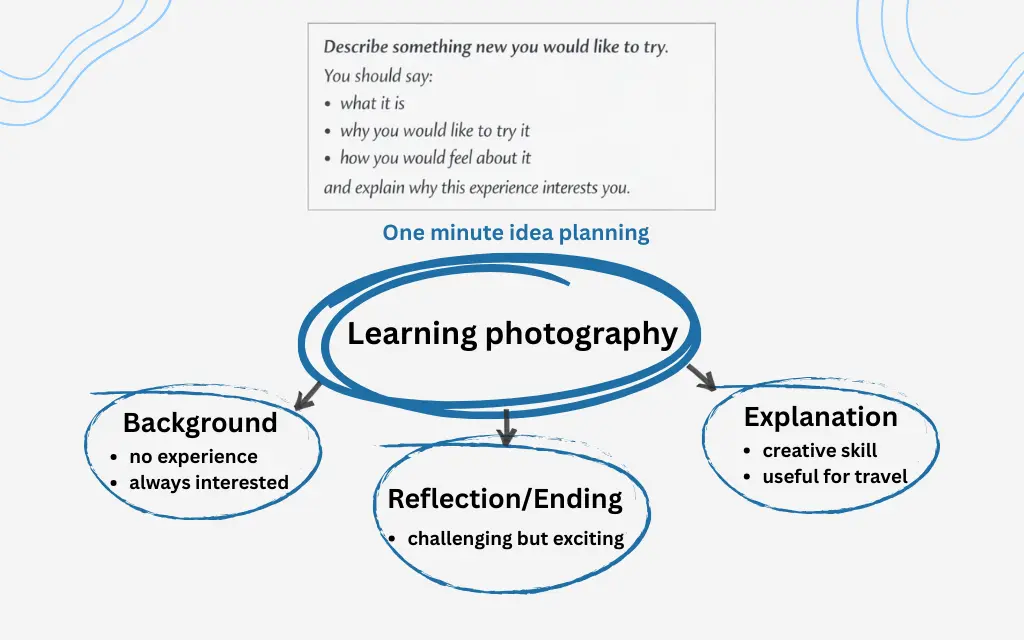
Using the one-minute preparation time for ideas
Your preparation minute is not for writing sentences.
Use it to:
- choose one main idea
- note two or three supporting points
- decide how you will end
Keywords keep your answer flexible and prevent memorisation.
Common idea development mistakes in Part 2
Several patterns repeatedly limit scores:
- repeating the same idea using different words
- listing information without explanation
- changing topics suddenly to find “more ideas”
Strong candidates stay with one idea and develop it deeply rather than moving between shallow points.
How examiners hear strong idea development
To an examiner, good idea development sounds controlled.
The speaker:
- stays focused on the topic
- connects ideas logically
- avoids rushing to new points
This creates a strong impression even when the language itself is not advanced.
Practising idea development effectively
Effective practice does not involve memorising answers.
Instead:
- practise planning ideas in one minute
- record yourself speaking
- check whether you explain rather than just describe
With repetition, idea development becomes automatic.
How idea development affects your speaking band score
Strong idea development improves:
- fluency and coherence
- ability to speak at length
- confidence under pressure
It often marks the difference between Band 6 and Band 7 performance.
Conclusion
IELTS Speaking Part 2 does not require clever ideas or exciting stories.
It requires controlled idea development.
When you learn how to expand simple ideas calmly, the fear of having nothing to say disappears. Part 2 becomes predictable, manageable, and far less stressful.
Focusing on depth rather than idea quality is one of the fastest ways to improve your speaking score.
Related IELTS Speaking Lessons
Glossary
Cue card (noun) — a task card with a topic and guiding prompts
Idea development (noun phrase) — explaining and expanding an idea clearly
Long turn (noun phrase) — the extended speaking section in Part 2
Fluency (noun) — ability to speak smoothly and continuously
Coherence (noun) — logical organisation of ideas
Comprehension & Practice Questions
- True or False: IELTS Speaking Part 2 tests how interesting your ideas are.
- Multiple choice: What should you plan during the one-minute preparation time?
A) Full sentences
B) Grammar rules
C) Keywords and ideas - Short answer: Why do candidates often stop early in Part 2?
- True or False: You must follow cue card prompts in order.
- Short answer: What is one way to expand a simple idea?
Answers
- False
- C
- Because they cannot develop ideas
- False
- Add explanation, background, or personal perspective
Join 1,300+ English learners
Get free English lessons, IELTS tips and useful vocabulary by email.
No spam. Just practical English you can use.