
Numbers, Dates, and Names in IELTS Listening: How to Catch Small Details Accurately
Introduction
Candidates understand the overall meaning of a conversation in IELTS Listening but lose marks when it comes to small details such as phone numbers, dates, or surnames. The difficulty is rarely vocabulary. It is precision under pressure.
Questions involving numbers, dates, and names in IELTS Listening are a major source of avoidable errors, particularly in Section 1 and Section 2 form completion and note taking listening tasks. A single incorrect digit or a missing letter is enough to lose the mark.
This lesson explains how to handle listening details in IELTS effectively, how to stay composed when hearing specific information, and how to build accuracy step by step.
Practise English every weekday with me
Get short Mon–Fri English practice in LINE with LEW Daily, plus regular feedback to help you improve.
Explore LEW DailyNT$399/month • Cancel anytime

Why Small Details Feel More Difficult
Understanding ideas is usually easier than catching details. When someone explains a topic, your brain follows the meaning naturally. However, when you hear something like:
“The reference number is 407B9.”
your attention must shift from meaning to precision.
Numbers, dates, and names require:
- Immediate recognition
- Accurate note taking
- Careful verification
These questions test attention and control rather than vocabulary range.
Listening to Numbers Clearly
Numbers appear frequently in IELTS Listening, including:
- Prices
- Phone numbers
- Room numbers
- Years
- Percentages
- Measurements
One common difficulty is fast speech. For example:
“The total cost will be one hundred and thirty-five pounds.”
Some candidates write “130” because they miss part of the phrase. Every component matters.
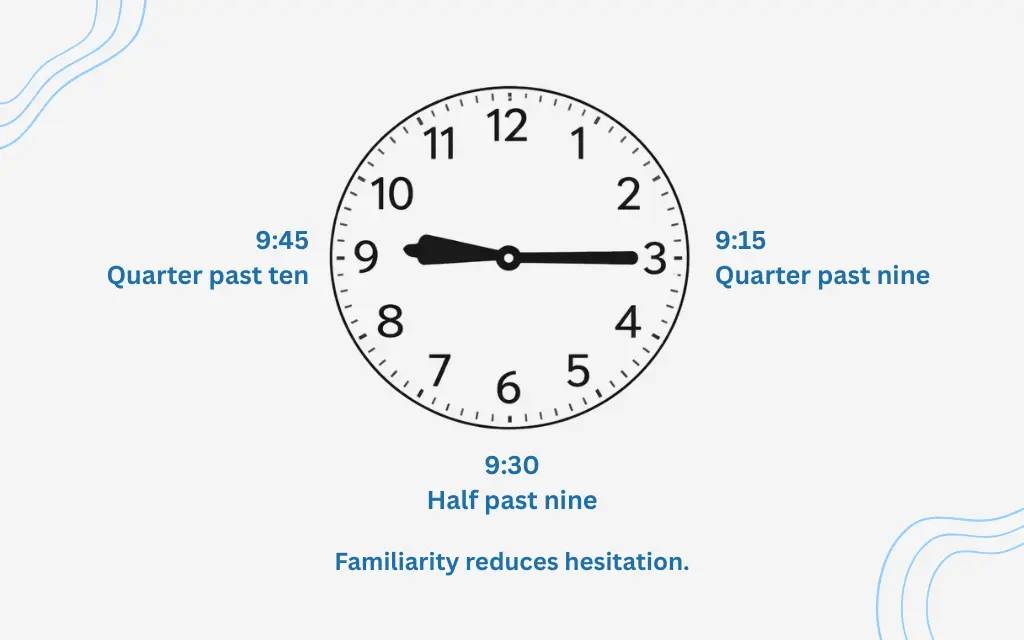
British Time Expressions
British English commonly uses expressions such as:
- Half past
- Quarter past
- Quarter to
- Twenty past
For example, “quarter past nine” means 9:15.
If you are unfamiliar with these expressions, practise them deliberately.
Recognising Dates in British Format
Dates in British English typically follow the day–month–year format:
14 July 2026
3 March
21 October
In speech, ordinal numbers are common:
“The meeting is on the twenty-third of May.”
This may be written as:
23 May
Always check the format required by the question. Some answers require numbers only; others may require words.
Watch for Date Corrections
Dates frequently include distractors:
“We originally planned for the 12th, but we’ve moved it to the 15th.”
The final confirmed date is the correct answer. Listening until the idea is complete is essential.
Handling Names and Spelling
Names can be especially challenging because they may be unfamiliar.
In Section 1, speakers often spell names clearly:
“That’s Peterson — P-E-T-E-R-S-O-N.”
Write each letter carefully. A single incorrect letter results in a lost mark.
Sometimes spelling includes clarification:
“That’s McAllister — M-C, capital A-L-L-I-S-T-E-R.”
When a speaker spells a word, it signals importance. Stay calm and write steadily.
Similar-Sounding Numbers
Certain numbers commonly cause confusion:
- Fifteen and fifty
- Thirteen and thirty
- Fourteen and forty
The key difference is stress. In British English:
FIFteen (stress on first syllable)
FifTY (stress on second syllable)
Listening for stress patterns improves accuracy significantly. Practising number repetition aloud can strengthen recognition.
Note Taking While Listening
Strong note taking listening skills help you manage detail-heavy sections effectively.
During the recording:
- Write digits clearly
- Avoid overthinking spelling
- Mark uncertain letters lightly for later review
After the recording:
- Confirm digits
- Check spelling
- Review plural forms
- Ensure word limits are respected
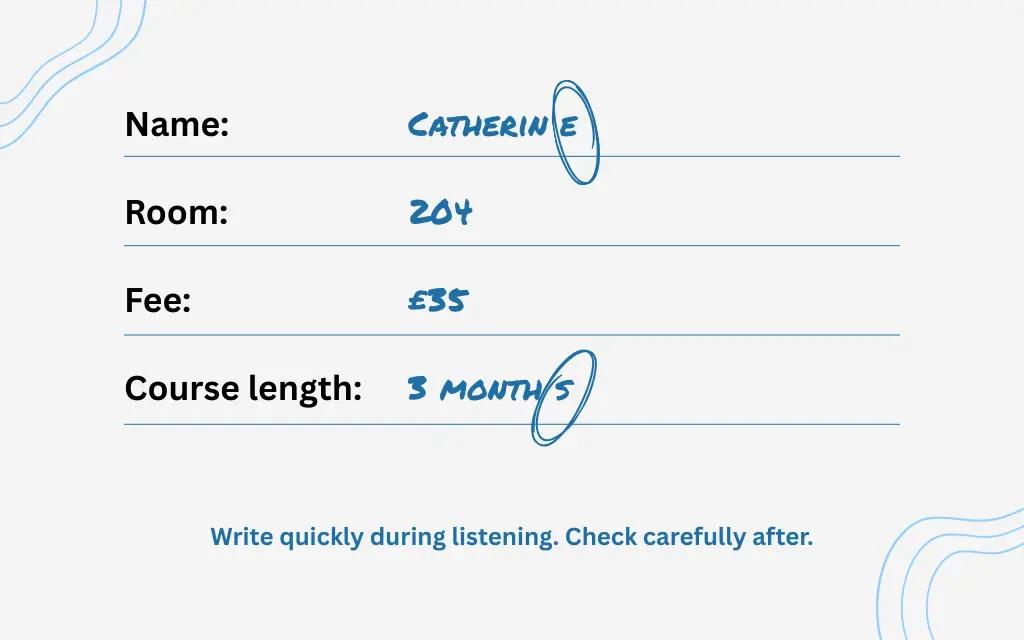
Separating listening from checking improves time management and reduces anxiety.
Recognising Corrections and Changes
Numbers and dates are often corrected mid-sentence:
“The price is £60 per person — sorry, that’s £16 for students.”
If you stop listening at the first number, you lose the mark.
Words that often signal change include:
- Sorry
- Actually
- Instead
- Rather
- On second thought
These indicate that the first detail may not be final.
Practising Detail Listening
Improving numbers dates names IELTS listening accuracy requires focused practice.
In addition to full listening tests, try targeted exercises such as:
- Dictation of numbers
- Spelling unfamiliar names
- Listening to phone numbers
- Writing dates from spoken form
You can create simple practice tasks by asking someone to read random numbers and names aloud.
The aim is comfort. When detail recognition becomes automatic, exam pressure decreases.
Why Detail Errors Affect Your Band Score
Many candidates lose several marks in Section 1 alone due to minor number or spelling errors. This can reduce the overall band score significantly.
The important distinction is this:
These are not comprehension problems. They are precision problems.
Precision can be improved quickly through deliberate attention and structured practice.
Staying Calm During the Test
On exam day, remember that numbers follow patterns, dates follow predictable formats, and names are simply sequences of letters.
If you feel unsure, make your best note and continue listening. There will be time to check.
Confidence supports accuracy. Panic reduces it.
Conclusion
Numbers, dates, and names in IELTS Listening are not difficult because they are complex. They are challenging because they demand accuracy.
When you learn to:
- Listen for stress in similar numbers
- Recognise British date formats
- Stay alert for corrections
- Write clearly during the recording
- Check methodically afterwards
you reduce avoidable errors and strengthen overall performance.
To continue building Listening precision, explore the related lessons below. Small details often make the difference between Band 6.5 and Band 7.
Related IELTS Listening Lessons
- Distractors in IELTS Listening (Why Answers Change)
- IELTS Listening Section 3 Explained
- Common IELTS Listening Mistakes (And How to Avoid Them)
Glossary
Detail (n.)
A small but specific piece of information such as a number or name.
Dictation (n.)
An exercise in writing words as they are spoken.
Ordinal (adj.)
A number showing position, such as first, second, or third.
Stress (n.)
Emphasis placed on a particular syllable in pronunciation.
Correction (n.)
A change from one piece of information to another.
Practice Section
Questions
- (True/False) British dates usually follow the month–day format.
- (MCQ) Which pair often causes confusion in IELTS Listening?
A. Ten and eleven
B. Fifteen and fifty
C. Eight and nine
D. Six and seven - (Short Answer) Why is stress important when listening to numbers?
- (MCQ) If a speaker says, “The meeting was on the 12th — sorry, the 15th,” the correct answer is:
A. 12th
B. 15th
C. Both
D. Neither - (True/False) Spelling mistakes in names do not affect your score.
Answers
- False
- B
- Because it helps you distinguish similar-sounding numbers such as fifteen and fifty.
- B
- False
Join 1,300+ English learners
Get free English lessons, IELTS tips and useful vocabulary by email.
No spam. Just practical English you can use.