
Introduction to IELTS Reading Band Descriptors
Many IELTS candidates spend months practising reading tests, completing mock papers, and learning strategies, yet still feel confused about one important question:
Why is my Reading score not improving?
You may feel that you understand most of the passages. You may finish the test on time. You may score well in practice at home. But in the real exam, your band score often stays the same.
This situation is frustrating, especially when you are working hard. In most cases, the problem is not effort. It is understanding.
Students practise without clearly knowing how their Reading score is calculated or what each band level really represents. They improve skills randomly instead of targeting what the exam is actually measuring.
This lesson explains how IELTS reading band descriptors work, how raw scores become band scores, and how you can use this knowledge to improve your results more strategically.
Practise English every weekday with me
Get short Mon–Fri English practice in LINE with LEW Daily, plus regular feedback to help you improve.
Explore LEW DailyNT$399/month • Cancel anytime

What Are IELTS Reading Band Descriptors?
In IELTS Reading, “band descriptors” refer to the official system that connects your number of correct answers to your final band score.
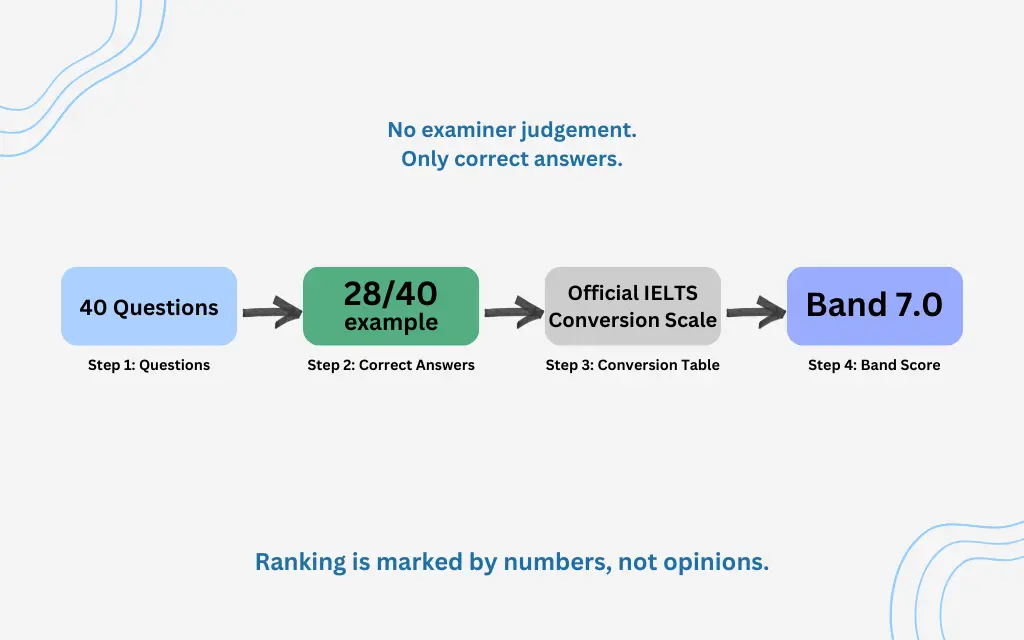
Unlike Writing and Speaking, Reading is not marked subjectively. Examiners do not judge style, fluency, or language quality. They simply count how many answers are correct.
However, your final score is not reported as a percentage. Instead, your raw score is converted into a band score using official tables.
The band descriptors explain how this conversion works and what each band represents in terms of real reading ability. They act as a bridge between your test performance and your reported result.
How IELTS Reading Scores Are Calculated
To understand band descriptors properly, you must first understand how scoring works.
Raw Score
In IELTS Reading, there are forty questions. Each correct answer is worth one mark. There is no penalty for wrong answers.
Your raw score is simply the number of correct answers.
For example, if you answer twenty-eight questions correctly, your raw score is twenty-eight. If you answer thirty-five correctly, your raw score is thirty-five. Nothing else is considered.
Band Score Conversion
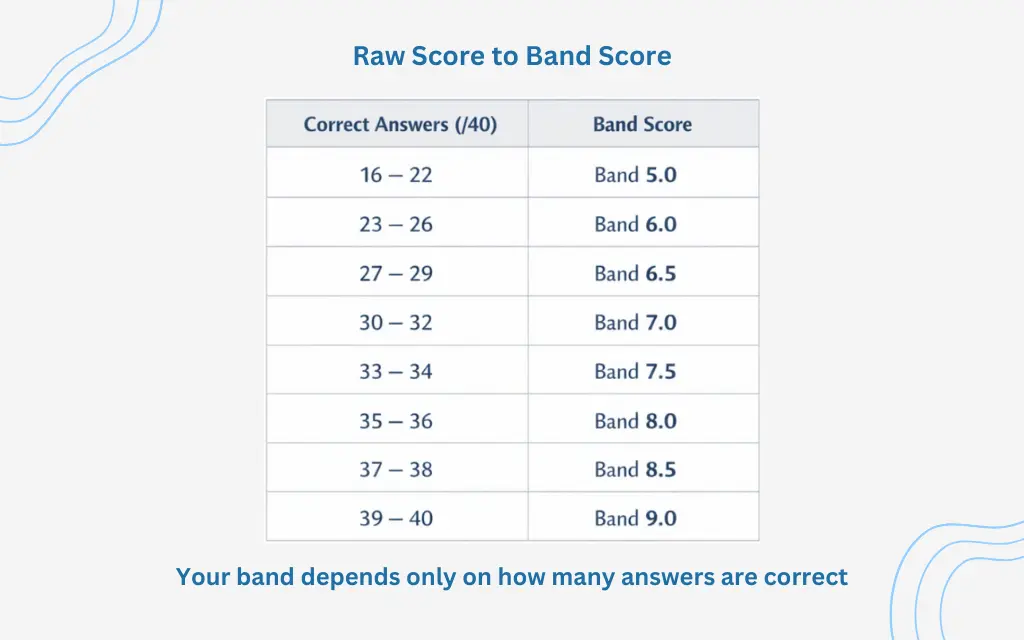
Your raw score is then converted into a band score using official conversion tables. Although the exact numbers may change slightly between test versions, the pattern is usually stable. For most Academic Reading tests, the conversion is approximately:
Sixteen to twenty-two correct answers corresponds to Band 5.
Twenty-three to twenty-six corresponds to Band 6.
Twenty-seven to twenty-nine corresponds to Band 6.5.
Thirty to thirty-two corresponds to Band 7.
Thirty-three to thirty-four corresponds to Band 7.5.
Thirty-five to thirty-six corresponds to Band 8.
Thirty-seven to thirty-eight corresponds to Band 8.5.
Thirty-nine to forty corresponds to Band 9.
Academic and General Training Differences
The Academic and General Training Reading tests use different passages and have different difficulty levels. As a result, their conversion tables are slightly different.
General Training usually requires fewer correct answers to reach the same band.
However, the principle remains the same in both versions. Accuracy determines everything.
What Each Band Level Represents in Practice
Understanding band descriptors becomes more useful when you connect them to real reading behaviour.
Band 5: Limited Reading Control
At Band 5 level, candidates can understand basic information but struggle with complexity.
A typical Band 5 reader can follow simple factual texts, but often misses implied meaning and struggles with paraphrasing. Accuracy drops sharply in difficult passages.
In practice, this usually means strong performance in Passage 1, mixed results in Passage 2, and very weak results in Passage 3.
Band 6: Functional but Inconsistent Reading
Band 6 is the most common plateau for IELTS candidates.
A Band 6 reader usually understands main ideas and can locate information. They recognise some paraphrasing, but still make frequent careless mistakes.
Their understanding is generally good, but unreliable. They often lose marks because of traps, rushed decisions, and small misunderstandings.
This inconsistency prevents progress to Band 7.
Band 7: Strong and Controlled Reading
Band 7 represents solid academic reading ability.
A Band 7 candidate understands detailed arguments, recognises complex paraphrasing, and handles most question types confidently. They maintain concentration across all three passages.
Mistakes still happen, but they are occasional rather than frequent.
This is the level most universities expect.
Band 8: Very High Accuracy
Band 8 reflects near-native academic reading skills.
A Band 8 reader understands subtle meaning, identifies writer attitude easily, and detects traps quickly. They combine speed with precision.
Guessing is rare. Most answers are chosen with confidence.
Band 9: Expert Reading Performance
Band 9 represents exceptional reading ability.
A Band 9 candidate reads efficiently, understands complex and abstract arguments, and maintains full control under time pressure.
This level is rare and usually requires extensive academic reading experience.
Why Many Candidates Stay at the Same Band
Understanding band descriptors also explains why progress often feels slow.
One common reason is focusing too much on test quantity. Many students believe that doing more practice tests automatically leads to higher scores. Without analysis, this simply repeats the same mistakes.
Another problem is ignoring error patterns. High-band candidates study their wrong answers carefully. Lower-band candidates often move on without reflection.
Weak paraphrase awareness is also a major barrier. Many students read words instead of meaning, which limits progress beyond Band 6.
Poor time management creates further problems. Working too slowly leads to unfinished questions. Rushing leads to careless errors. Both damage band scores.
Using Band Descriptors to Guide Your Study Plan
Once you understand what each band represents, your preparation becomes more focused.
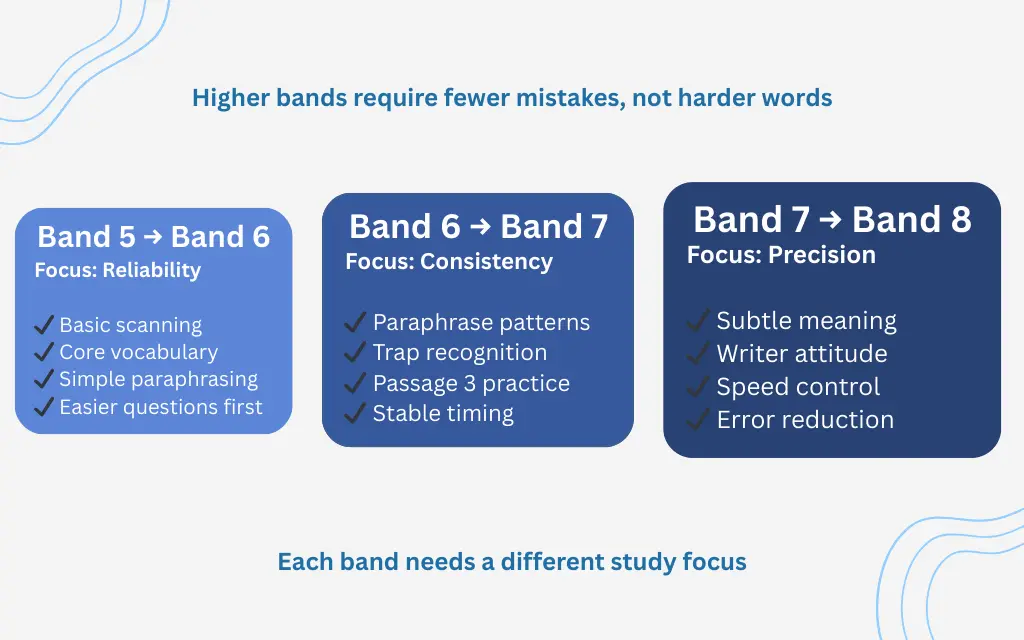
Moving from Band 5 to Band 6
At this stage, the main goal is reliability.
You should focus on basic scanning skills, vocabulary recognition, and simple paraphrasing. Your aim is to answer easier questions consistently.
Moving from Band 6 to Band 7
This stage requires deeper skills.
You should work on recognising paraphrasing patterns, identifying traps, and improving performance on Passage 3. Consistency is the main target.
Moving from Band 7 to Band 8
At higher levels, improvement comes from precision.
You should focus on subtle meaning, writer attitude, and speed control. Small mistakes matter more at this stage.
How Examiners and Institutions Use Band Descriptors
Although Reading is objectively scored, band descriptors are used to interpret ability.
Universities use them to judge academic readiness and language independence. Employers use them to assess document comprehension and training capacity.
Your Reading band is more than a number. It represents how effectively you can work with complex written information.
Common Misunderstandings About Reading Band Scores
Many candidates hold beliefs that slow progress.
Some believe that understanding everything means they deserve Band 7. In reality, only correct answers count.
Others think weak vocabulary prevents improvement. In fact, many Band 7 candidates know fewer words than Band 6 candidates. They simply read more intelligently.
Some students panic after one bad test. Scores naturally fluctuate. Progress should be judged over time.
Finally, many believe speed is everything. Speed without accuracy lowers scores. Balance matters.
Using Mock Tests to Predict Your Band Level
Practice tests are useful when used properly.
After each test, you should calculate your raw score, convert it to a band, analyse mistakes, and record patterns in an error log.
This transforms practice into progress.
If you consistently score around thirty correct answers, you are close to Band 7. If you regularly score above thirty-three, you are approaching Band 7.5 or higher.
One test is never enough. Look for long-term patterns.
Building Long-Term Reading Ability
High scores come from habits, not shortcuts.
Strong readers develop regular academic reading routines, learn vocabulary in context, practise under timed conditions, and review mistakes carefully.
Over time, this builds genuine reading competence rather than temporary test skills.
Conclusion: Using Band Descriptors to Improve Strategically
IELTS Reading band descriptors explain more than scoring.
They show where you are, why you are there, and what you need to improve next.
When you understand them clearly, your preparation becomes realistic and efficient. Instead of guessing how to improve, you can target the skills that move you to the next band.
With focused training and careful analysis, steady progress becomes possible. To strengthen your reading performance further, explore related guides on paraphrasing, time management, and question types.
Related IELTS Reading Lessons
Glossary
Summary (noun)
A shortened version of a longer text.
Paraphrase (verb)
To express the same idea using different words.
Gap (noun)
A missing part in a sentence or text.
Instruction (noun)
Information that tells you how to answer.
Accuracy (noun)
Being correct and precise.
Practice Section
Questions
- (MCQ) What is the main skill tested in summary completion?
A. Memorisation
B. Paraphrase recognition
C. Fast reading
D. Spelling - (True/False) You may paraphrase the answer if the meaning is correct.
- (Short Answer) Why is grammar important in summary completion?
- (MCQ) What should you check first before writing an answer?
A. Passage title
B. Word limit
C. Question number
D. Time left - (True/False) Answers usually follow the same order as the passage.
Answers
- B
- False
- Because the answer must fit grammatically into the summary sentence.
- B
- True
Join 1,300+ English learners
Get free English lessons, IELTS tips and useful vocabulary by email.
No spam. Just practical English you can use.